

Salt Lake City & surrounding counties
Every layer off, a new roof from the deck up
On an older Roy house, a replacement starts by finding out what is really up there, and that is often more than one roof. We strip all of it, fix the wood we find, and build the new roof back in a day or two of good weather.
When another patch stops paying off
A lot of our replacements start as a repair call. A stain shows up on a bedroom ceiling, we climb up to fix one spot, and the shingles around it crack the moment we try to lift them. That is usually where a patch stops buying anything. Small fixes on a brittle field keep coming back one tab at a time, and each visit costs you something.
Plenty of the houses we reroof here are older postwar homes, and many have been roofed more than once since they were built. Before we say the word replace, we look at three things: how much of the surface has lost its granules, whether the shingles still bend or snap, and whether water has already reached the wood. When two of those three are bad, another repair is money spent on a roof that is on its way out.
Houses that came from the same builder tend to wear out the same way, because they share the same shortcuts. Once we have opened a few roofs in one subdivision, we have a fair idea what the next one holds, and we tell you that up front instead of surprising you halfway through the tear-off.
If you are not sure which side of that line your roof sits on, an inspection of your Roy roof answers it with photographs before anybody brings up replacement. When a roof still has years in it, we leave it on.
How the job runs on site
Weather first
We pick the start day from the forecast. If rain or snow is due before the new roof can be closed in, the date moves and we call to tell you.
Tear-off
Every old layer comes off down to the boards, and the old shingles, felt and nails get cleared as the crew works so the deck can be read clean.
Wood and edges
Soft or broken decking gets replaced. Then ice-and-water shield goes down at the eaves and through the valleys, and drip edge goes on around the perimeter.
The new field
Underlayment covers the rest of the deck, the shingles go on course by course, and every wall, chimney and pipe gets its own flashing before the ridge is capped.
Walk-through
With the last ridge cap on, we haul the debris away, clean the yard and driveway, and walk the finished roof with you.
Plank boards under the old roof
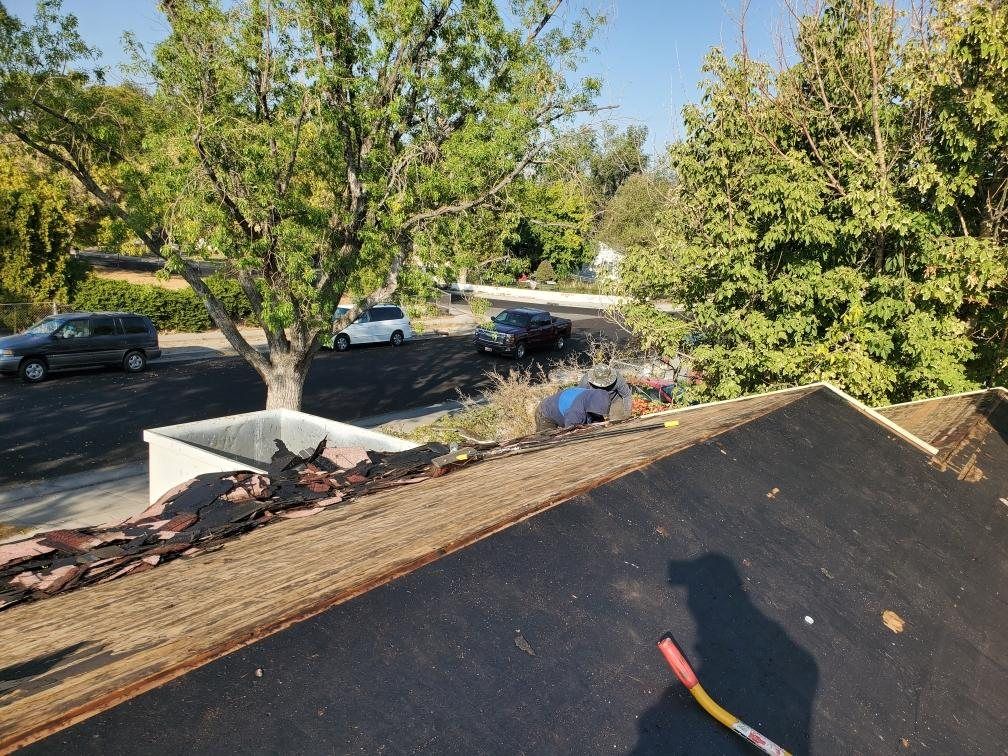
This photo comes from the middle of a tear-off: a bare wood deck half covered in black underlayment, a worker beside the pile of torn-off shingles at the ridge, and a street with parked cars below. Older houses were often decked with boards laid side by side, before sheets of plywood and OSB took over.
Boards are not a problem in themselves, and plenty of plank decks are still sound when the old shingles come off. We check the gaps between boards, the knots that have dropped out, and any board gone soft where water sat. A gap wide enough for a nail to miss the wood is a gap the new shingles cannot hold onto.
When most of the boards are good, we swap out the bad ones and keep going. When too many are cupped, split or spaced wide, new sheathing goes over the planks so the shingles have a flat, solid surface to nail into. You hear which case you have as soon as the deck is open, since nobody can see it before then.
Membrane and metal at the edges
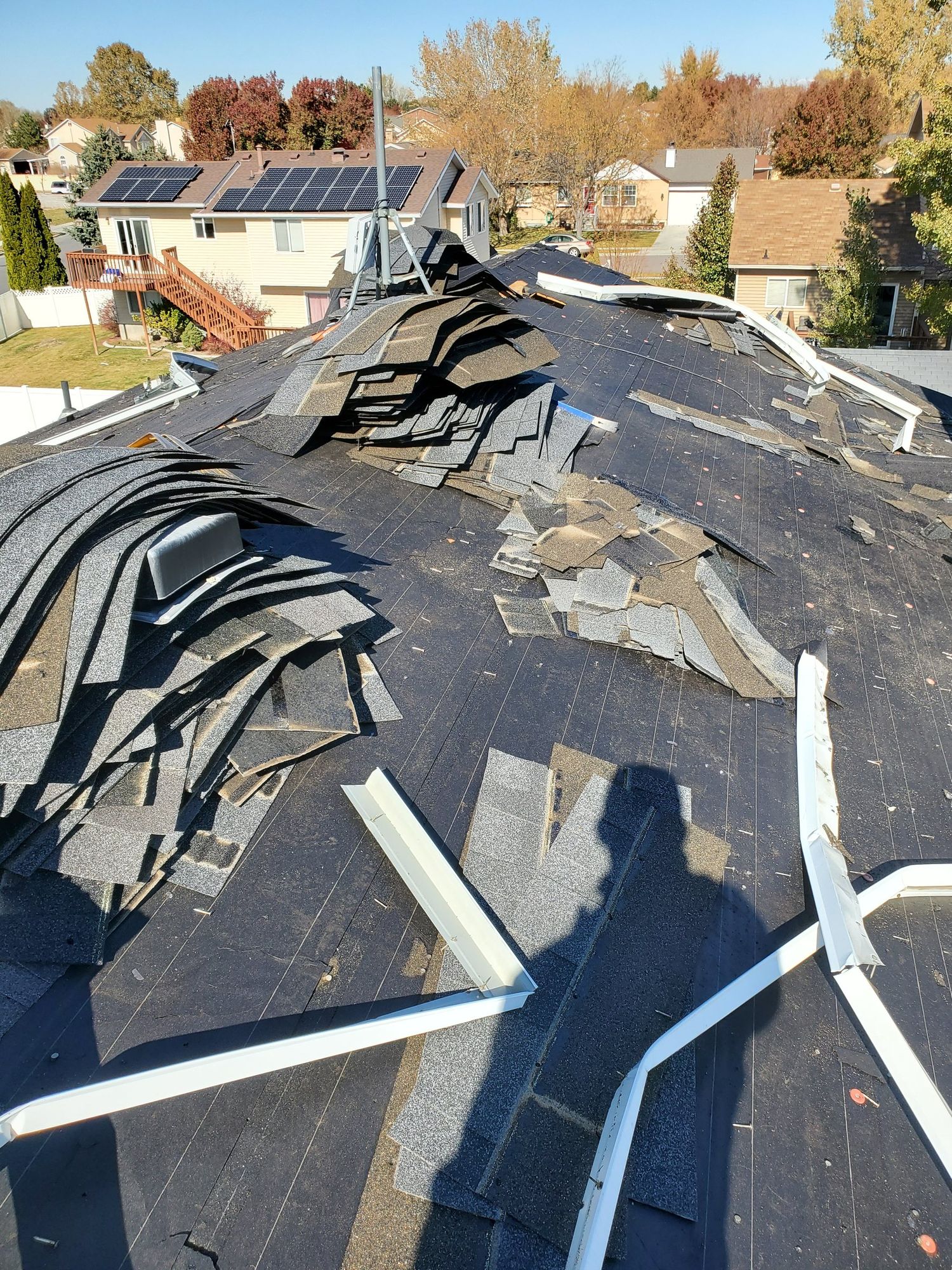
The second photo shows torn-off gray shingles heaped on black underlayment, with lengths of white drip edge staged on the roof beside a box vent. Drip edge is the metal strip along the eaves and rakes. Water coming off the shingles drops clear of the fascia board instead of curling back underneath.
Along the eave the key layer is ice-and-water shield, a self-sealing membrane that grips the deck and closes around each nail. That matters here because heavy spring snow sits on the overhang, melts a little in the afternoon and freezes again overnight. Water trapped behind that ice can only back up under the shingles, and the membrane is what keeps it out of the house.
The valleys get the same membrane along their full length, and so does the deck around chimneys, flues and plumbing pipes. On a replacement it is easy to do right, and hard to add later, because the next person to see that layer will be whoever tears off the roof after ours.
The old roof comes off completely, so the new one sits on wood we have actually looked at.
A warranty you can read in one sentence
A full replacement from us carries a 10-year workmanship warranty. Put simply, if something we installed fails because of how we installed it, we come back and make it right. It covers our part of the job, the nailing, the flashing and the details, and we go over what it includes before any work starts.
We have 27 years in the trade and 8 of them under the Hancock Signature name. We are a second-generation, woman-owned family company working out of Salt Lake City, south of Roy. With a family name on the contract, a callback never gets passed to somebody else.
Our main roof replacement page covers this work across the valley. If your roof only needs a few pieces put back, start with roof repair in Roy, and if the roof is part of a bigger plan for the house, see residential roofing for Roy homes. Finished jobs are in the gallery, the town has its own Roy service area page, and you can send us a note or call (801) 382-8898 to set a time to walk the roof.
Where Roy sits on our map
Roy sits in Weber County, about 30 miles north of our Salt Lake City base, and a replacement there gets scheduled around the forecast like every other job we run.
Can you put the new roof over the old one?
We do not. Every layer comes off so we can see the deck, fix what is soft, and get the membrane and flashing onto clean wood. A second layer also hides problems and adds weight the framing has to carry.
What happens if you find bad wood under the shingles?
We show you, replace what is damaged, and keep working. Where a plank deck has wide gaps or a lot of rot, new sheathing goes over the boards. You hear about it before it happens, with photos.
How do you protect the yard and the gutters?
Tarps go over plantings along the walls, the gutters are covered during tear-off, and debris goes straight to a trailer or bin. At the end we run a magnet across the yard and driveway for stray nails.
Why did my start date move?
A storm was coming before we could get the new roof closed in. Shingles also need warm days to seal their strips. Starting a few days late beats leaving a roof half open to weather.
What does the 10-year warranty cover?
Our workmanship on a full replacement: how the roof was installed, flashed and finished. If a problem in that period traces back to our work, we return and fix it.
The rest of the Roy work
Talk to Hancock
Plan a replacement
Tell us how old the roof is and what it has been doing, and we will set a time to walk it, look in the attic, and put a written quote in your hands.