
Rotted fascia repair for South Salt Lake homes
The fascia is the board along your roof edge that the gutter hangs on. When it goes soft we fix the wood and close off whatever let the water in.
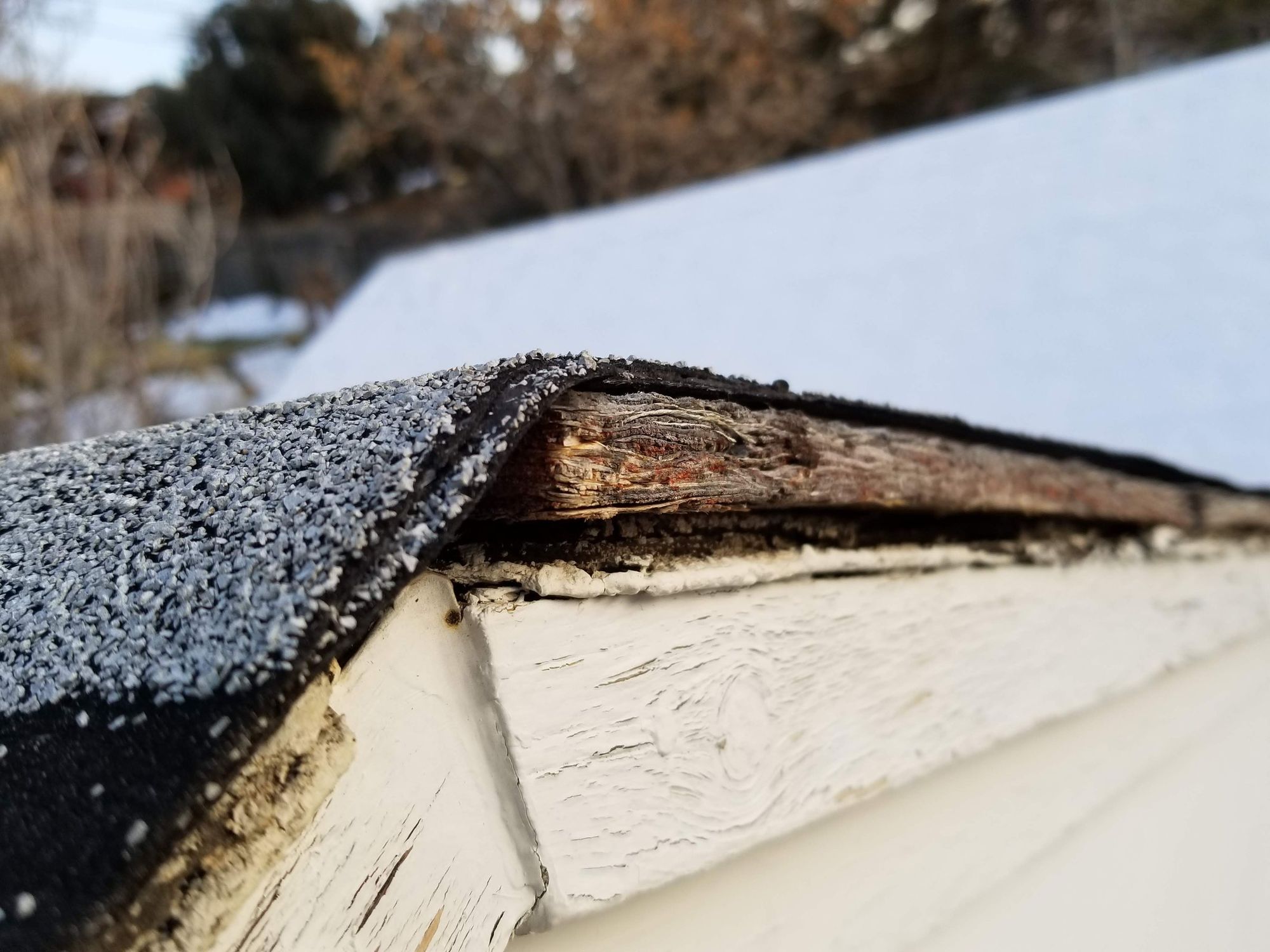
The board your gutter is hanging on
Fascia is the trim board nailed across the ends of the rafters, right where the roof stops. It does two jobs that most people never think about. It finishes the edge so you are not looking up at raw rafter tails, and it carries the full weight of the gutter, plus whatever water and ice happens to be sitting in it.
That second job is the reason we always look at the two together. A gutter that sags in the middle, pulls away at the ends or keeps dropping hangers usually has a fascia problem behind it. The screws are fine. The wood they were driven into has gone soft, and soft wood lets go of anything you fasten to it.
The photo here is the kind of thing we find when we lift a shingle edge with a thumb. The board underneath is stained dark and dirty, which means water has been getting behind the gutter for a long while and soaking into the back of the wood. On the older houses around South Salt Lake, the fascia is often the original lumber, painted over again and again, and it has carried a gutter through a lot of winters.

How water gets behind an edge board
Most fascia rot starts above the board, at the roof edge. Shingles are supposed to hang past the edge and drop water straight into the gutter. Under them there should be a strip of bent metal called drip edge that laps down over the top of the fascia and throws the water clear. Plenty of older roofs never got drip edge at all, or got a short piece that stops before it reaches the gutter.
Without it, water clings to the underside of the shingle, curls back toward the house and runs down behind the gutter onto the face of the board. Every rain wets the same strip of wood. Paint keeps it out for a few years, then the paint cracks along the top edge and the wood starts drinking.
Winter adds weight. A gutter that fills with ice hangs a heavy load off the face of the board, and every hanger screw takes a share of it. In soft wood those screws work loose a little more each cold snap, the gutter tips forward, and melt starts landing behind it on the board. Our ice damage repair page goes further into what that freeze does to the rest of a roof edge.
If the gutter screws keep backing out, the wood behind them is telling you something the paint is hiding.
What a fascia repair looks like on your house
Take the gutter down
The gutter comes off along the stretch we are working, so we can see the whole board, top edge and back side included.
Probe the wood
We press into the board along its length and check the rafter tails behind it. Every soft spot gets marked before anything is cut.
Cut back to sound wood
The rotted section comes out and a new board goes in, with the joint landing on a rafter so the seam has something solid behind it.
Add the drip edge
If the roof edge never had drip edge, or had a short piece, new metal goes in so water clears the board from now on.
Hang the gutter back up
The gutter goes back on into fresh wood, pitched toward the downspout, and we run water through it before we leave.
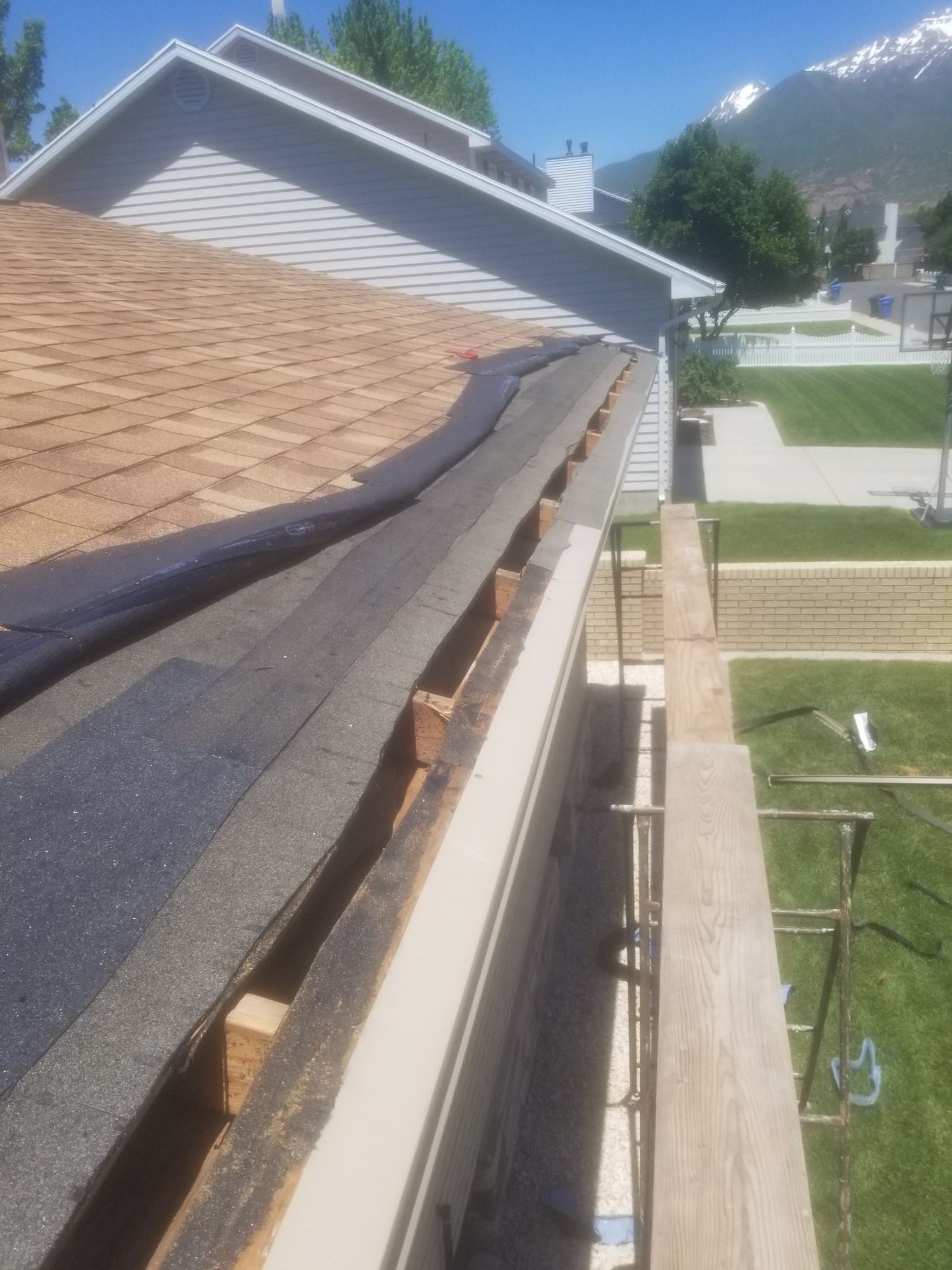
When the rafter tails are soft too
Sometimes only the fascia is bad. Sometimes the water has been at it long enough that the rafter tails behind the board are soft as well, and that changes the job. The second photo shows an eave opened up from above, the roof edge stripped back to the rafter tails before the gutter on that stretch has come down, with a scaffold plank set alongside so the crew can work the whole length of it.
A sound rafter tail just needs a new board nailed to it. Where the end of a rafter has rotted, we cut the rot out and sister a new length of lumber alongside the old rafter, fastened through both, so the new fascia lands on wood that will hold a nail. A fresh board nailed to a rotten rafter end is a repair that comes loose again.
If the rot keeps going past the edge and into the sheathing, you see it before anything gets covered, and we talk through roof deck repair with you. When a whole side of the house has gone soft, it stops being a patch and becomes fascia replacement, which we handle as its own job.
Things you can spot from the yard
You do not need a ladder to get a fair idea of whether your fascia is in trouble. Stand back far enough to see the whole roof edge and look along the top of the gutter. A straight line is good. A gutter that dips between hangers, or has a gap opening up between its back and the board, is pulling out of soft wood.
Paint tells you a lot, too. Peeling along the top inch of the board, right under the shingles, points to water coming off the roof edge. Dark streaks running down the face under the gutter point to a leaking seam or a gutter that overflows. After a storm, drips falling behind the gutter instead of out the downspout mean the water is going where it should not.
Getting the edge done once
A single stretch of fascia is never too small a job for us to come out for. The general rundown on how we handle edge boards is on the main fascia repair page, and the rest of what we do in town is on the South Salt Lake page.
If your gutters are near the end of their life too, it makes sense to replace them while they are already down. That job has its own page for gutter replacement in South Salt Lake, and on that job we always sort out the board first. You can see edge work we have finished in the gallery. To have us look at yours, call (801) 382-8898 or send a note through the contact page.
Where South Salt Lake sits on our map
South Salt Lake runs from State Street out toward I-15, a short run down from our Salt Lake City shop.
Fascia questions we get asked
Short answers to what people ask once they notice a gutter pulling away. If yours is not here, call the shop.
(801) 382-8898How do I know if my fascia is rotted?
Push a screwdriver into the board by hand. If it sinks in without much effort, the wood is soft. Other signs are paint peeling at the top edge, gutter hangers backing out, and a gutter that sags between its hangers or pulls away from the house.
Can you replace just the bad section of the board?
Usually, yes. We cut back to sound wood and splice in a new piece so the seam sits over a rafter. If the rot runs along most of one side of the house, a full new board is the better repair.
Do I need drip edge if my roof never had any?
We strongly recommend it. Without drip edge, water rolls back off the shingles and runs down the face of the fascia every time it rains. Adding it during the repair is the main thing that stops the new board from rotting out the same way the old one did.
Will my gutters have to come down?
To replace the board, the gutter on that stretch comes down. It goes back up into new wood when we are done, unless it is worn out and you decide to replace it at the same time.
Does fascia damage mean I need a new roof?
Almost never on its own. Fascia rot is usually an edge problem with an edge fix. If the water has reached the roof deck, we show you photographs of what we found and you decide where to go from there.
The rest of the South Salt Lake work
Seeing a gutter pull away from the house?
Send us a photo of the roof edge, or ring the shop, and we will come look at the edge board and the gutter together.