
Roofing across Salt Lake County
Roofing across Salt Lake County, from Salt Lake City, West Valley City, South Salt Lake, Millcreek and more.
Working across Salt Lake County
Salt Lake County covers enough ground that a roof on one side of it faces a different year from a roof on the other. Exposure, elevation and the age of the housing all shift as you move across the county, and so does what a roof needs to survive here.
We cover 21 communities in Salt Lake County as part of the ground we cover around Salt Lake City. Being close enough to get there quickly is most of what matters after a storm, and being on roofs across the county regularly is what makes an honest read of a roof possible rather than a guess from the driveway.

What Salt Lake County does to a roof
Dust storms before the rain
Ahead of a summer cell the wind arrives dry and full of grit off the open ground west of here. That grit gets driven into every horizontal surface on a roof, then the rain lands on top of it and packs it into a paste in the valleys and the gutter seams.
Grit is an abrasive
It grinds at the mat under foot traffic and it holds moisture against metal long after the surface has dried.
So we clear twice a year
Once before summer, once after the leaves are down.
The rot that follows a slow leak
The dangerous leak is not the one that stains a ceiling in a week. It is the one that puts a cup of water into a rafter bay every storm for four years. Nothing shows inside because the insulation absorbs it and the attic dries out between events, while the sheathing goes dark, then soft, then delaminates around the fasteners.
How we find it
Daylight through the deck from inside the attic, rust at the nail points, and a sheathing surface that gives under a knuckle.
Wood is the expensive part
Shingles are a material cost. Structure is not.
The valley floor sees less snow than the benches above it, but the benches above it are where a lot of the housing is. A roof in Holladay or Cottonwood Heights lives a different winter from one in Kearns, five miles away.
What we find across the county
Ridge cap is its own material
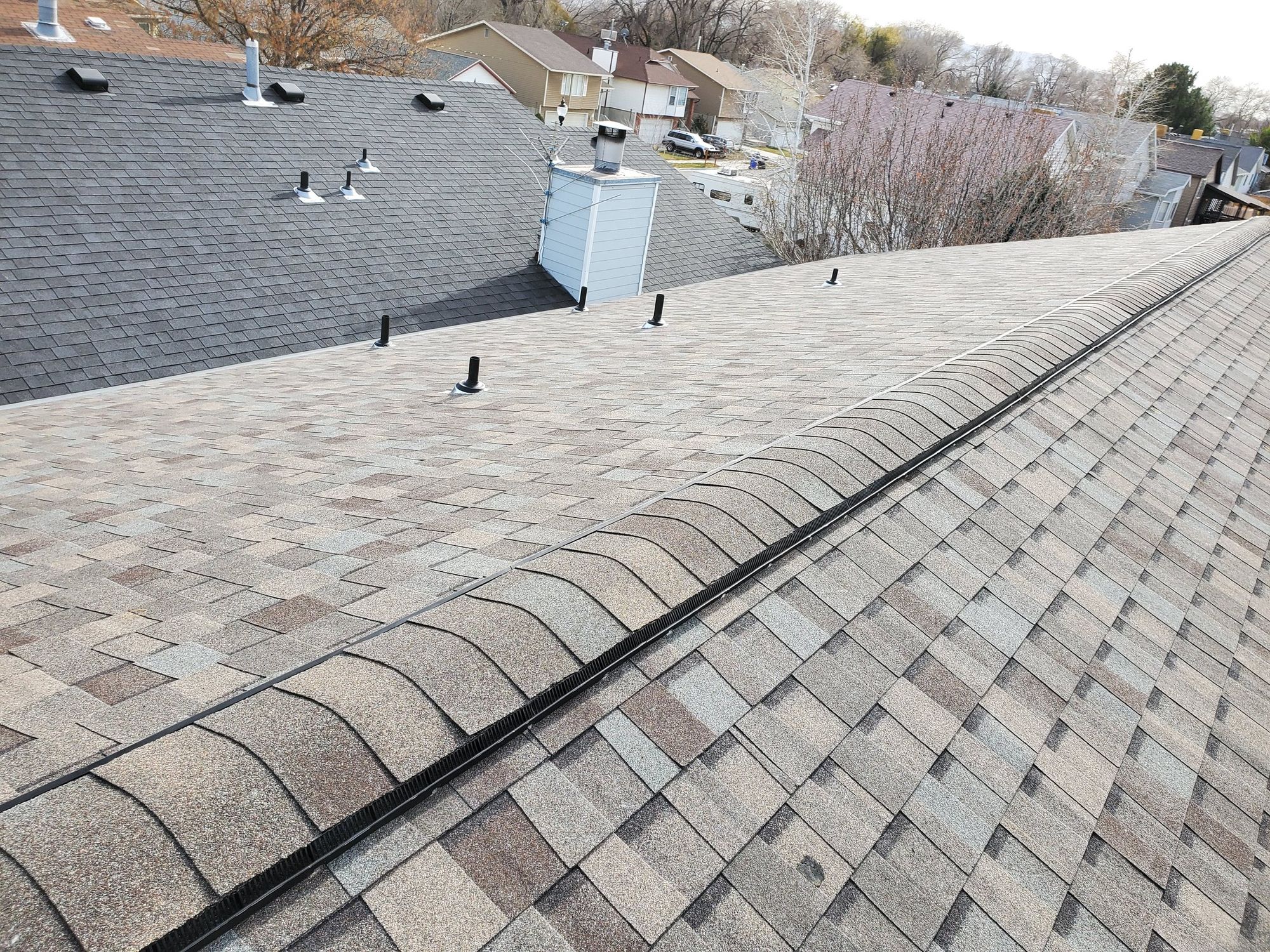
The cap along a ridge or a hip is the most exposed run on any roof and the most abused during installation. Cutting three-tab pieces to serve as cap on an architectural roof is a common shortcut, and the folded pieces crack at the bend within a few seasons up here. Purpose-made hip and ridge stock is thicker, pre-bent, and holds the fold through the cold.
Nail placement is the other half
Fasteners land under the next piece’s overlap, never through the weather surface where they sit exposed to the sky.
Architectural over three-tab
Most homes here that are replacing a roof move to architectural shingles and stay there. The laminated construction is thicker, carries a higher wind rating out of the wrapper, and does not show every wave in old decking the way a three-tab does. Three-tab still has a place on a rental, an outbuilding or a repair that has to match what is already up.
Wind rating is a nailing question
A shingle only earns its rating if it is fastened the way the wrapper says. Six nails in the nail line, not four in the wrong spot.
Communities we cover in Salt Lake County
Every community below has its own page. 21 of them across Salt Lake County.
Salt Lake County
How we work across the county
What underlayment actually does
Shingles shed water. Underlayment is what handles the water that gets past them, and something always gets past them. Synthetic underlayment has largely replaced felt because it does not wrinkle when it gets damp, does not tear when the wind catches it during installation, and keeps its footing when a crew is working a steep slope.
Felt still shows up
On small repairs and on matching an existing older assembly it is fine. On a full replacement up here there is no reason to go back to it.
Fasteners rust from the inside out
Screws and nails on a roof within reach of the lake air corrode faster than the same hardware would inland. A plain steel nail head disappears under a shingle and takes years off the roof’s hold without a single visible symptom. Hot-dipped galvanized or stainless where the metal is exposed is a small line item that decides whether the roof reaches its rated life.
Mixed metals make it worse
Aluminum flashing pinned with the wrong screw sets up a reaction that eats the softer metal at every contact point.
We look at the old nails
What came out of the last roof tells you what to put in the new one.
What we check on every roof
- Field condition and granule loss
- Valleys, ridges and every transition
- Penetrations and their flashing
- Gutter and fascia condition
What we do in Salt Lake County
Every service below is its own page. Whichever one Salt Lake County turns out to need, the roof gets walked before anything is quoted.
Roofing
Full replacements and new roofs on Salt Lake County homes, deck up.
Repairs
Leaks and failed details, which is most of what Salt Lake County calls about.
Upkeep
Inspections, cleaning and sealing before a small thing gets expensive.
Shingles
Architectural laminate, the field material on most of this valley.
Metal
Standing seam and corrugated, common on canyon-side snow load.
Tile
Clay and concrete tile, and the flashing work they need.
Commercial
Membrane systems for flat and low-slope buildings around Salt Lake County.
Coatings
Restoration coatings when a commercial roof has life left.
Storm
Hail, wind and the insurance paperwork that follows.
Skylights
Installation and the curb-flashing repairs skylights usually need.
Gutters
Gutters, downspouts and fascia, which are part of the roof.
Government
Schools, city, county, state and federal buildings. Every government service is on the government roofing page.
Work from around the county

Questions we get asked
Not the question you had? Call the shop and ask a person. We would rather talk it through than have you guess from a website.
(801) 382-8898Do you actually work in Salt Lake County?
Yes. Salt Lake County sits inside the ground we cover around Salt Lake City, and the crew is there most weeks rather than once a season.
How fast can you get to Salt Lake County after a storm?
We make the roof safe first, then come back and do the repair properly when conditions allow.
What makes a Utah roof different?
Snow load, ice at the eaves, canyon wind and high-altitude sun, all on the same roof. A crew that learned roofing somewhere mild has to learn it again up here.
How do I know when a roof is getting close?
Granules collecting in the gutters, tabs lifting or curling at the edges, shingles that look bare in patches, and daylight or staining in the attic. Any of those is worth a look.
Will you tell me if I do not need a new roof?
Yes. Plenty of what we look at turns out to be a repair, and we say so. A roof with years left in it gets left alone, and you get the photographs either way.
Where Salt Lake County sits on our map
Salt Lake County work is scheduled like the rest of the valley.
Roof work in Salt Lake County
Call (801) 382-8898 and we will get on the roof.