
Salt Lake City & surrounding counties
South Salt Lake gutters, replaced when patching stops working
When a gutter run has been patched more times than it has been cleaned, it is due for a new one. We size it for your roof and hang it on wood that will hold it.
When a run has had enough
Plenty of gutter problems are repairs. A seam that drips at one corner, or a downspout that got knocked loose by a ladder. Those get fixed where they are, and our gutter repair work is built around exactly that. Replacing a whole run because of one bad joint is money you did not need to spend.
Replacement makes sense once the problems stop being one-offs. Seams leaking at nearly every joint along a run. Sections crushed or dented badly enough that they hold water instead of moving it. Hangers that keep pulling out no matter how many times they get reset. A run that has sagged out of pitch, so water sits in the low spot and spills over the front edge in a heavy rain.
Any one of those on its own might be worth fixing. Two or three on the same run and you are paying to keep something alive that has already quit. If it is a repair, a repair is what we do.
What sets the size of a new gutter
A new gutter gets sized for the house it is going on. These are the things we look at before we pick one.
Old sealant tells you how tired a gutter is
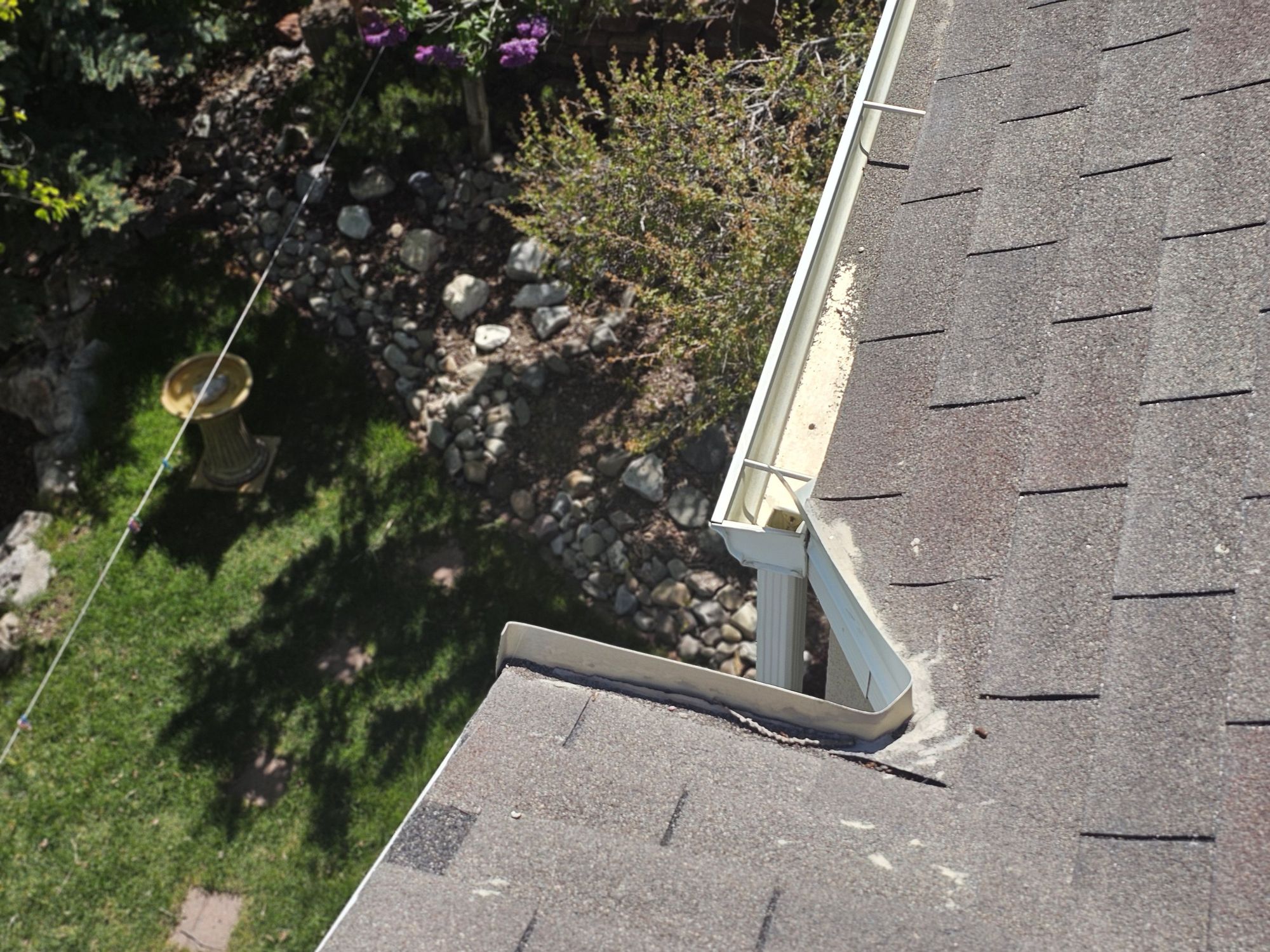
The photo here shows a gutter corner and its downspout outlet, the spot where most runs start leaking first. On a lot of older runs that corner has been kept going for years with another layer of sealant every time it dripped. Each layer holds for a while, then the drip finds its way back.
Corners and outlets go first because that is where the most water moves and where the metal is cut and joined. On a new run we keep the joints to a minimum and put downspouts where the water actually collects, so each seam has less work to do.
A gutter is only as good as the board behind it
Every hanger on a gutter is screwed into the fascia board behind it. On a lot of the older houses we work on around South Salt Lake, the fascia has had water running behind the gutter for years. Hang a new gutter on soft wood and the hangers start pulling out the first time it fills with ice.
So the old run comes down first and we check the board along its whole length. If it is rotted, we fix that before anything new goes up, and that work is laid out on our fascia repair page for South Salt Lake. Then the new gutter goes up on hidden hangers, screwed through the back of the gutter into solid wood at close spacing.
The back edge of the gutter tucks up under the drip edge, so water leaving the shingles lands inside the gutter and never gets behind it. If the roof edge has no drip edge, we add it. That one strip of metal decides whether your new gutter drains the roof or slowly rots the board it hangs on.
Swapping a run, start to finish
On the day, the old gutter and its downspouts come down first, along with every spike and strap that held them. Those leave holes in the fascia, and a board that has been drilled and spiked for years is often softer around the holes than anywhere else, so that is where we start probing.
Once the wood is sound and the drip edge is right, the new run goes up, the downspouts get reconnected, and we put a hose in the gutter at the far end to watch the water travel to the outlet. The yard gets walked for screws and bits of sealant before we leave.
Hangers hold what they are screwed into, and that is the fascia.
Pitch, downspouts and where the water lands
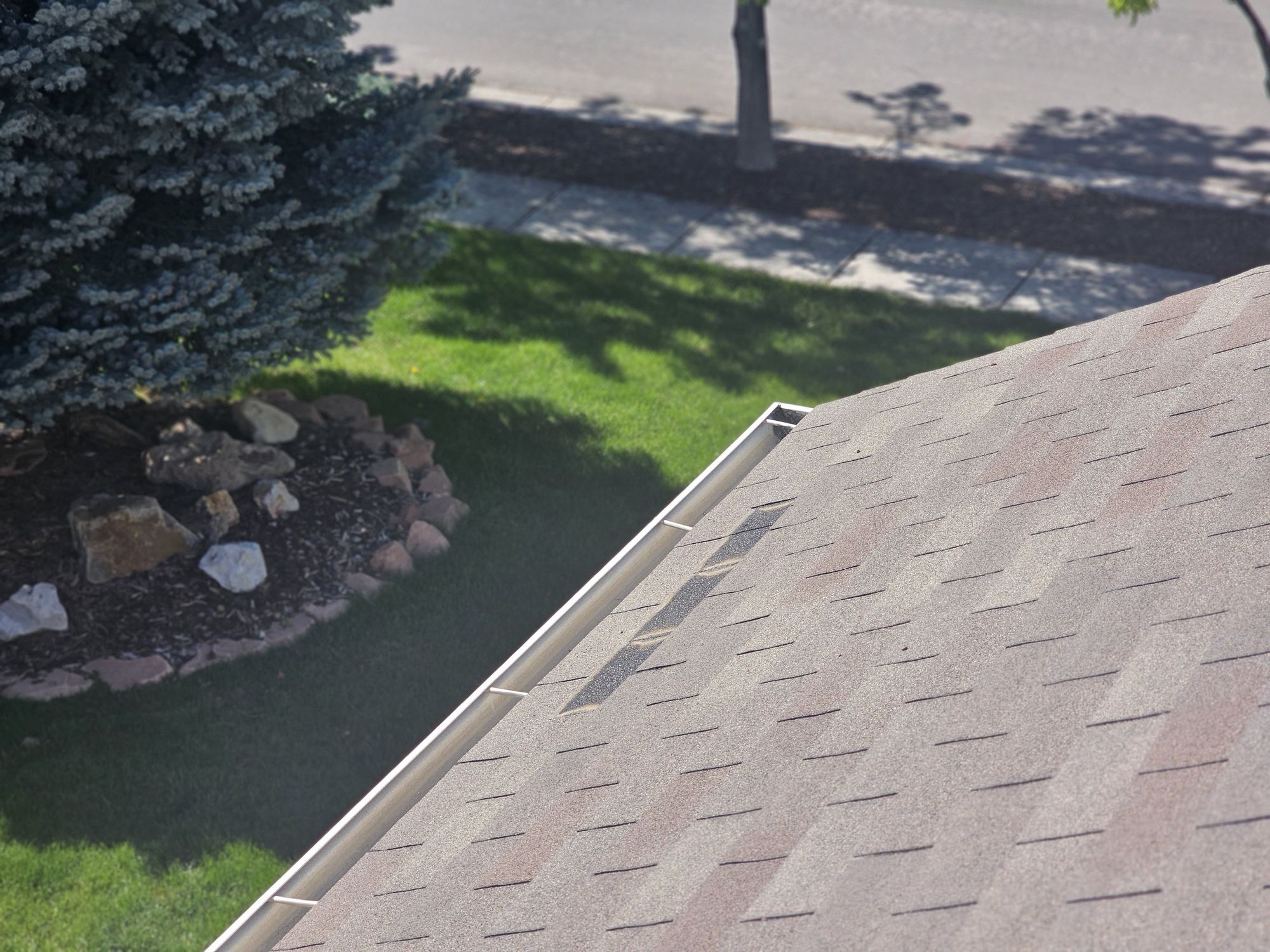
The second photo shows a finished run on hidden hangers along a shingled eave, with the lawn below it. What a photo cannot show you is the pitch. A gutter has to fall toward its downspout along the whole run, enough that water keeps moving and does not sit, without so much slope that it looks crooked from the street.
Then the water needs somewhere better to go than the base of your wall. We look at where each downspout lets out and how close that is to the foundation, and we carry it away from the house with an extension where it needs one. Water dumped against a foundation every storm tends to find its way into a basement. Our downspout installation page has more on that end of the job.
A new gutter still needs cleaning. Dry, windy spells blow grit and leaves into the seams, and the next rain turns it to a paste that holds water against the metal. Twice a year keeps it working the way it was hung.
For the longer version, see our main gutter replacement page. Other work we take on around town is listed on the South Salt Lake service area page. Finished runs are in the gallery. Call (801) 382-8898 or use the contact page and we will come have a look.
Where South Salt Lake sits on our map
We are in South Salt Lake for gutter and roof edge work regularly.
Before you replace your gutters
What homeowners ask us most when a gutter run is on its way out.
(801) 382-8898Can you replace one run instead of every gutter on the house?
Yes. If one side has a crushed or sagging run and the rest are sound, we replace that run and leave the others alone. We match the profile and color as closely as we can so the new section does not stand out from the street.
What are hidden hangers?
They are brackets that sit inside the gutter under the front lip and screw through the back into the fascia. You cannot see them from the ground, and they hold a gutter tighter than the old spikes driven through the front of it.
Why check the fascia before putting up new gutters?
Because the gutter hangs on it. If the board is soft, new hangers will work loose as soon as the gutter fills with water or ice. Fixing the wood first is what lets a new gutter stay where we put it.
How can I tell if my gutter is pitched right?
Watch it during a good rain. Water should run toward the downspout and drain out the bottom. If it pools in the middle or spills over the front edge, either the pitch is off or the outlet is blocked, and both are worth a look.
How often should gutters be cleaned?
For most houses in the valley, twice a year is about right: once in late spring and once after the trees drop their leaves. A house under big trees may need it more often. Packed debris holds water against the seams and wears them out early.
The rest of the South Salt Lake work
Talk to Hancock
Got a gutter that keeps letting go?
We will look at the gutter and the board it hangs on, and sort out whether it needs a repair or a new run.