
Roofing in the Provo area
From tear-off to ridge cap across Provo and the streets around it.
The conditions a Provo roof lives with
Provo has a wide mix, from century-old homes near the center to dense newer construction, and a lot of rentals where a small leak goes unreported until it is a big one.
Because we are on Utah County roofs most weeks, we know how the housing around Provo was put together, which is a different thing from knowing how roofs work in general.

The weather a Provo roof works against
Wet leaves against a wall line
Where a lower roof runs into a two-story wall, leaves and needles collect in that inside corner and stay. The pile holds water directly against the bottom of the siding and the top of the step flashing, which is the one place on a roof where a little standing moisture does the most damage.
Clear the corner, check the kickout
A kickout flashing at the bottom of that run throws the water into the gutter instead of behind the siding. Plenty of houses up here were built without one.
Fog that never burns off
Valley fog in the cold months sits low and holds. It puts a film of moisture on everything without registering as precipitation, which is why a homeowner can swear it has not rained in three weeks while the roof has been wet the whole time. Organic debris in a valley stays soft and packed instead of drying out and blowing clear.
Where that shows first
Under the bottom course at a wall, and in the seam where a porch roof ties into the main body of the house.
Utah County spans the lake plain and the mountain benches, and the growth of the last decade means whole neighbourhoods of roofs are aging out at the same time.
What we find on roofs around Provo
Ridge cap is its own material
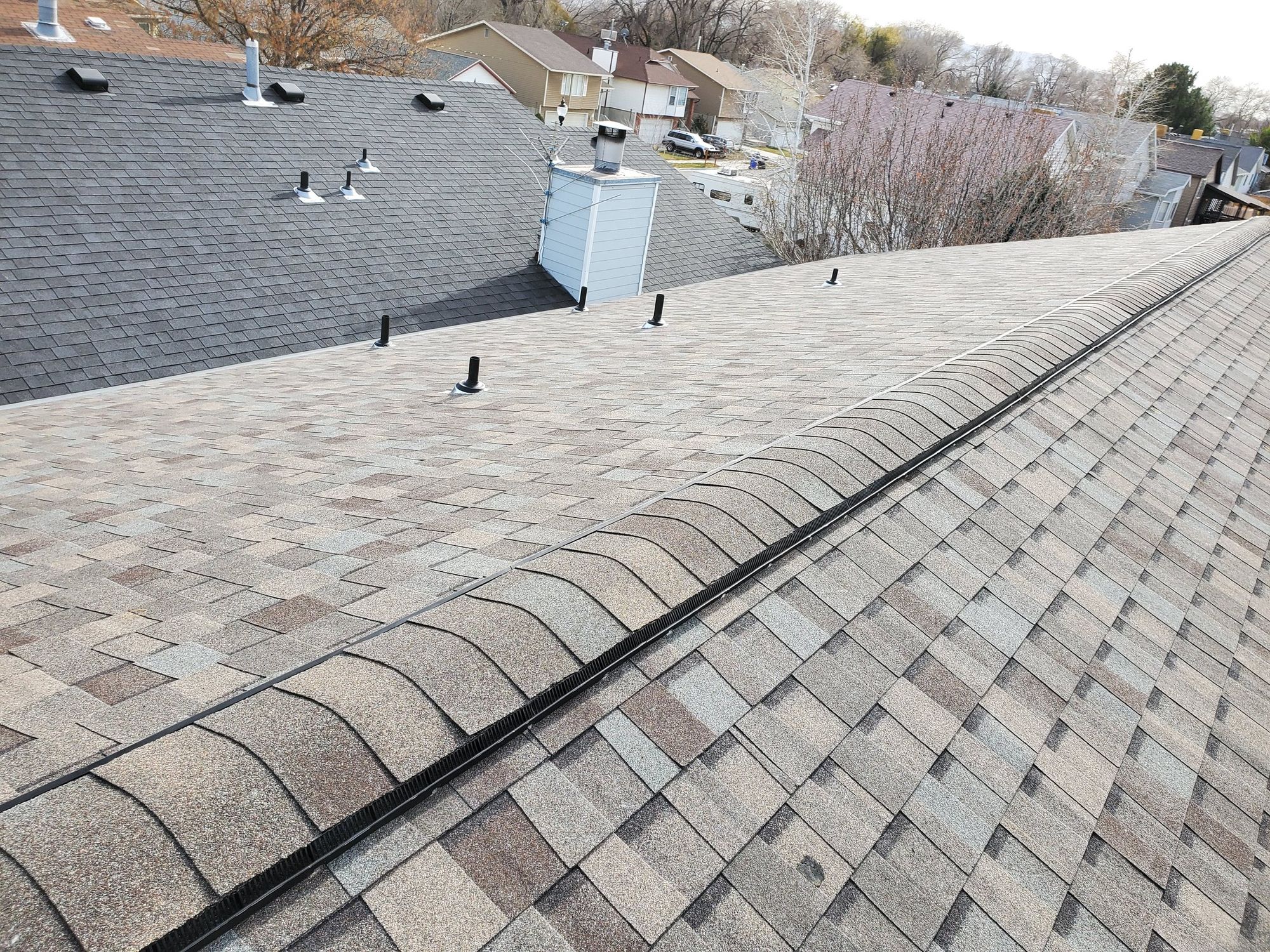
The cap along a ridge or a hip is the most exposed run on any roof and the most abused during installation. Cutting three-tab pieces to serve as cap on an architectural roof is a common shortcut, and the folded pieces crack at the bend within a few seasons up here. Purpose-made hip and ridge stock is thicker, pre-bent, and holds the fold through the cold.
Nail placement is the other half
Fasteners land under the next piece’s overlap, never through the weather surface where they sit exposed to the sky.
Flashing is where roofs leak
Very few roofs fail in the field of the shingles. They fail at the transitions, at a wall, a chimney, a skylight curb, a pipe boot, a valley. Good flashing is metal shaped so water has nowhere to go but out. Bad flashing is sealant spread over a gap and a hope that nobody looks for four years. When we pull a roof apart, the flashing is what tells us whether the last crew was in a hurry.
Step flashing is one piece per course
There is no shortcut version of that detail that works.
What we do around Provo
Every service is its own page. These are the ones Provo asks for most.
Roofing
Full replacements and new roofs on Provo homes, deck up.
Repairs
Leaks and failed details, which is most of what Provo calls about.
Upkeep
Inspections, cleaning and sealing before a small thing gets expensive.
Shingles
Architectural laminate, the field material on most of this valley.
Metal
Standing seam and corrugated, common on canyon-side snow load.
Tile
Clay and concrete tile, and the flashing work they need.
Commercial
Membrane systems for flat and low-slope buildings around Provo.
Coatings
Restoration coatings when a commercial roof has life left.
Storm
Hail, wind and the insurance paperwork that follows.
Skylights
Installation and the curb-flashing repairs skylights usually need.
Gutters
Gutters, downspouts and fascia, which are part of the roof.
Government
Schools, city, county, state and federal buildings. Every government service is on the government roofing page.
How the job runs
What happens before the crew arrives
Materials get delivered and staged so nothing has to be carried farther than it needs to be, dumpster or trailer placement gets sorted with you, and we talk through the start before anyone is on the roof. Deliveries do slip, and when one does we tell you rather than leave you guessing.
Neighbors get a heads up
A roofing crew is loud. It is a small courtesy and it goes a long way on a tight street.
Power and water
The crew needs an exterior outlet. That gets confirmed, not assumed.
Staging bundles on a steep pitch
On anything past about an eight in twelve, material cannot just be set down on the slope. Bundles get loaded flat onto roof jacks and staging planks, distributed across the roof rather than stacked in one place, and positioned so the crew works down toward the material instead of carrying it up. Getting that right on the first morning is most of why a steep roof goes smoothly.
Piled weight is a load
Forty bundles stacked on one rafter bay is a heavier point load than any snow that roof will ever see.
Work from around the valley


Down to earth, and particular
Friendly does not mean casual about the work. We will joke with you in the driveway and we will also tear out a valley that was ninety percent right and redo it. Those two things live comfortably together in a family shop.
What particular looks like
Six nails in the line. Step flashing one piece per course. The magnet run twice.
What friendly looks like
You get a real person on the phone and a straight answer.
The work happens after the handshake
Anybody can be pleasant during a walkthrough. What matters is whether the same person is pleasant on the third morning when the decking is worse than expected and somebody has to make a phone call they would rather not make. That is the part of this job that decides who a company is.
Bad news travels fast here
You hear it from us before you find it yourself.
Questions we get asked
Not the question you had? Call the shop and ask a person. We would rather talk it through than have you guess from a website.
(801) 382-8898Do you actually work in Provo?
Regularly. Provo is ordinary working territory for us, not an outlying job we take when it is quiet.
How fast can you get to Provo after a storm?
We stop the water first. Temporary work is genuinely temporary and we say so, but it buys the time to do the actual repair right.
Will you tell me if I do not need a new roof?
Yes. Plenty of what we look at turns out to be a repair, and we say so. A roof with years left in it gets left alone, and you get the photographs either way.
How long does a roof replacement take?
Most houses in this valley are a one to two day job once the crew is on site. Steeper pitches, multiple layers to strip and complicated roofs with a lot of valleys take longer, and we tell you which yours is before we start.
Do you handle the insurance side?
On hail-damaged roofs, we work with your insurance to get the roof covered. We document the damage thoroughly with photographs, so the claim reflects what is actually on the roof.
What happens if you find bad decking?
We show you. The decking is only visible during a tear-off, so that is when soft sheathing gets found and replaced. We photograph it rather than just add it to a list.
Where Provo sits on our map
Our Utah County route covers Provo, so a look at a roof here does not wait on a gap.
Roof work in Provo
Call (801) 382-8898. If it turns out to be a repair we will say so and do the repair.