
Salt Lake City & surrounding counties
Roof leaks, traced back to where water gets in
Water rarely comes through a ceiling right under the spot it entered the roof. We start in the attic, follow the wet wood uphill and repair the opening we find there.
The stain sits downhill of the opening
When water gets past a roof, it almost never drops straight down. It lands on top of the sheathing or the side of a rafter and follows it downslope until it reaches a seam, a nail or a joist that lets it fall. By the time it shows up as a brown ring on drywall, it may have traveled several feet from where it came in.
That is why patching the shingles directly over the stain so often changes nothing. Somebody climbs up, finds the spot above the wet ceiling, spreads roof cement on it and leaves. Next storm the ring is bigger, because the opening was farther up the roof the whole time.
On older houses with an attic you can actually get into, the quickest way to the source is from underneath. We go up through the hatch with a good light, find the wettest wood and work uphill from there until the trail runs out. Our main roof leak repair page covers the method in general. Here we are talking about the older houses we work on around South Salt Lake, where the attics are often tight and the roofs have usually been patched more than once.
Where we usually find the opening
On roofs we trace, most leaks start at one of a handful of spots.
Reading the last person’s patch
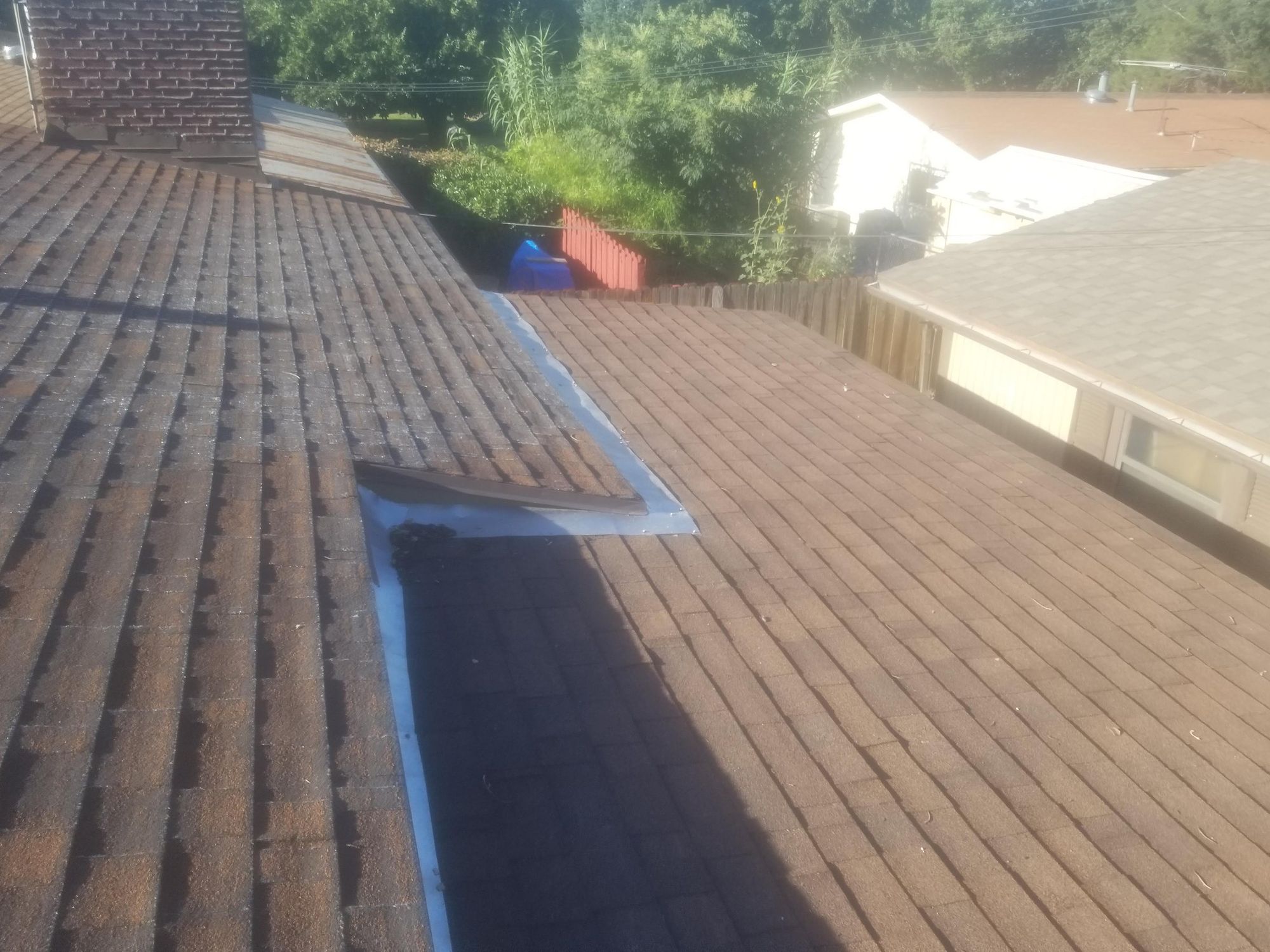
Many of the leaks we get called about have been fixed before. You can often tell from the yard: black smears of roof cement, sometimes painted over in white, usually in a valley or around a vent. This photo is a good example: a joint packed with mastic beside a vent pipe, with white coating brushed over the shingles next to it, which is what a quick fix looks like after a few summers.
Mastic is a consumable that goes on soft and does not stay that way through many Utah summers. A patch like that tells us somebody saw water at that spot, and that whatever sits underneath was never actually rebuilt.
We take patches like that apart instead of adding another layer on top. Under the cement there is usually a split boot, a valley seam that was never lapped properly, or a nail driven into the channel where the water runs. Repair that, and the sealant has nothing left to hold together.

By the time a stain shows on the ceiling, the leak has usually been going for a while.

Where a lower roof runs into a wall
Some of the worst leaks we open up are where a lower roof meets a wall, like a porch roof or an addition tied into the side of the house. That joint needs step flashing, one piece per course and tucked up behind the siding, plus a kickout at the bottom that throws wall water into the gutter instead of behind the trim.
When those pieces were never installed, the shingles just stop at the wall and water finds the seam. Pictured here is exactly that: shingles running into a painted board wall, with the paint peeling and the bottom edge dark and stained along the joint where water has sat for years. From the yard it reads as a paint job that needs touching up. Up close, that dark line is where the water has been getting in.
Fixing it means opening the siding along the bottom courses, installing real step flashing and a kickout, and replacing the wood that has gone bad. If the rot has reached the sheathing, our South Salt Lake roof deck repair page covers what happens next. If the wall in question is a chimney, see chimney flashing repair for South Salt Lake.
What a leak visit looks like from your side
Tell us the weather
When the stain shows up matters: a heavy rain, a fast melt, or a cold dry week. Each one points at a different kind of opening.
Attic first
We go up through the hatch with a light and follow the wet wood until it stops, marking where the trail begins.
Roof second
Up top we find the spot that lines up with that mark and take apart whatever patch is sitting on it.
Photographs both ways
You see the opening before it gets rebuilt and again after, so the repair is something you watched rather than something you were told about.
Tarp tonight, real repair after
Some calls come in while it is still raining. Then the first job is stopping more water, usually with a tarp or a temporary membrane over the area, fastened so wind cannot get under it. That is a dry-in, and it is temporary. Our emergency roof repair page explains how we handle those calls.
The real repair comes once the roof is dry enough to open and work on. The old patch comes off and the opening gets rebuilt with metal and shingles that turn water by their own shape. While it is open we check the deck underneath, because a slow, long leak usually leaves the sheathing darker and softer than anyone expected.
A stain that grows in cold, dry weather with no storm involved is often attic condensation. Bath fans that dump into the attic instead of outside are the usual cause, and we check for that before anyone touches the shingles. Our roof ventilation page has more on it.
The South Salt Lake page lists everything else we do in town. To have us look at a leak, call (801) 382-8898 or use the contact page. Photos of finished repairs are in the gallery.
Where South Salt Lake sits on our map
South Salt Lake borders our Salt Lake City shop, close enough that a leak can get covered before the next round of weather.
Leak questions we hear
Short answers to the things people ask before they pick up the phone.
(801) 382-8898Do you trace leaks on a flat or low-slope roof the same way?
The idea is the same and the trail is shorter. Water on a low slope does not run far before it drops, so the opening is usually closer to the stain. Seams in the membrane, the edges around rooftop units and any spot where water sits after a storm get looked at first.
Can a small leak wait until the weather warms up?
Covered with a tarp or a temporary dry-in, it can usually hold for a while, and sometimes that is the right call when the roof is wet or iced over. Leaving it open is the mistake. A slow leak over one winter soaks the insulation and stains the sheathing long before the ceiling shows anything.
Do you check the attic or only the roof?
Both, whenever the house has an attic we can get into. From inside we look for daylight between boards, rust on nail tips and dark or soft sheathing. The attic shows where water has already been.
Will your repair hold up?
We rebuild the opening so the metal and shingles turn water away on their own, and any sealant is extra. Repairs built that way last as long as the roof around them. If the weather only allows a caulked stopgap that day, we come back to finish it.
Does a leak mean I need a new roof?
Usually not. A cracked pipe boot, a bad valley seam or a missing kickout gets fixed by itself. If the shingles are worn out across the whole roof, we show you the photographs and you decide what happens next.
The rest of the South Salt Lake work
Talk to Hancock
Talk to Hancock about the leak
Tell us where the stain is and what weather brings it out. That alone usually narrows down where to start looking.