
Salt Lake County, Utah
Roofing in the Riverton area
Roof work around Riverton by a second-generation crew that knows open-exposure lots with little windbreak.
What we see on Riverton roofs
Winter here does the damage in April rather than January. Wet spring snow runs far heavier per foot than dry powder, and a roof in Riverton that carried three feet in February can groan under eighteen inches of the wet stuff two months later. Pitch, sheathing condition and whether the framing was sized for the zone all decide how that load comes off.
On a booked replacement the calendar does most of the work. On the day something fails at a Riverton house, stopping the water comes first and the real repair follows.

The weather a Riverton roof works against
Dry for months, then all at once
This climate does not rain steadily, it saves up. Long dry stretches let dust pack into valleys and gutters, then a single cell drops an inch in half an hour. A valley that was clean in May is holding pine duff and grit by August, and that debris dams the water right where the roof concentrates it.
What we clear before storm season
Valleys, gutter runs, the back side of chimneys, and the low end of any cricket. Ten minutes of clearing beats a drywall repair.
Hail on the west slope
When a cell moves through here it usually comes across the valley from the west, so the stones hit the west and southwest faces hardest and at an angle. It is common to find a roof with real bruising on two slopes and a north face that is untouched.
Angle changes what you look for
A vertical drop dents flat metal. An angled hit scrapes granules off the upslope edge of a tab and leaves the tab itself looking fine from below.
Two slopes can need two answers
And an honest look says so.
The valley floor sees less snow than the benches above it, but the benches above it are where a lot of the housing is. A roof in Holladay or Cottonwood Heights lives a different winter from one in Kearns, five miles away.
What we find on roofs around Riverton
Intake and exhaust have to match
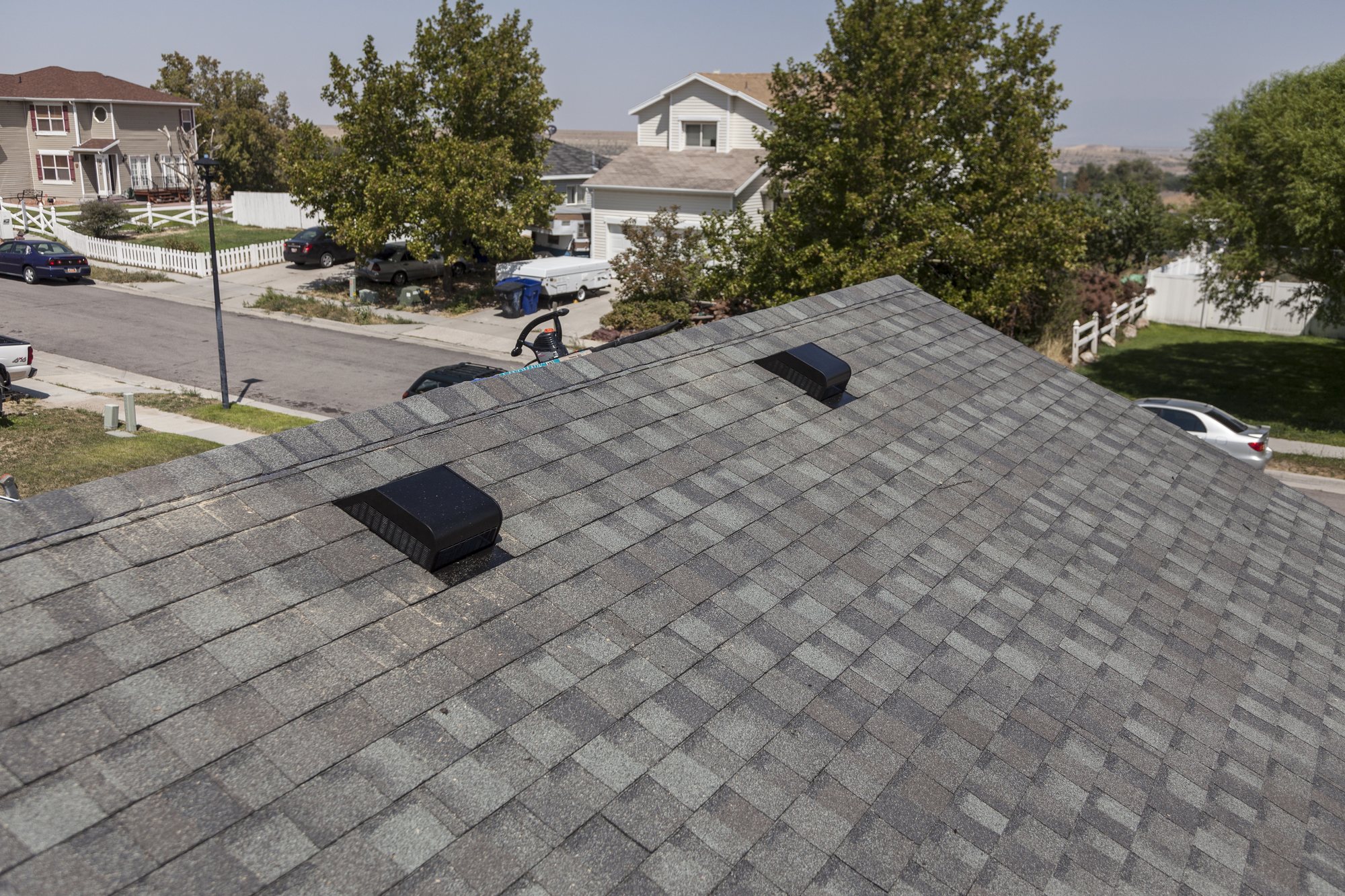
Attic ventilation is a balance, and most of the failures we find are unbalanced. Ridge vent with the soffit stuffed full of insulation is exhaust with no intake, so the attic pulls its air from the house instead and drags moisture up with it.
How it shows up
Frost on the sheathing in January, a hot attic in July, curling shingles on the upper courses, and an ice dam at the eave that nobody can explain.
Baffles are cheap
Keeping the insulation off the soffit with a proper chute fixes more roofs than most people would believe.
Ice-and-water shield, and where it goes
This is the single most important membrane on a Utah roof. It is a self-adhering sheet that seals around nail shanks, and it belongs at the eave, in every valley, and around every penetration.
The eave measurement people get wrong
Code language is about coverage past the interior wall line, not a flat number of feet. On a house with deep overhangs that means more courses than a builder might assume.
Valleys get it too
A valley carries water from two planes. It gets the membrane whether anybody asks for it or not.
Riverton is part of our Salt Lake County work. 27 years in the trade, and a full replacement carries our 10-year workmanship warranty.
What we do around Riverton
Every service is its own page. These are the ones Riverton asks for most.
Roofing
Full replacements and new roofs on Riverton homes, deck up.
Repairs
Leaks and failed details, which is most of what Riverton calls about.
Upkeep
Inspections, cleaning and sealing before a small thing gets expensive.
Shingles
Architectural laminate, the field material on most of this valley.
Metal
Standing seam and corrugated, common on canyon-side snow load.
Tile
Clay and concrete tile, and the flashing work they need.
Commercial
Membrane systems for flat and low-slope buildings around Riverton.
Coatings
Restoration coatings when a commercial roof has life left.
Storm
Hail, wind and the insurance paperwork that follows.
Skylights
Installation and the curb-flashing repairs skylights usually need.
Gutters
Gutters, downspouts and fascia, which are part of the roof.
Government
Schools, city, county, state and federal buildings. Every government service is on the government roofing page.
How the job runs
Repair or replace, honestly
Not every leak is a new roof. A cracked pipe boot, a lifted flashing, a handful of wind-damaged tabs on one slope: those are repairs, and we do them. The line gets crossed when the mat is brittle across the whole roof, when granule loss is general rather than local, or when the repair count keeps climbing.
How we tell you
We say which one it is and why, and if it is a repair we do not walk it up into a replacement.
Sequencing around a mason or a painter
When a chimney needs tuckpointing or a wall needs paint, the order those trades go in decides whether anybody has to come back. Masonry work happens before the roof ties into it so the flashing can be cut into fresh joints. Siding and paint on a wall above a roof plane go in before the final course below them.
We will talk to your other trades
A five minute phone call between two crews saves a week of scheduling around each other, and we would rather make the call than let you relay it.

Roofs around Riverton
Work from around the valley


Down to earth, and particular
Friendly does not mean casual about the work. We will joke with you in the driveway and we will also tear out a valley that was ninety percent right and redo it. Those two things live comfortably together in a family shop.
What particular looks like
Six nails in the line. Step flashing one piece per course. The magnet run twice.
What friendly looks like
You get a real person on the phone and a straight answer.
Talking to homeowners like adults
We explain what we find in plain language and we show the pictures. You do not need a roofing vocabulary to make a good decision about your own house, you just need somebody willing to say what a bruised mat is and why it matters. Most people, given real information, decide well.
No scare tactics
Nobody needs to be frightened into fixing their roof.
Questions we get asked
Not the question you had? Call the shop and ask a person. We would rather talk it through than have you guess from a website.
(801) 382-8898Do you actually work in Riverton?
Yes, and often. Riverton is part of our regular service area, so it is ground we know well.
How fast can you get to Riverton after a storm?
Storm calls jump the queue. We get there, stop what is coming in, and schedule the real fix rather than rushing a permanent repair in bad weather.
Do you work through the winter?
Yes, with judgment. Shingles need to seal, and in genuine cold that takes longer or needs hand sealing. Emergency work happens whenever it has to. Full replacements get scheduled around the weather rather than forced into it.
What makes a Utah roof different?
Snow load, ice at the eaves, canyon wind and high-altitude sun, all on the same roof. A crew that learned roofing somewhere mild has to learn it again up here.
How do I know when a roof is getting close?
Granules collecting in the gutters, tabs lifting or curling at the edges, shingles that look bare in patches, and daylight or staining in the attic. Any of those is worth a look.
Will you tell me if I do not need a new roof?
Yes. Plenty of what we look at turns out to be a repair, and we say so. A roof with years left in it gets left alone, and you get the photographs either way.
Where Riverton sits on our map
Our Salt Lake County route covers Riverton, so a look at a roof here does not wait on a gap.
Talk to Hancock
Roof work in Riverton
Call (801) 382-8898. Photographs of what we find come back to you either way.