
Roofing in the West Haven area
Roof work around West Haven handled by people who live and work up here.
What we look at first around West Haven
Attic condensation gets reported as a leak in West Haven more often than an actual leak does. Water drips onto insulation, stains a ceiling, and the roof above it is perfectly sound. Telling the two apart takes getting into the attic rather than onto a ladder.
Because we are on Weber County roofs most weeks, we know how the housing around West Haven was put together, which is a different thing from knowing how roofs work in general.

The weather a West Haven roof works against
Spring wind off the benches
Canyon wind is the thing homeowners here tend to shrug off. It does not arrive as a steady push, it arrives in gusts that lift a shingle tab, break the seal strip, and set it down again looking fine. Three or four of those and the tab is loose, water gets a path, and nobody knows until a ceiling stains.
Rakes and ridges go first
Edges take the uplift. That is why we nail the rake tighter, use a starter course with a factory seal at the eave, and look at ridge caps before anything else after a blow.
Moss and shade on the north side
Under mature trees on a shaded slope, the north face stays damp long after the rest of the roof has dried. Moss takes hold in that damp, and moss holds water against the mat and lifts shingle edges as it grows under them.
It is a cleaning problem first
Pressure washing an asphalt roof strips the granules and takes years off it. Gentle treatment, then clearing the overhanging limbs that keep the slope wet, is the order it should happen in.
Watch the gutter below
Moss coming off in the gutter is a sign the mat is losing surface too.
Ogden’s older housing stock has steeper pitches and more complicated rooflines than most of the valley, which means more valleys, more flashing, and more places for a rushed job to show.
What we find on roofs around West Haven
Six nails in the right line
Every shingle wrapper prints a nailing pattern and a nail line, and that pattern is what the wind rating was earned with. High nailing misses the reinforced strip and leaves the nail head sitting in the exposed area of the shingle below. Four nails where the wrapper asks for six cuts the uplift resistance on the one part of the roof the wind works hardest.
Overdriven is as bad as missing
A gun set too hot cuts through the mat and the shingle is hanging on a hole.
Cheapest detail to get right
And the most common thing done wrong.
Ridge vent against box vents
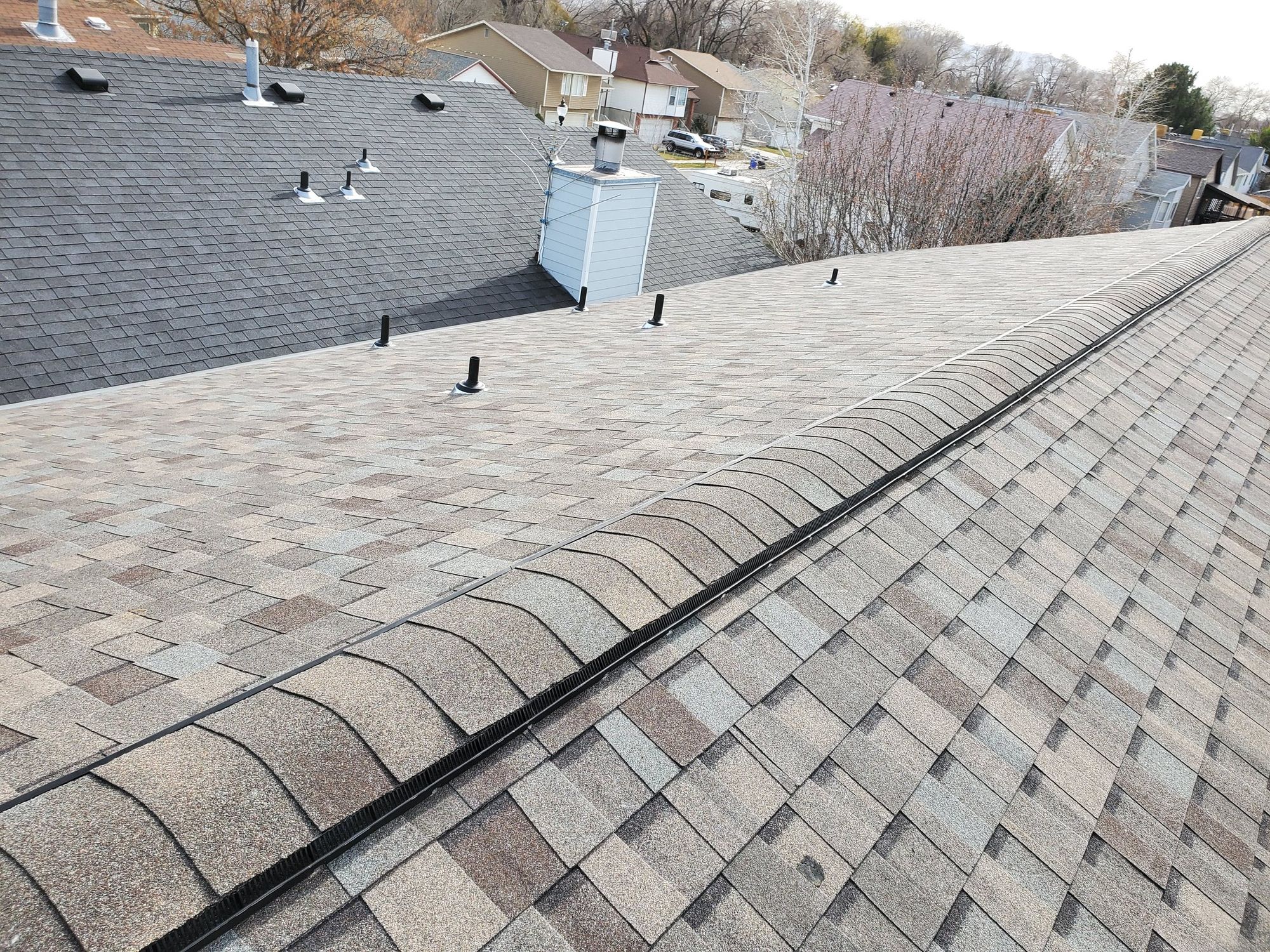
A continuous ridge slot pulls air along the entire peak, which is why it outperforms a row of box vents on most houses. Box vents still win in specific situations: a hip roof with almost no ridge to cut, a roof broken into separate attic spaces that do not share air, or a low ridge where a slot would sit under drifted snow all winter.
Never mix the two on one attic
Put both on the same space and the ridge pulls its air from the nearest box vent instead of from the soffit. The attic barely moves and the roof looks correctly vented from the driveway.
What we do around West Haven
Every service is its own page. These are the ones West Haven asks for most.
Roofing
Full replacements and new roofs on West Haven homes, deck up.
Repairs
Leaks and failed details, which is most of what West Haven calls about.
Upkeep
Inspections, cleaning and sealing before a small thing gets expensive.
Shingles
Architectural laminate, the field material on most of this valley.
Metal
Standing seam and corrugated, common on canyon-side snow load.
Tile
Clay and concrete tile, and the flashing work they need.
Commercial
Membrane systems for flat and low-slope buildings around West Haven.
Coatings
Restoration coatings when a commercial roof has life left.
Storm
Hail, wind and the insurance paperwork that follows.
Skylights
Installation and the curb-flashing repairs skylights usually need.
Gutters
Gutters, downspouts and fascia, which are part of the roof.
Government
Schools, city, county, state and federal buildings. Every government service is on the government roofing page.
How the job runs
Photographs at every stage
We shoot the roof before anything comes off, we shoot the bare deck with anything we are replacing marked, we shoot the ice barrier and the metal before the shingles cover them, and we shoot the finished roof. The photos that matter most are the middle ones, because those are of the parts nobody can see once the job is done.
You get the whole set
Not a curated few. If something in there raises a question, ask it.
It keeps everybody honest
Including us.
Staging bundles on a steep pitch
On anything past about an eight in twelve, material cannot just be set down on the slope. Bundles get loaded flat onto roof jacks and staging planks, distributed across the roof rather than stacked in one place, and positioned so the crew works down toward the material instead of carrying it up. Getting that right on the first morning is most of why a steep roof goes smoothly.
Piled weight is a load
Forty bundles stacked on one rafter bay is a heavier point load than any snow that roof will ever see.
Work from around the valley


Second generation on a roof
This is a family trade here. The owner learned it working for his uncle, who did not tolerate a sloppy valley, and those habits carry into every job the name goes on. Twenty-seven years in the trade is the owner’s own time on roofs, learned before there was a company.
Eight years under this name
The Hancock Signature name has been on trucks for eight of those years. Two different numbers, and we keep them straight because the difference is the whole story.
Talking to homeowners like adults
We explain what we find in plain language and we show the pictures. You do not need a roofing vocabulary to make a good decision about your own house, you just need somebody willing to say what a bruised mat is and why it matters. Most people, given real information, decide well.
No scare tactics
Nobody needs to be frightened into fixing their roof.
Questions we get asked
Not the question you had? Call the shop and ask a person. We would rather talk it through than have you guess from a website.
(801) 382-8898Do you actually work in West Haven?
We do. West Haven falls well inside the radius we run, and being there often is what lets us tell you how the housing around it was built.
How fast can you get to West Haven after a storm?
Storm calls jump the queue. We get there, stop what is coming in, and schedule the real fix rather than rushing a permanent repair in bad weather.
Will you tell me if I do not need a new roof?
Yes. Plenty of what we look at turns out to be a repair, and we say so. A roof with years left in it gets left alone, and you get the photographs either way.
How long does a roof replacement take?
Most houses in this valley are a one to two day job once the crew is on site. Steeper pitches, multiple layers to strip and complicated roofs with a lot of valleys take longer, and we tell you which yours is before we start.
Do you handle the insurance side?
On hail-damaged roofs, we work with your insurance to get the roof covered. We document the damage thoroughly with photographs, so the claim reflects what is actually on the roof.
What happens if you find bad decking?
We show you. The decking is only visible during a tear-off, so that is when soft sheathing gets found and replaced. We photograph it rather than just add it to a list.
Where West Haven sits on our map
Weber County work, West Haven included, is a normal week for this crew rather than a trip.
Roof work in West Haven
Call (801) 382-8898. If it turns out to be a repair we will say so and do the repair.