
Roofing in the Willard area
Honest roof work in Willard, from a family company in its second generation.
What we see on Willard roofs
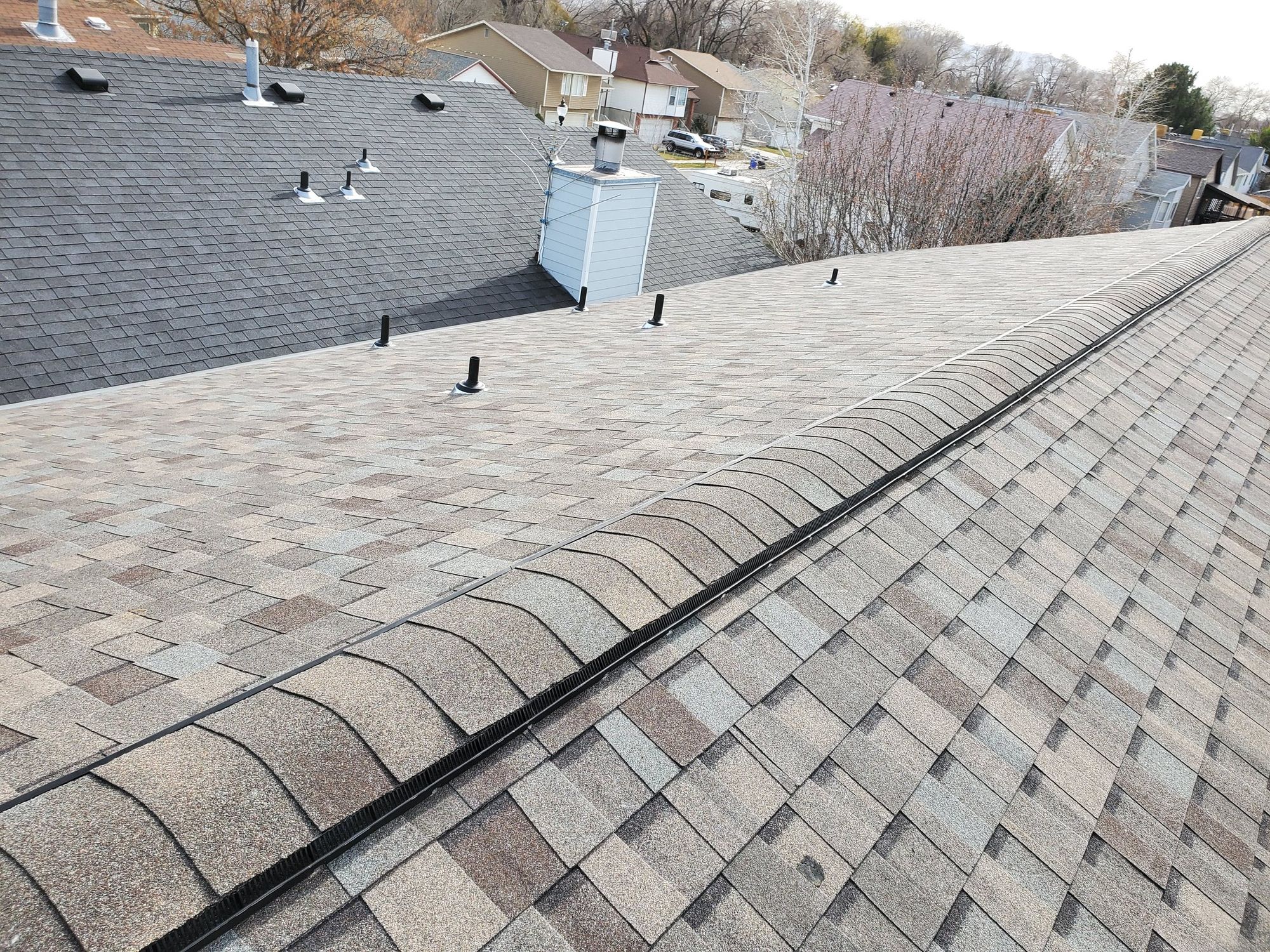
Most of what shortens a roof around Willard is slow and unremarkable: needles packed into a valley, debris caught behind a chimney, moss holding moisture on the north slope through a wet spring. None of it is dramatic and all of it works on the roof every single day.
Because we are on Box Elder County roofs most weeks, we know how the housing around Willard was put together, which is a different thing from knowing how roofs work in general.

The weather a Willard roof works against
Hail does not always look like damage
Hail here can be pea sized and harmless or big enough to bruise a mat. A bruise is a soft spot where the granules are knocked loose and the fiberglass underneath is fractured. You cannot see it from the ground, and from a ladder you often have to feel for it with a thumb.
Soft metal tells the truth
Before we call a roof hit, we check the soft metals: vents, gutter aprons, the fins on a swamp cooler. Dents there are the honest record of what fell.
Dust storms before the rain
Ahead of a summer cell the wind arrives dry and full of grit off the open ground west of here. That grit gets driven into every horizontal surface on a roof, then the rain lands on top of it and packs it into a paste in the valleys and the gutter seams.
Grit is an abrasive
It grinds at the mat under foot traffic and it holds moisture against metal long after the surface has dried.
So we clear twice a year
Once before summer, once after the leaves are down.
Open valley farm country north of the lake, where wind crosses a long fetch with nothing to break it and the housing sits spread out rather than packed in. Fasteners take a beating this close to the water.
What we find on roofs around Willard
Decking is the part nobody plans for
The sheathing under the roof only gets looked at once every couple of decades, which is when the old roof comes off. Older homes up here might have skip sheathing, plank decking with gaps, or plywood that has been soft over a leak for years. It gets replaced where it is bad, because fasteners do not hold in punky wood and a soft deck telegraphs every wave through a new roof.
It is measured, not guessed
Sheet count gets documented once the roof is open, before anything goes back down.
Pipe boots and roof penetrations
The rubber collar around a plumbing vent is the shortest-lived thing on most roofs. Ultraviolet at this elevation cracks that rubber long before the shingles are tired, and the crack sits directly over an open hole in the deck. Lead boots or a metal collar with a replaceable seal last considerably longer.
Everything that comes through gets a plan
Furnace flues, swamp cooler curbs, satellite mounts, solar standoffs. Each one is a hole somebody has to detail correctly.
What we do around Willard
Every service is its own page. These are the ones Willard asks for most.
Roofing
Full replacements and new roofs on Willard homes, deck up.
Repairs
Leaks and failed details, which is most of what Willard calls about.
Upkeep
Inspections, cleaning and sealing before a small thing gets expensive.
Shingles
Architectural laminate, the field material on most of this valley.
Metal
Standing seam and corrugated, common on canyon-side snow load.
Tile
Clay and concrete tile, and the flashing work they need.
Commercial
Membrane systems for flat and low-slope buildings around Willard.
Coatings
Restoration coatings when a commercial roof has life left.
Storm
Hail, wind and the insurance paperwork that follows.
Skylights
Installation and the curb-flashing repairs skylights usually need.
Gutters
Gutters, downspouts and fascia, which are part of the roof.
Government
Schools, city, county, state and federal buildings. Every government service is on the government roofing page.
How the job runs
The final walk
When the roof is done, we walk it together. Not a handshake at the truck, an actual look at the ridge line, the valleys, the edges, the penetrations and the ground around the house. If something looks off to you, we would much rather hear it standing there than in a phone call three weeks later.
Paperwork in your hands
What was replaced, how much decking, what materials went on, and where the leftover shingles ended up if you kept a bundle for future repairs.
We get on the roof
An honest look means hands on the material, not a drive-by or a drone pass alone. We walk the slopes we can safely walk, check the soft metals, lift a shingle to see how the mat is holding, look at the flashing at every wall and penetration, and then go into the attic if there is access.
A record of what we found
You get pictures of what we found, including the parts that are fine. A roof report that only shows problems is a sales pitch.

Work from around the valley


A salesman is not a roofer
In this trade a lot of the people knocking on doors have never installed anything. They are paid on what they close, they hand the job to a crew they have never met, and they are gone before the work starts. Ask the person in your driveway how they would flash a sidewall and listen to the answer.
Here it is the same people
The person who looks at your roof is the person who is going to be responsible for it.
No commission in the conversation
Nobody’s paycheck goes up if you buy more roof.
Straight about what a roof needs
Not every roof needs replacing. Some roofs need a pipe boot. Some need one slope. Some need everything. We tell you which, we show you the pictures, and we let you decide with the real information in front of you.
Including when it is not us
If a roof needs something outside what we do well, we will point you at who does it.
Questions we get asked
Not the question you had? Call the shop and ask a person. We would rather talk it through than have you guess from a website.
(801) 382-8898Do you actually work in Willard?
Yes. Willard sits inside the ground we cover around Salt Lake City, and the crew is there most weeks rather than once a season.
How fast can you get to Willard after a storm?
We make the roof safe first, then come back and do the repair properly when conditions allow.
Do you work through the winter?
Yes, with judgment. Shingles need to seal, and in genuine cold that takes longer or needs hand sealing. Emergency work happens whenever it has to. Full replacements get scheduled around the weather rather than forced into it.
What makes a Utah roof different?
Snow load, ice at the eaves, canyon wind and high-altitude sun, all on the same roof. A crew that learned roofing somewhere mild has to learn it again up here.
How do I know when a roof is getting close?
Granules collecting in the gutters, tabs lifting or curling at the edges, shingles that look bare in patches, and daylight or staining in the attic. Any of those is worth a look.
Will you tell me if I do not need a new roof?
Yes. Plenty of what we look at turns out to be a repair, and we say so. A roof with years left in it gets left alone, and you get the photographs either way.
Where Willard sits on our map
We work Willard as part of our Box Elder County schedule.
Roof work in Willard
Call (801) 382-8898. We will get on the roof, look properly, and tell you what it needs.