

Hancock Signature Roofing
Contact Hancock Signature Roofing
Call (801) 382-8898 or send a note and we will get on the roof.
Getting hold of us
The fastest way is the phone: (801) 382-8898. If it is a storm call and water is coming in, say so and we will move it up.
Email reaches the office at office@hancocksignature.com. We cover Salt Lake City, the Salt Lake valley and the counties around it.
If you are not sure whether what you are seeing is a repair or a replacement, that is exactly the call to make. We will tell you which.
Send us the roof
A name, a number and what the roof is doing, and we will call you back.
What we find on roofs around here
What we find most often
On houses in this valley the three recurring findings are unbalanced ventilation, flashing that was sealed rather than formed, and decking that went soft under a valley nobody could see into. All three are invisible from the ground and all three are cheap to fix while the roof is already open.
What the age of the house tells us
A house built in the 1950s, one built in the 1980s and one built last year each fail differently. Older stock tends to have thinner decking and original framing that was never sized for a second layer of shingles. Houses from the building booms tend to share a builder’s ventilation shortcut across a whole subdivision. New construction usually fails at a detail somebody rushed to hit a schedule.
The year a Utah roof works through
Snow sliding off steep pitch
Steep roofs shed, which is good for the roof and hard on everything below it. A loaded slope lets go at once and takes gutters, vent caps and the occasional shrub with it. On metal it happens faster because there is nothing to hold it. Homes with steep pitch over a walkway or a doorway get looked at differently than the same roof over an open yard.
Snow retention when it matters
Where a slide is a hazard, cleats or a retention rail spread the load and let it melt off instead of releasing in one sheet.
Sun at this elevation
The thing that quietly ages a roof around here is not a storm. It is a mile of thin air between the shingle and the sun, with more clear days than most of the country gets. Ultraviolet breaks down the asphalt binder, the mat loses flexibility, granules let go, and a south or west slope wears out years ahead of the north side of the same house.
Uneven wear is normal
On plenty of homes up here the south face is done and the north face has life left. That is not a defect, it is exposure, and it is worth knowing before anybody talks about replacing everything.
What we check
- Access and fall protection
- Landscaping and drive protection
- Where material is staged
- Daily cleanup and magnet sweep
Where roofs go wrong
The shortcut we see most
Shingles laid over a second existing layer to save a tear-off. It hides the decking, adds weight the framing was not sized for, and guarantees that the next roof is a bigger job than this one should have been.
What good looks like instead
Down to the deck, sheathing repaired where it is soft, ice barrier where the eaves need it, and the flashing formed rather than sealed.
Signs worth a look
- Granules collecting in the gutters or at the downspout discharge
- Tabs lifting or curling along a rake or ridge
- Shingles that look bare or patchy from the street
- Staining or daylight visible in the attic
We work Salt Lake City & surrounding counties: 9 counties and 103 communities, with 27 years in the trade.
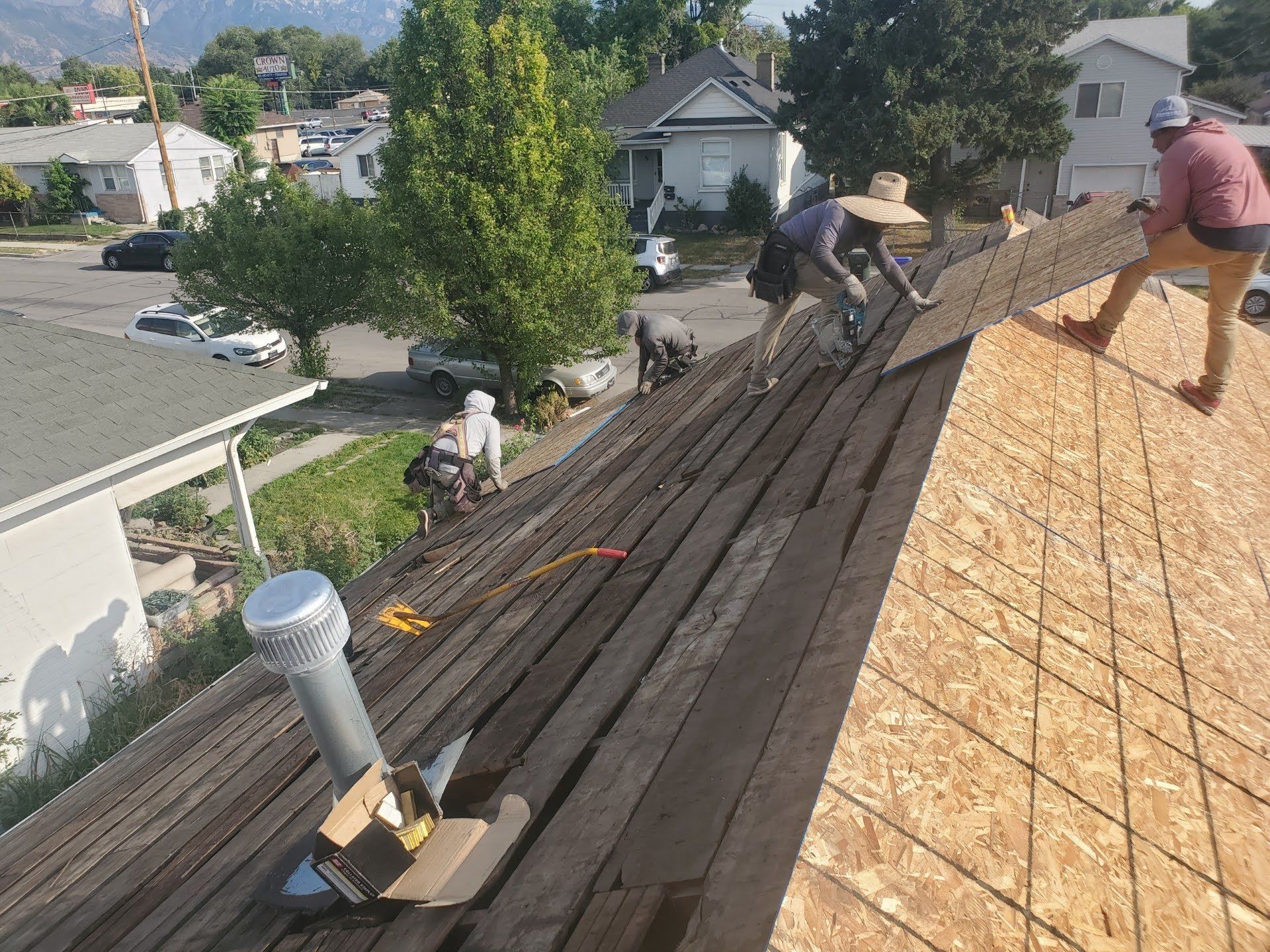
From recent jobs


What to expect
How long it takes
Most houses in this valley are one to two days on site once the crew arrives. What stretches it is pitch, the number of existing layers to strip, and how many valleys and penetrations the roof has. We tell you which of those apply to yours before the schedule is set.
What happens to your yard
Tarps go down over landscaping and the drive before anything comes off the roof. Material is staged where it will not crack concrete. At the end of every day the site gets cleared, and when the job is finished a magnet goes over the whole yard for nails.
What you should expect from us
A walk of the roof before anything is quoted, photographs of what we found, a plain explanation of what needs doing and what does not, and Hancock answering for the job through to the finish.
Why Hancock
We know the inspectors here
Working the same jurisdictions for years means knowing what each building department actually looks at and how they want it shown. That is not about getting anything past anybody, it is the opposite. It means the ice barrier is already where the inspector expects it and the ventilation math is already on the paperwork, so nothing gets opened back up.
A failed inspection costs you time
Usually a week, sometimes a shingle course. Easier to do it right on Tuesday.
Standing behind old work
There are roofs we put on years ago that we still drive past and look at. When one of them needs something, we go. A company that is around long enough to be accountable for its own history behaves differently than one planning to be somebody else’s problem in five years.
Eight winters is the test
Eight years operating under this name is long enough for the early roofs to have been through real weather, which is the only test that counts.
Twenty-seven years before that
The owner’s own time in the trade, kept as a separate number.
Where we work
Nine counties around Salt Lake City, plus every community inside them.
Salt Lake County
Davis County
Weber County
Box Elder County
Tooele County
Utah County
Summit County
Wasatch County
Morgan County
Questions we get asked
Not the question you had? Call the shop and ask a person. We would rather talk it through than have you guess from a website.
(801) 382-8898How long does a roof replacement take?
Most houses in this valley are a one to two day job once the crew is on site. Steeper pitches, multiple layers to strip and complicated roofs with a lot of valleys take longer, and we tell you which yours is before we start.
Do you work through the winter?
Yes, with judgment. Shingles need to seal, and in genuine cold that takes longer or needs hand sealing. Emergency work happens whenever it has to. Full replacements get scheduled around the weather rather than forced into it.
Will you tell me if I do not need a new roof?
Yes. Plenty of what we look at turns out to be a repair, and we say so. A roof with years left in it gets left alone, and you get the photographs either way.
What happens if you find bad decking?
We show you. The decking is only visible during a tear-off, so that is when soft sheathing gets found and replaced. We photograph it rather than just add it to a list.
How do I know when a roof is getting close?
Granules collecting in the gutters, tabs lifting or curling at the edges, shingles that look bare in patches, and daylight or staining in the attic. Any of those is worth a look.
Talk to Hancock
Talk to Hancock
Call (801) 382-8898 or send a note.