
Davis County, Utah
Roofing in the Woods Cross area
Woods Cross roofs, read honestly and repaired or replaced on their merits.
The conditions a Woods Cross roof lives with
The freeze that follows a warm afternoon does more damage around Woods Cross than a steady cold spell ever does. Meltwater finds its way into a lap or a nail hole at two in the afternoon and turns to ice by eight, and ice that expands in a seam does not put the seam back where it found it.
A Woods Cross roof that opens up in a storm needs a tarp before it needs a sales pitch. We stop the water first, because that is usually the difference between a ceiling and a remodel.

The weather a Woods Cross roof works against
Freeze and thaw works on everything
A February day here can swing forty degrees between sunrise and mid afternoon. Water gets into a nail hole, a lap, a crack in the flashing sealant. It freezes overnight and expands. It thaws and goes deeper. Multiply that by a hundred cycles a winter and small openings become real ones. It is slow, and it is the reason a roof that was fine three winters ago is leaking now.
Sealant is a maintenance item
Anything relying on caulk has a clock on it. Flashings that rely on metal geometry instead of sealant last a great deal longer.
A slide onto a walkway
A loaded slope above a front door or a side path is a safety matter before it is a roofing one. Snow releases in one piece, and a hundred pounds landing on a step is how people get hurt. It also tears at the gutter on the way past and bends the hangers out of the fascia.
Fixing it means changing the geometry
Retention hardware, or a small roof over the entry to break the fall, or moving the path. Something has to change, because the slope will keep doing what slopes do.
Davis County runs narrow between the lake and the mountain, and the wind funnels through it. The corridor around the base sees gusting that the sheltered streets further east do not.
What we find on roofs around Woods Cross
Flashing is where roofs leak
Very few roofs fail in the field of the shingles. They fail at the transitions, at a wall, a chimney, a skylight curb, a pipe boot, a valley. Good flashing is metal shaped so water has nowhere to go but out. Bad flashing is sealant spread over a gap and a hope that nobody looks for four years. When we pull a roof apart, the flashing is what tells us whether the last crew was in a hurry.
Step flashing is one piece per course
There is no shortcut version of that detail that works.
Open valley or closed
A closed valley weaves or cuts the shingles across the intersection. An open valley runs metal down the center with the shingles cut back off it. Around here, with the volume of water and ice a valley concentrates, open metal over ice-and-water shield is the detail we reach for on most homes. It moves debris out instead of catching it, and it gives ice a smooth surface instead of a shingle edge to grab.
The W profile
A center rib keeps water from one plane washing up under the shingles on the other.
Woods Cross is part of our Davis County work. 27 years in the trade, and a full replacement carries our 10-year workmanship warranty.
What we do around Woods Cross
Every service is its own page. These are the ones Woods Cross asks for most.
Roofing
Full replacements and new roofs on Woods Cross homes, deck up.
Repairs
Leaks and failed details, which is most of what Woods Cross calls about.
Upkeep
Inspections, cleaning and sealing before a small thing gets expensive.
Shingles
Architectural laminate, the field material on most of this valley.
Metal
Standing seam and corrugated, common on canyon-side snow load.
Tile
Clay and concrete tile, and the flashing work they need.
Commercial
Membrane systems for flat and low-slope buildings around Woods Cross.
Coatings
Restoration coatings when a commercial roof has life left.
Storm
Hail, wind and the insurance paperwork that follows.
Skylights
Installation and the curb-flashing repairs skylights usually need.
Gutters
Gutters, downspouts and fascia, which are part of the roof.
Government
Schools, city, county, state and federal buildings. Every government service is on the government roofing page.
How the job runs
Protecting what is under the roof
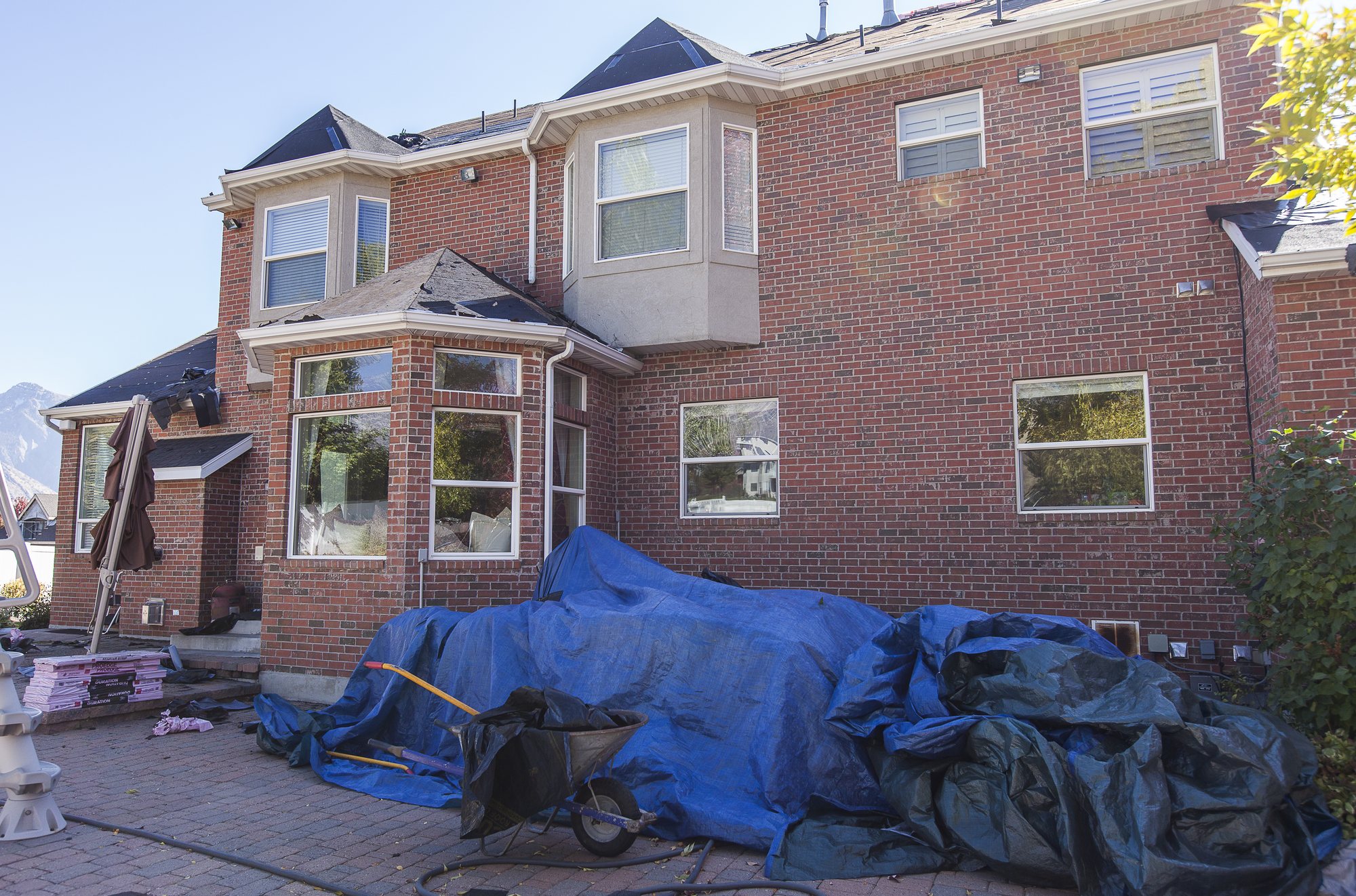
A tear-off throws debris, and there is a lot of it. Before anything comes off, we tarp landscaping, lay plywood over anything that would take a hit, move what can be moved off the deck and the driveway, and set the dump trailer where it will not crack a concrete apron.
Attic coverage matters too
Old roofs shed dust and nail points into an attic. Anything stored up there gets covered before the first shingle moves.
How long a house takes
Most single-family roofs here are a one or two day job once the crew is on it. Steeper pitch, multiple stories, cut-up rooflines with a lot of valleys and dormers, or tile work take longer. Decking replacement adds time that nobody can quote before the roof is open.
Start to finish on a normal house
Tear-off and dry-in in the morning, underlayment and metal, then shingles, then ridge and cleanup.
We do not leave a roof open
Whatever comes off in a day gets dried in that day.

Roofs around Woods Cross
Work from around the valley


Explaining before deciding
We would rather spend twenty minutes on a driveway explaining what a valley does than have you approve something you do not understand. A homeowner who knows why the ice barrier runs four feet past the wall makes better decisions about their own house, including sometimes deciding against what we suggested.
Take the information elsewhere
If you want another opinion, get one. A roof is a large thing to buy on one conversation and we are comfortable being compared.
No expiring pricing
The number holds while you think.
Twenty-seven years of Utah roofs
Twenty-seven years working roofs in this state teaches things that do not show up in a manufacturer’s manual. Where ice actually forms on a north-facing eave. How canyon wind hits a rake edge differently than open valley wind. Which shingle colors fade hard at elevation.
Local knowledge is specific
A crew that learned roofing somewhere with mild winters has to learn all of it over again up here.
Eight years as Hancock Signature
The company itself is eight years old, built on that earlier experience.
Questions we get asked
Not the question you had? Call the shop and ask a person. We would rather talk it through than have you guess from a website.
(801) 382-8898Do you actually work in Woods Cross?
Yes, and often. Woods Cross is part of our regular service area, so it is ground we know well.
How fast can you get to Woods Cross after a storm?
We stop the water first. Temporary work is genuinely temporary and we say so, but it buys the time to do the actual repair right.
What happens if you find bad decking?
We show you. The decking is only visible during a tear-off, so that is when soft sheathing gets found and replaced. We photograph it rather than just add it to a list.
Do you work through the winter?
Yes, with judgment. Shingles need to seal, and in genuine cold that takes longer or needs hand sealing. Emergency work happens whenever it has to. Full replacements get scheduled around the weather rather than forced into it.
What makes a Utah roof different?
Snow load, ice at the eaves, canyon wind and high-altitude sun, all on the same roof. A crew that learned roofing somewhere mild has to learn it again up here.
How do I know when a roof is getting close?
Granules collecting in the gutters, tabs lifting or curling at the edges, shingles that look bare in patches, and daylight or staining in the attic. Any of those is worth a look.
Where Woods Cross sits on our map
Davis County work, Woods Cross included, is a normal week for this crew rather than a trip.
Talk to Hancock
Roof work in Woods Cross
Call (801) 382-8898. If it turns out to be a repair we will say so and do the repair.