
Salt Lake City & surrounding counties
A roof for the house you actually live in
Every house we roof around Roy has somebody living under it while the crew is up top, whether it is a small postwar place or a bigger, newer home. Either way, the choices are yours and the crew works around the people inside.
Two kinds of house, one way of working
The range runs wide. Older postwar houses tend to be small, with board decks, shallow attics and a few vents somebody cut in over the years. Bigger, newer homes carry more roof planes, more valleys and a long run of ridge, which means more flashing and more places for water to turn a corner. The two ask different things of a roofer, and a crew that only knows one of them shows it on the other.
The order of the work does not change between them. We look in the attic, walk every slope, and note what the deck and the details need before anybody mentions color. Houses put up by one builder usually share one habit, good or bad, so after a few roofs on a street we have a fair idea what sits under the next. The main residential roofing page covers this work across the valley, and the Roy town page has the weather and the map.
Choosing a shingle color from the yard
Laminated shingles are the field material on most houses in this valley, and most people pick a color from a small sample held in one hand. That sample nearly always looks darker and flatter than the finished roof. On a slope, sunlight strikes the granules at an angle, the blend of tones spreads over the whole plane, and a brown with a little red in it can read as red from the curb.
So take the sample outside. Hold it against the brick or the siding in daylight, then find a finished roof in the same color nearby and look at it from the street, once in the morning and again late in the day. We do not hold up one manufacturer as the right answer for every house. We tell you what we would put on that particular roof and why, and the color stays your decision.
Venting along the peak
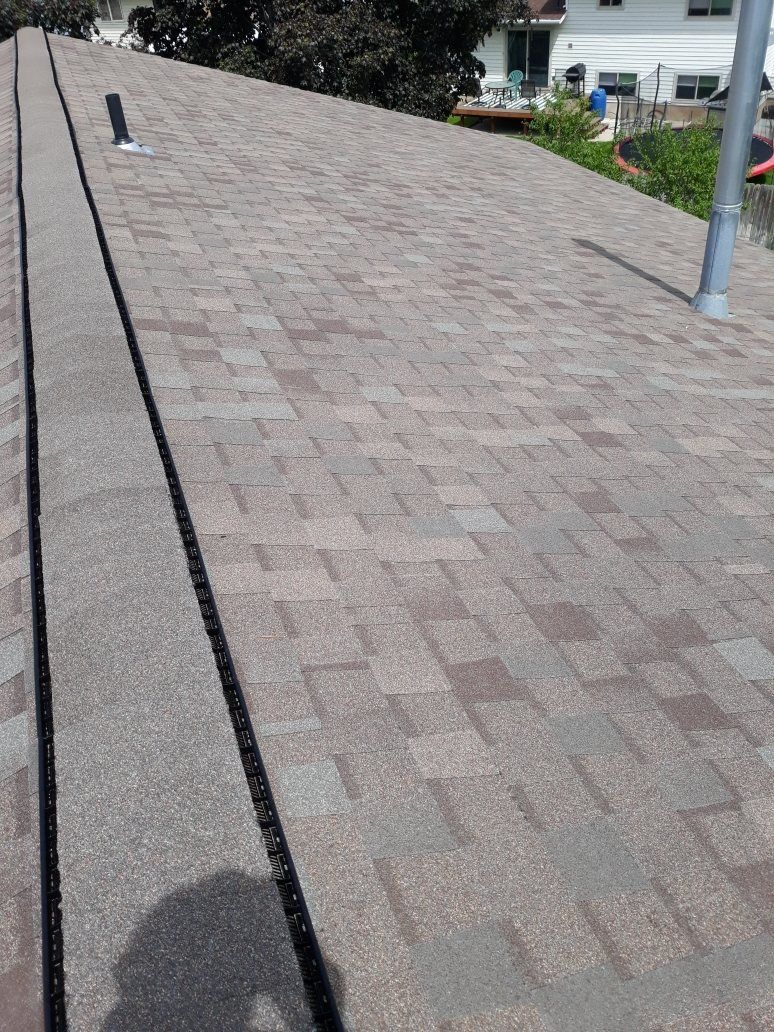
This photo shows a tan and brown laminated field with a finished ridge vent running down the peak, its black edge showing under the cap shingles, and a back deck below. A ridge vent is the exhaust half of the attic: a slot cut along the top of the deck, covered by the cap. Warm, wet air rises to the peak and leaves through it, while cooler, drier air comes in low at the soffits to take its place.
It only works when the attic has one plan. Leave old box vents on the same attic as a new ridge vent and the ridge feeds off the nearest box vent, the soffits sit idle, and most of the attic hardly moves. So when a ridge vent goes on, the box vents come off and the holes get decked and shingled. A hip roof with very little ridge to cut is the usual case where we keep box vents and skip the slot. Either way, never both.
We also check that the soffits are open and look for a bath fan that empties into the attic rather than outdoors, since that moisture turns into frost on the underside of the deck in midwinter.
Living at home while we work
People stay in their houses through a reroof, and a little planning on both sides makes the days easier.

One plane open at a time
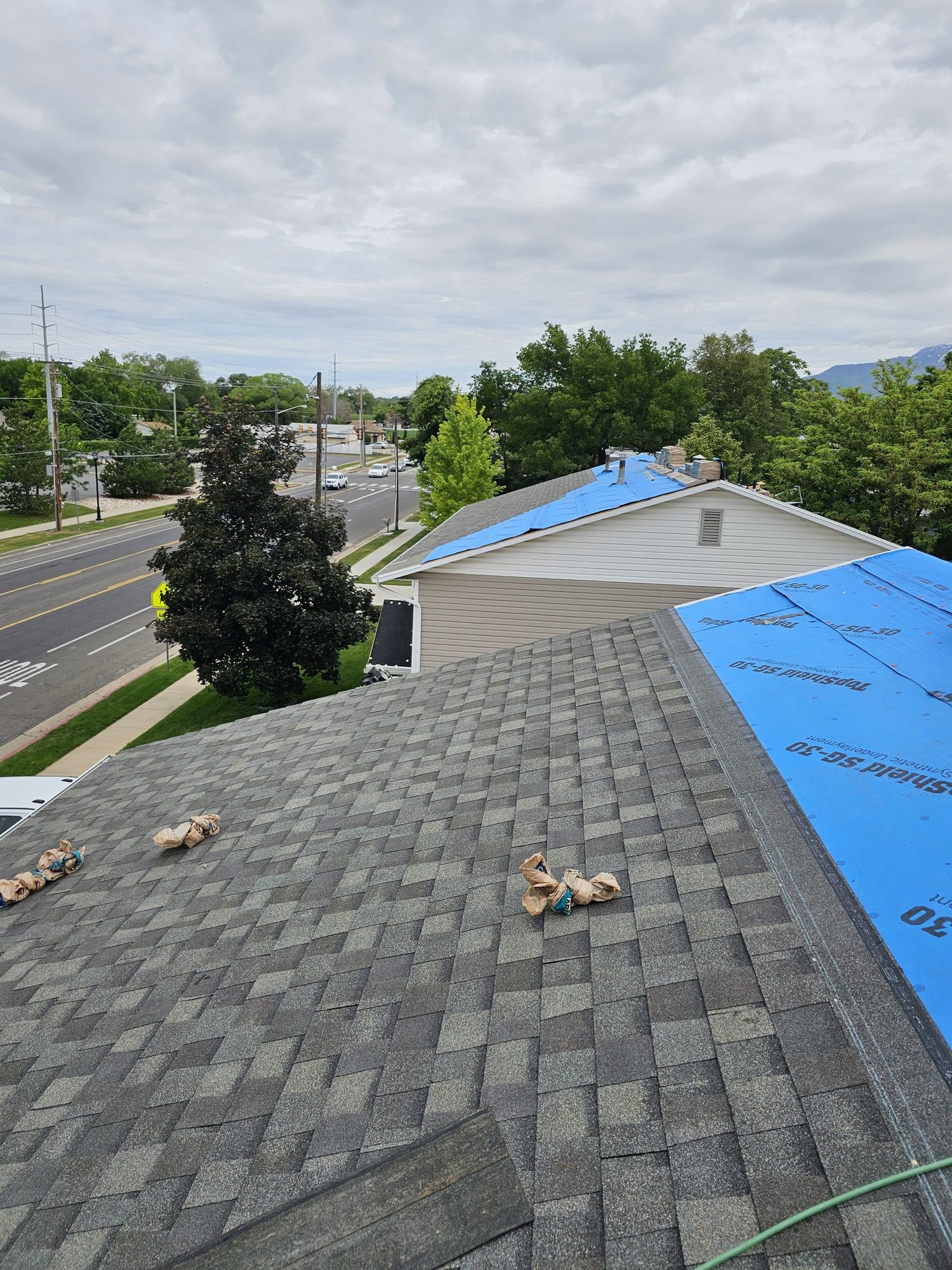
In this photo the new gray shingles are finished in the foreground while the next plane is stripped to blue underlayment, bundles staged and waiting, above a covered parking area. That is how a reroof should move across a house. A section comes off, gets dried in, and gets shingled before the crew opens the next one.
Working that way, the house is never open to the sky all at once. If the afternoon turns, only the plane in progress needs covering, and it is already under underlayment. Most houses here take the crew one to two days on site. A steep pitch, more than one old layer, or a roof full of valleys stretches that, and you hear which kind you have before the tear-off starts. The deck, the layers and the warranty side are on our Roy roof replacement page.
A family stays home through a reroof, so the roof comes off one dry section at a time.
Our name stays on it after the truck leaves
Hancock Signature Roofing is a family company, second generation and woman owned, with 27 years in the trade and 8 years under the Hancock Signature name. There is no regional office to pass a complaint along to. If something on your roof is wrong, it comes back to us, and we come back to fix it. A full replacement carries our 10-year workmanship warranty, which stands behind the installation itself.
If your house needs something smaller, the Roy roof repair page covers the fixes we make most, and a yearly maintenance walk keeps a newer roof ahead of trouble. Finished roofs are in the gallery. Call (801) 382-8898 or send us a note, and we will set a time to look at the house with you.
Where Roy sits on our map
Roy sits in Weber County beside Hill Air Force Base, about 30 miles north of our Salt Lake City shop, and the crew works there through the season rather than once in a while.
Do I need to be home while you reroof the house?
No. Most people go about their day, and plenty work from home through the noise. We do need the driveway clear, pets inside, and a way to reach you if soft decking changes the plan.
Why does my shingle sample look different up on the roof?
A sample shows one small patch up close. On the roof, sunlight hits the granules at an angle and the blend spreads across the whole plane, so it tends to read lighter and more varied from the street.
Can I keep my box vents and add a ridge vent too?
Not on the same attic. The ridge draws from the box vent beside it instead of the soffits, and the rest of the attic hardly moves. We choose one plan for the roof and close off the other.
Do you work on the smaller older houses too?
Yes. A small postwar house often needs more care, with board decking, a shallow attic and vents added over the years. It gets the same walk through the attic and over every slope as a bigger home.
Which shingle brand do you put on every house?
We do not run one brand on every roof. We tell you what we would install on yours and why, show you samples outdoors in daylight, and leave the color choice with you.
The rest of the Roy work
Talk to Hancock
Want the roof walked before you pick a shingle?
We look in the attic and over every slope, bring samples outside, and tell you plainly what the house needs. Talk to Hancock and pick a time that fits your week.