
Salt Lake City & surrounding counties
First roofs on new Herriman houses
A lot of Herriman is newer construction, and a first roof gets one chance to go on right. We start at the bare decking and work up to the ridge, putting every layer where the water will actually be.
Layout lines before the first full course
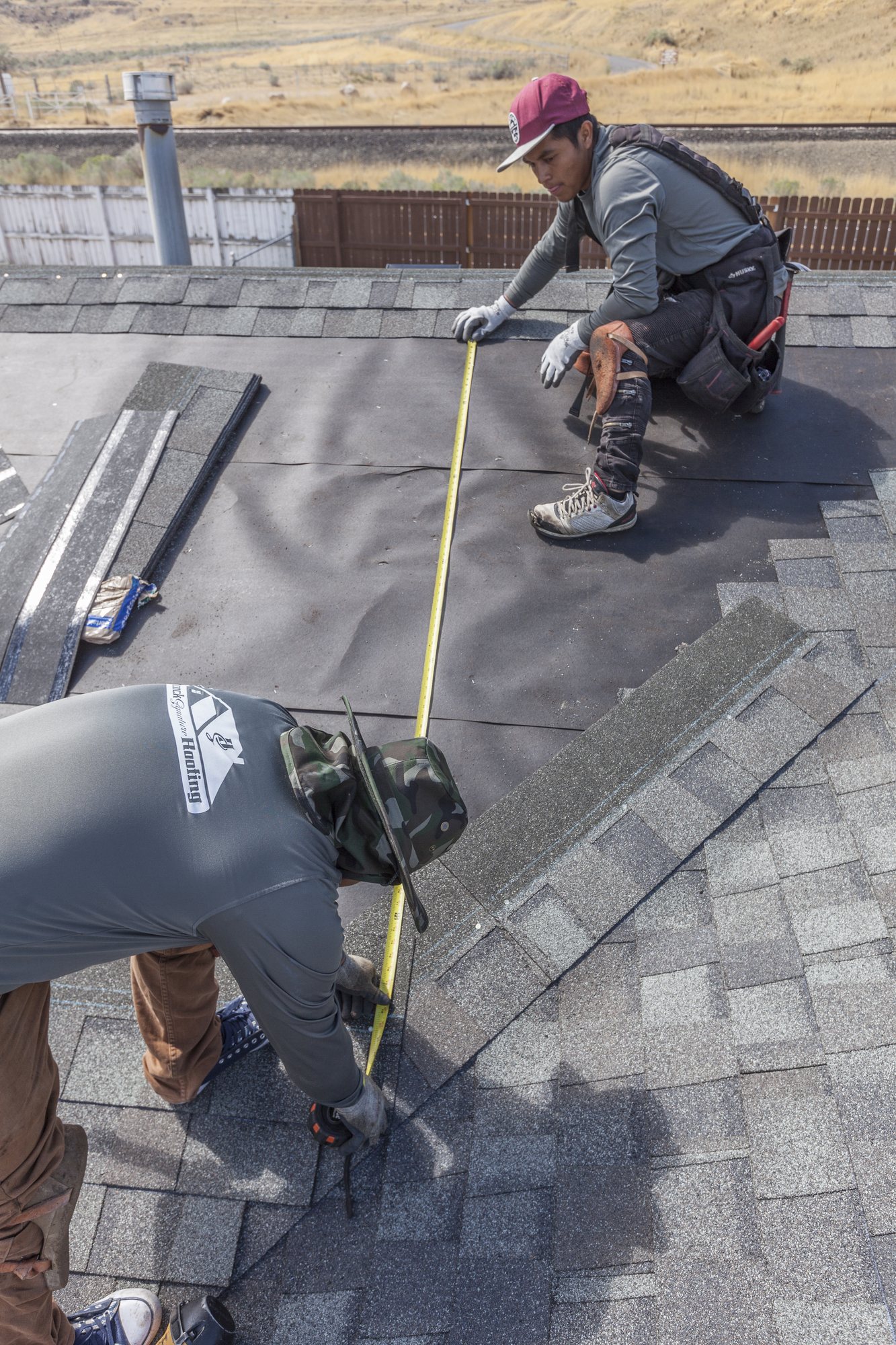
In this photo two of our roofers are stretching a tape measure across black underlayment, with the first gray shingle courses already down along the bottom edge and dry, grassy hills and a board fence out past the eave. That tape matters more than it looks. Before the field goes on, we measure from the eave up to the ridge at both ends of the plane and snap lines between the marks.
Framing on a new house is rarely perfectly square, and a plane that runs a little wider at one end will drag the courses out of line if nobody checks. Measuring at both ends tells us early. We can spread the difference over many courses so nobody standing in the driveway ever sees it, instead of finding out at the ridge and closing the gap with a thin sliver of shingle.
Straight courses are mostly about looks. The measuring also decides where the nail line lands on every row, and that is what holds a shingle down when a wind-driven storm leans on the roof.
The membrane that goes down first
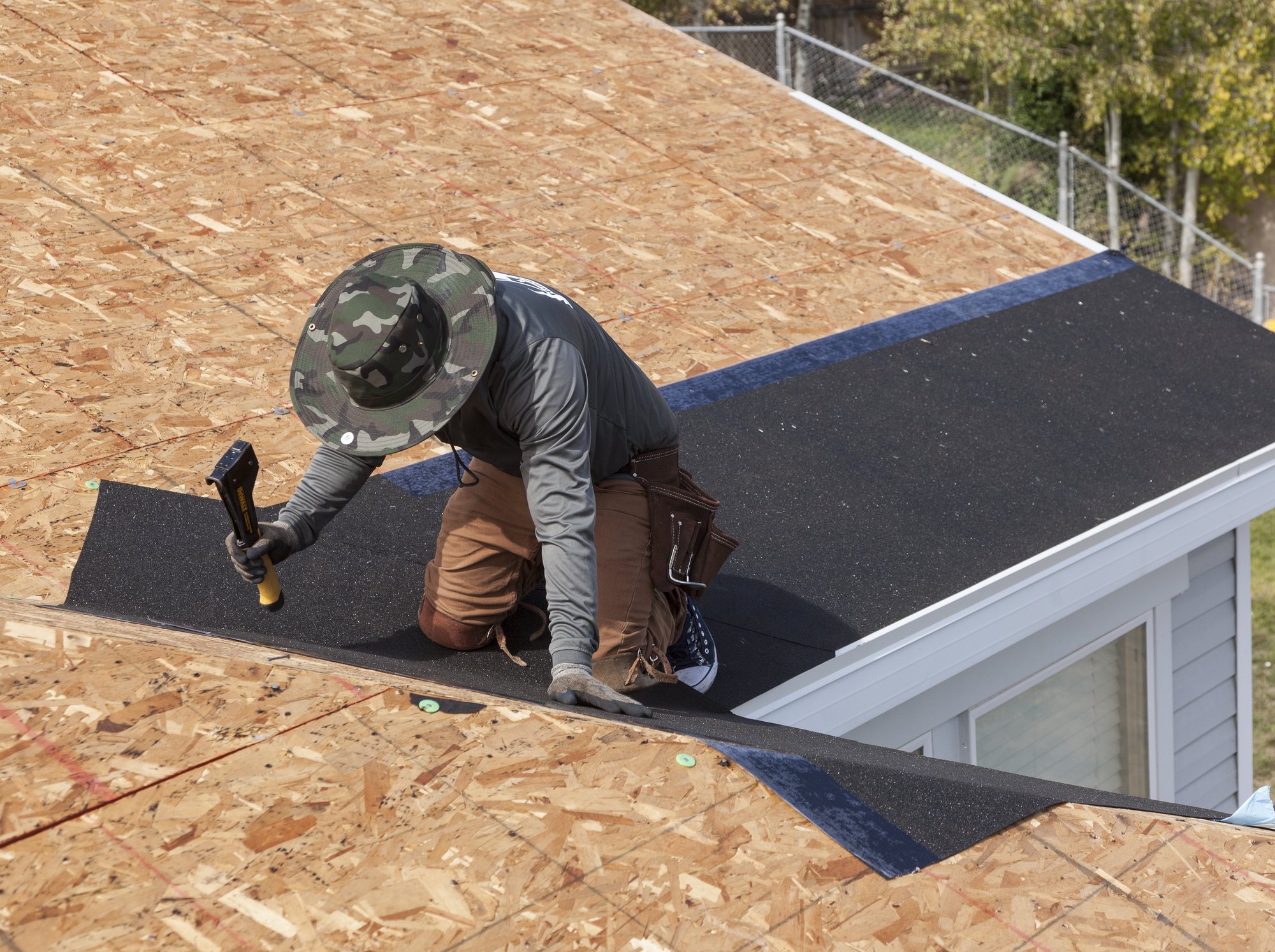
Ice-and-water shield is a sticky, self-sealing sheet that goes on the bare deck before any underlayment. When a nail goes through it, the membrane closes around the shank, which is why we want it anywhere water slows down or collects. On a new roof that means the eaves, every valley, and around every pipe, vent and opening in the deck.
The eave is the spot that gets shorted. Coverage there is measured by how far the membrane runs up the slope past the line of the inside wall, and a house with a deep overhang needs more of it than a builder might plan for. Melt that refreezes at the cold edge of a roof backs up toward that wall line, and the membrane has to be waiting when it does.
A new deck is the easiest time to get this right. Nothing has to come off first, and every seam and opening is out in plain sight.
How a first roof goes on
We walk the decking and look for loose sheets, fasteners sticking up and any edge that does not land on framing.
Ice-and-water shield goes down along the eaves and into every valley, then around each pipe and vent opening.
Synthetic underlayment covers the rest of the deck, lapped so water runs over each seam and never into it.
We measure the planes, snap the layout lines and set a starter course along the eave.
The field shingles go on with six nails in the nail line, course by course up to the ridge.
Pipes, vents and walls get flashed as the courses reach them, never patched in afterward.
Purpose-made hip and ridge cap closes the top of the roof.

Synthetic underlayment, then the field
The second photo shows a roof plane about half covered in new brown blended architectural shingles, with the other half still in printed white synthetic underlayment. Above a lawn and a white vinyl fence, you can see exactly where the shingles stop and where the next courses will pick up.
That white sheet is what we put down on full replacements and new roofs alike. Felt wrinkles when it gets damp, and a wrinkle under a shingle shows through as a wave. Synthetic lies flat, holds together when the wind catches an edge during the install, and gives the crew better footing on a pitched roof. On a new house, where the roof may sit dried in for a few days while other trades work underneath it, that toughness earns its keep.
The brown blend in the photo is an architectural shingle, which is another name for a laminated one, built from two layers bonded together. Our asphalt shingle roofing page for Herriman covers how those are built and how they compare with three-tab.
Fitting into a house that is still going up
A roof on a new house goes on while plenty else is happening. Siding crews want the roof edge finished, and the gutter installer needs the fascia clear. Somebody also has to know where the trailer will sit. We settle where the trailer and the chute go before our crew arrives, with an eye on the slope of the lot, the meter, and whatever else is parked in the driveway that week.
If weather moves the start or a delivery slips, you hear about it from us before you notice an empty driveway. We are a second-generation family company, woman owned, and the person who picks up the phone is part of the family that answers for the roof. If you have a build coming up, send us a note with where things stand and we will come walk the deck with you.
The easiest leak to fix is the one that never gets built into the roof.
After the roof is on
A first roof still needs looking after. The slope facing somewhere between south and west takes the midday and afternoon sun here and wears out ahead of the others, and the dry grit that blows in ahead of summer storms packs into valleys and gutter seams. A visit every so often catches that early, and our Herriman roof maintenance page explains what one involves.
When a storm does open something up, our emergency roof repair page for Herriman covers what happens on that call. If you are reroofing an older house instead of building one, the decking may need work first, and that is on the Herriman roof deck replacement page. Our main new construction roofing page has more on first roofs anywhere we work.
We have been in the trade 27 years. Everything else we do around town is on the Herriman service area page, finished roofs are in the gallery, and you can reach us at (801) 382-8898 or through the contact page.
Where Herriman sits on our map
Herriman sits at the south end of the valley against the Oquirrhs, and it is a regular stop on our Salt Lake County route.
Before the first course goes on
What Herriman homeowners and builders ask about a first roof.
(801) 382-8898Do you roof houses that are still under construction?
Yes. We work from bare decking up and fit our days around the other trades on the house. Tell us where the build stands and we will talk through the timing before anything is scheduled.
Where does ice-and-water shield go on a new roof?
Along the eaves, far enough up the slope to pass the line of the inside wall, plus every valley and every pipe, vent and opening. It seals around the nails that go through it, which is why it belongs where water slows down.
Why synthetic underlayment instead of felt?
Synthetic stays flat when it gets damp, so it does not push waves up through the shingles. It also holds together better if the wind catches it during the install, and it gives the crew surer footing on a slope.
Can the roof sit dried in while other work goes on?
For a short stretch, yes. Once the deck is covered, the house can shed water while siding and other work carries on below. We still want the shingles on soon after, because underlayment is not meant to be the finished roof.
Do you look at the decking before you start?
Every time. Loose sheets, nails that missed the framing, and edges that do not land on anything get fixed before the membrane goes down, because they are much harder to reach once the roof is on.
What should I keep an eye on in the first few years?
The slope that faces south to west, since it takes the most sun here. Granules collecting in the gutter under that slope, or tabs starting to cup, are worth a call.
The rest of the Herriman work
Talk to Hancock
Building in Herriman?
Talk about a new build with us before the framing is finished. We will walk the deck with you and fit our days around everyone else on the job.