
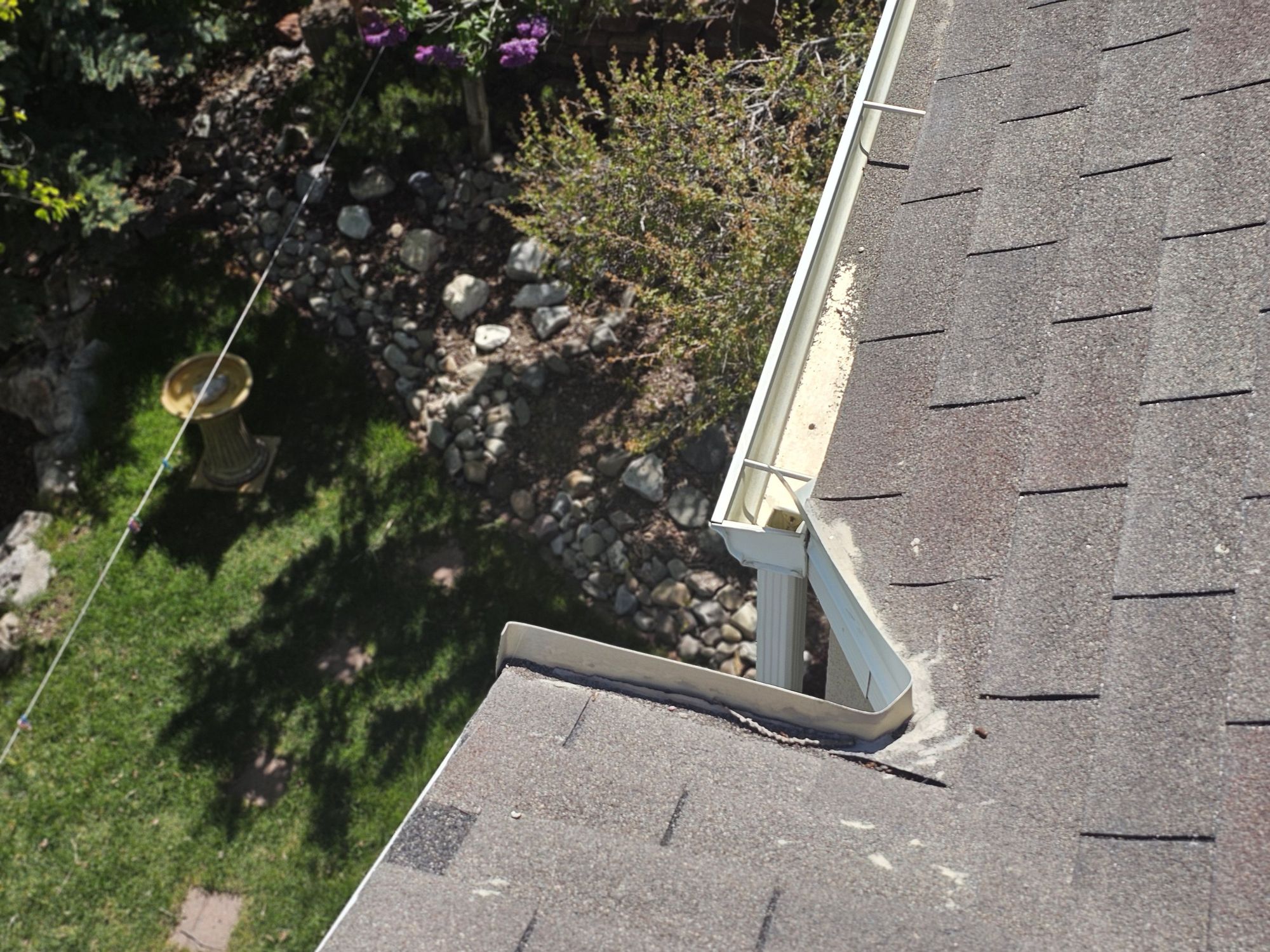
What downspout installation involves
Downspouts sized and routed so the discharge lands where it should, well clear of the house.
Water dumped at the foundation becomes somebody’s basement problem later.
What matters on downspout installation
Sizing follows roof area
Gutter and downspout sizing is arithmetic from the roof area draining into it. Undersized gutter behaves perfectly for most of the year and overflows in exactly the storm where it mattered.
The fascia behind it
Gutters pull away because the board they hang on rotted, usually because the previous gutter overflowed onto it. Hanging new gutter on bad fascia repeats the failure on a delay.
How the system goes together
How long a bead of sealant lasts
Roof sealant is a consumable. In this climate, with the ultraviolet load and the temperature swing, a good product stays flexible for a handful of years and then shrinks, crazes and pulls away from one side of the joint. That is normal and expected behavior for the material.
Design so sealant is a backup
Every joint that matters should shed water by its shape, with the sealant there as a second line. Where sealant is the only thing standing between water and the deck, somebody has signed you up for a maintenance visit every few years.
Ask what is holding a repair together
If the answer is caulk, ask again.
Decking is the part nobody plans for
The sheathing under the roof only gets looked at once every couple of decades, which is when the old roof comes off. Older homes up here might have skip sheathing, plank decking with gaps, or plywood that has been soft over a leak for years. It gets replaced where it is bad, because fasteners do not hold in punky wood and a soft deck telegraphs every wave through a new roof.
It is measured, not guessed
Sheet count gets documented once the roof is open, before anything goes back down.
What we check
- Drip edge present and correctly lapped
- Gutter pitch toward each downspout
- Fascia condition behind the gutter
- Downspout discharge clear of the foundation
How we approach it
Look first
We get on the roof and read what is actually happening before quoting anything.
Say what we find
Photographs and a plain explanation, including when the answer is that you do not need us yet.
Built in sequence
Crews we hire and run, working the right detail in the right order.
Leave it clean
Magnet over the yard, container gone, walked with you.
Fog that never burns off
Valley fog in the cold months sits low and holds. It puts a film of moisture on everything without registering as precipitation, which is why a homeowner can swear it has not rained in three weeks while the roof has been wet the whole time. Organic debris in a valley stays soft and packed instead of drying out and blowing clear.
Where that shows first
Under the bottom course at a wall, and in the seam where a porch roof ties into the main body of the house.
A slide onto a walkway
A loaded slope above a front door or a side path is a safety matter before it is a roofing one. Snow releases in one piece, and a hundred pounds landing on a step is how people get hurt. It also tears at the gutter on the way past and bends the hangers out of the fascia.
Fixing it means changing the geometry
Retention hardware, or a small roof over the entry to break the fall, or moving the path. Something has to change, because the slope will keep doing what slopes do.
Where roofs go wrong
The shortcut we see most
New gutter hung on the old fascia without looking behind it. The rotted board that let the last gutter sag is still there.
What good looks like instead
Fascia inspected and repaired first, gutter sized to the roof area, pitched properly, and downspouts routed clear of the foundation.
Signs worth a look
- Gutter pulling away from the fascia
- Water overflowing at a corner in heavy rain
- Staining down the siding beneath a seam
- Downspout discharging at the foundation
What to expect
Sizing and pitch
Gutter size follows from the roof area draining into it, and pitch determines whether water actually reaches the downspout. Both get calculated rather than eyeballed.
Materials
Seamless aluminium suits most houses here. Heavier gauges and steel make sense where snow slides off a steep pitch directly into the run.
Where the water goes
Downspout discharge matters as much as the gutter. Water dropped at the foundation becomes a basement or a settlement problem years later.
Gutters are part of the roof
A roof and its gutters are one system. The roof sheds the water and the gutter has to carry it away from the building, and when the second half fails the first half gets blamed.
Most gutter problems we are called to started on the roof: a drip edge that was never installed, a valley dumping a concentrated stream into one corner of a run, or shingles overhanging so far the water skips the gutter entirely in heavy rain.
That is why we look at the roof line before quoting gutter work. Replacing a gutter without fixing what killed the last one is a repeat visit with extra steps.
Related work
Gutters covers more than one job, and they are not interchangeable. These are the others in the same family, each on its own page.
Questions we get asked
Not the question you had? Call the shop and ask a person. We would rather talk it through than have you guess from a website.
(801) 382-8898What size gutter do I need?
It follows from the roof area draining into it. An undersized gutter looks fine most of the year and overflows in the storm that actually matters.
Why do gutters pull away from the house?
Almost always because the fascia behind them has rotted. We check and repair that before hanging anything new.
Where should downspouts discharge?
Well clear of the foundation. Water dumped at the base of the house becomes a basement problem later.
How long does a roof replacement take?
Most houses in this valley are a one to two day job once the crew is on site. Steeper pitches, multiple layers to strip and complicated roofs with a lot of valleys take longer, and we tell you which yours is before we start.
What happens if you find bad decking?
We show you. The decking is only visible during a tear-off, so that is when soft sheathing gets found and replaced. We photograph it rather than just add it to a list.
What makes a Utah roof different?
Snow load, ice at the eaves, canyon wind and high-altitude sun, all on the same roof. A crew that learned roofing somewhere mild has to learn it again up here.
Ask about downspout installation
Call (801) 382-8898 or send a note. We will look at the roof and tell you straight what it needs.