
Salt Lake City & surrounding counties
Reading a roof before anyone sells you one
An inspection is how you find out whether a roof needs work, and how much, from somebody who will actually be on it. We go over it from the yard, on the slopes and from the attic, and the photographs are yours whatever the answer turns out to be.
The order we look in
From the yard
Before the ladder goes up we walk the house: a sagging ridge, uneven planes, stained fascia, downspouts emptying against the foundation, and where the roof ties into any additions.
On the slopes
Up top we check the field for granule loss and cracking, every pipe, flue and vent, the valleys, and each place a roof meets a wall or chimney.
In the attic
Inside we read the underside of the deck for stains and soft spots, check insulation depth at the eaves and the vents, and look for any fan blowing damp air into the space.
The write-up
You get photos of everything we saw and a plain account of what we found, written so it makes sense without us standing beside you.
The flat roof tacked onto the back
The first photo is a low gravel-surfaced flat roof littered with loose chunks of asphalt, a blue push broom lying on it, beside a brick house. Low roofs like this sit over additions, carports and back porches on older houses, and they get forgotten because nobody sees them from the street.
A roof that flat sheds water slowly. We look for places where the gravel has washed thin and left the membrane bare, low spots where water sits after rain, and debris blocking the edge or the drain. Loose material like those asphalt chunks holds water against the surface and wears it where it sits.
The seam where that low roof meets the shingled one gets most of our time. Two different systems butt together there, often built years apart, and the flashing between them is frequently a smear of roof cement. On houses with an add-on like this, that seam is one of the first places we suspect when a ceiling stains.


What worn granules tell us
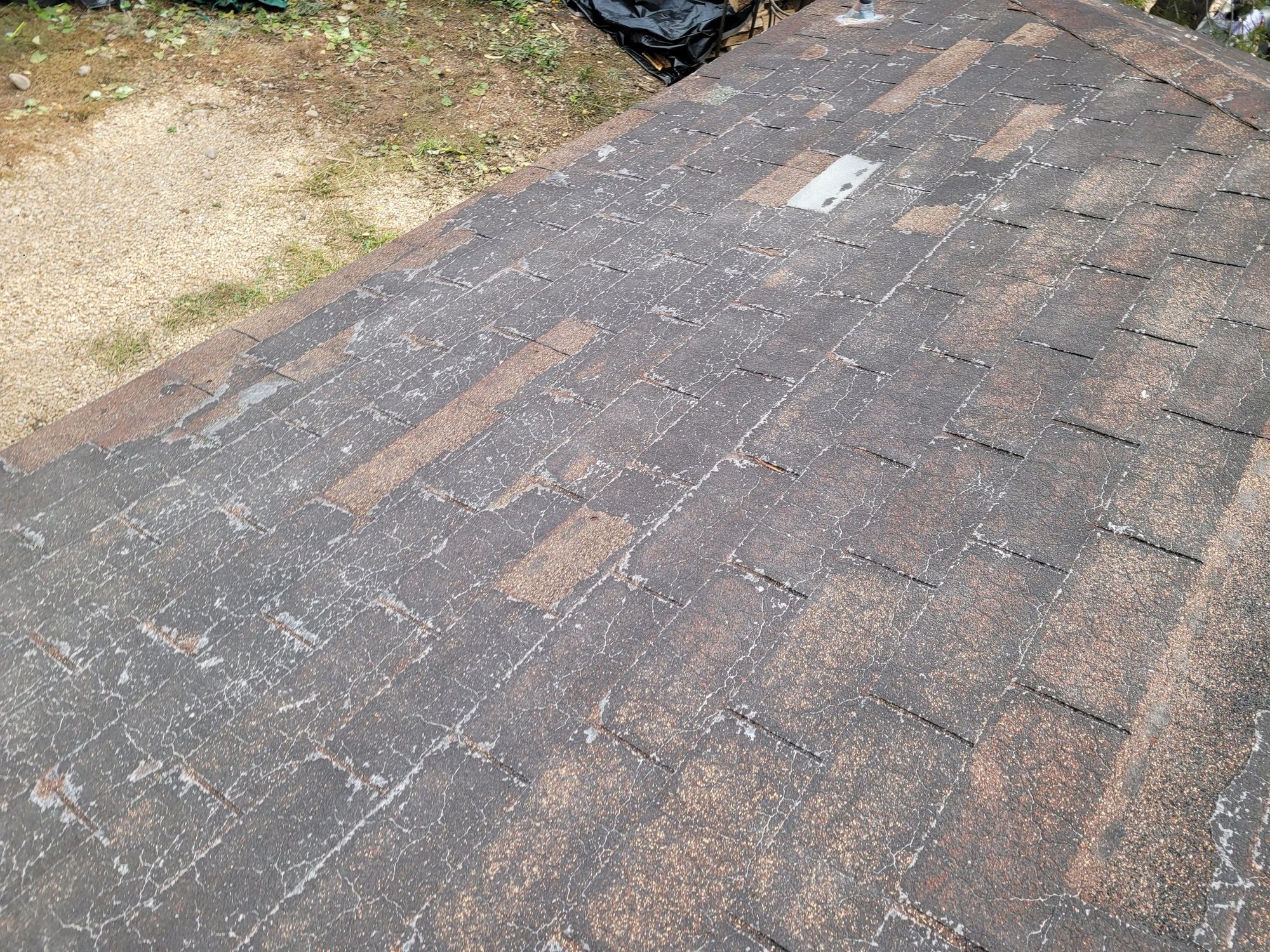
The second photo shows a roof corner where one course has lost its granules: tabs cracked and broken, nail heads showing. Granules are the mineral coating that shields asphalt from sunlight. Once they wash off, the sun works on the asphalt directly, and it dries, shrinks and splits.
That is why granule loss is one of the clearest reads on remaining life. A few thin spots under a downspout that empties onto the roof are ordinary wear. Bare patches across a whole slope, cracks running through the tabs and exposed nail heads mean that slope is near the end, and every exposed nail is a small leak path of its own.
Old patches tell their own story. Each blob of cement or mismatched shingle marks a leak somebody dealt with at some point. We note where they are, whether they are still holding, and whether one spot has been patched more than once, since a repeat patch usually means the cause underneath was never found.
Small parts that fail before the shingles
The rubber boot around each plumbing pipe usually gives out long before the field does, so we look at every one closely. Where a roof meets brick, we check whether the metal was cut into a mortar joint or simply run up the wall and caulked along its top. The caulked version is common, and it is only as good as the last time someone resealed it.
Ventilation gets a look too. When an attic has a ridge vent and box vents together, the two short-circuit each other: air comes in through the closest box vent and leaves through the ridge, and the soffits sit idle. From the street the vents all look fine, and the attic still never gets a fresh breath. We note it, because a stale attic wears a roof out from underneath.
What the report gives you
The report is written in plain language, and it is yours to keep whether or not you hire us for anything. We go over it with you in person or over the phone, whichever suits you.
Sometimes the most useful thing an inspection turns up is a roof that should be left alone.
Good news is a normal result
We say so when a roof is fine. It stays on the house, and you keep the photos along with a short list of small things worth watching. Coming down the ladder with good news is a regular part of this job. The inspection is still worth having, because now you know what you own.
Those small things are what a yearly roof maintenance visit in Roy handles: resealing what has dried out, clearing the valleys and gutters, and looking after that low gravel roof. If the report does find a roof at its end, our Roy roof replacement page walks through the job, and the main roof inspection page covers how we inspect across the valley.
We are a family company in our second generation, woman-owned, and we have spent 27 years in the trade. Read more about the town on our Roy page, look through finished work in the gallery, call (801) 382-8898, or use the contact page to pick a time.
Where Roy sits on our map
Roy is one of the Weber County communities we cover from our Salt Lake City shop, and an inspection there follows the same order as everywhere else.
Will you go into the attic?
Yes, whenever there is access. The underside of the deck shows stains, soft wood and airflow problems you cannot see from the roof, and some leaks turn out to start in there.
Do you check the flat roof over my addition too?
Yes. A low gravel roof over an addition, porch or carport gets the same attention as the main roof, and the joint where the two meet gets more, because leaks often begin there.
How do you judge how much life my roof has left?
From granule loss, cracking, how brittle the shingles have become, the state of the flashing, and what the deck looks like from the attic. Each slope gets its own read, since they wear differently.
What happens if the roof turns out fine?
We tell you it is fine and leave it alone. You still get the photos and notes on anything to keep an eye on, and nobody pushes you toward work you do not need.
Can an inspection help after hail?
Yes. When hail has hit the roof, we photograph the damage on each slope and work with your insurance company so the claim matches what is really on the roof.
The rest of the Roy work
Talk to Hancock
Book a roof walk
Tell us what got you wondering about the roof, a stain, a storm or just its age, and we will set a time to go over it.