
How this list works
Tap a service to see how we do it. Not sure which one? Call (801) 382-8898.
Services
Roofing
- Roof ReplacementA full tear-off and rebuild when patching stops making sense.
- Roof InstallationNew roofs on new builds and additions, set right the first time.
- New Construction RoofingRoofing on new builds, scheduled to the framing.
- Residential RoofingRoofs for houses across the Salt Lake valley and the counties around it.
- Roof Deck RepairReplacing sheathing that has gone soft.
- Roof Deck ReplacementFull re-sheathing when the deck is past repair.
Repairs
- Roof RepairTargeted fixes when the roof has life left in it.
- Roof Leak RepairFinding the actual entry point, not the stain on the ceiling.
- Emergency Roof RepairFast response when water is coming in right now.
- Roof Flashing RepairRebuilding the metal where roofs meet walls and pipes.
- Chimney Flashing RepairThe detail that leaks on more houses than any other.
- Fascia RepairRepairing the board the gutter hangs on.
- Fascia ReplacementFull fascia replacement where the run is gone.
Upkeep
- Roof InspectionA walk of the whole roof with photographs of what we find.
- Roof MaintenanceKeeping a sound roof sound through the Utah year.
- Roof CleaningDebris and growth off, gently.
- Roof Moss RemovalClearing moss off north-facing slopes without wrecking the shingles.
- Roof VentilationIntake and exhaust balanced so the attic breathes.
Shingles
- Asphalt Shingle RoofingThe standard Utah roof, done properly.
- Architectural Shingle RoofingLaminated shingles with real depth and a longer service life.
Metal
- Metal RoofingMetal roofs that shed snow and last decades.
- Standing Seam Metal RoofingConcealed-fastener metal, the quiet premium option.
- Corrugated Metal RoofingExposed-fastener metal for outbuildings and agricultural work.
Tile
- Tile RoofingConcrete and clay tile, set on a roof built to carry it.
- Clay Tile RoofingTraditional clay tile with a long service life.
- Concrete Tile RoofingConcrete tile, heavier and less costly than clay.
Commercial
- Commercial RoofingLow-slope and membrane systems for commercial buildings.
- Flat RoofingLow-slope roofs where water has to be driven off, not shed.
- TPO RoofingHeat-welded white membrane for commercial low-slope.
- EPDM RoofingBlack rubber membrane, proven over decades.
- PVC RoofingWelded PVC where chemical and grease resistance matter.
- Modified Bitumen RoofingTorch and self-adhered modified sheets for low-slope.
- Built-Up RoofingThe traditional layered low-slope roof.
Coatings
- Roof CoatingCoatings that extend a sound low-slope roof.
- Roof WaterproofingMaking assemblies watertight where roofs meet other things.
- Roof SealingSealing penetrations and terminations properly.
Storm
- Storm Damage RoofingRoof work after wind, hail or heavy snow.
- Hail Damage RoofingFinding hail bruising before it turns into leaks.
- Wind Damage RoofingRepairs after Utah’s canyon wind gets under the shingles.
- Insurance Roof RestorationWorking alongside your insurance claim.
- Roof Snow RepairRepairs after snow load has done damage.
- Ice Damage RepairFixing what ice dams leave behind.
Skylights
- Skylight InstallationSkylights set and flashed so they stay dry.
- Skylight RepairFixing the flashing around a skylight that has started to let go.
Gutters
- Gutter InstallationNew gutters sized and hung to carry the roof’s water.
- Gutter ReplacementReplacing gutter that has pulled away or rusted through.
- Gutter RepairFixing sags, leaks and separated seams.
- Downspout InstallationGetting water away from the foundation.
Government
- Government Roof ReplacementFull roof replacement on government buildings, planned around the building’s schedule.
- Government Roof RepairRepairs on government roofs, traced to where the water actually gets in.
- Government Commercial RoofingCommercial roof systems for government facilities, specified for the building.
- Municipality RoofingRoofing for city halls, public works buildings and other municipal facilities.
- Municipal Roof ReplacementFull roof replacement on municipal buildings, sequenced so the building stays in use.
- County Roof ReplacementRoof replacement on county buildings, from courthouses to road shops.
- State Roof ReplacementRoof replacement on state facilities, planned around fixed work windows.
- Federal Roof ReplacementRoof replacement on federal buildings, with the documentation and site conduct the work calls for.
- School Roof ReplacementSchool roof replacement planned around the school calendar.
- Public Building Roof RepairRoof repair for libraries, rec centers and other public buildings.
- Government Emergency Roof RepairEmergency roof repair on government buildings: the water gets stopped first.
- Government Storm Damage RoofingStorm and hail damage on government roofs, documented and repaired.
- Government Metal RoofingMetal roofing on government and public buildings.
- Government TPO RoofingTPO membrane on government flat roofs.
- Government EPDM RoofingEPDM membrane roofing on government buildings.
- Government Flat RoofingFlat and low-slope roofing on government buildings.
- Government Roof CoatingsRoof coatings that add years to sound government roofs.
- Government Roof WaterproofingWaterproofing for government roofs, decks and parapets.
- Government Roof InspectionsRoof inspections for government facilities, with photographs and a written record.
- Government Roof MaintenanceScheduled roof maintenance for government buildings.
- Government Roof RestorationRoof restoration for government roofs with years left in them.
What we find on roofs around here
What we find most often
On houses in this valley the three recurring findings are unbalanced ventilation, flashing that was sealed rather than formed, and decking that went soft under a valley nobody could see into. All three are invisible from the ground and all three are cheap to fix while the roof is already open.
What the age of the house tells us
A house built in the 1950s, one built in the 1980s and one built last year each fail differently. Older stock tends to have thinner decking and original framing that was never sized for a second layer of shingles. Houses from the building booms tend to share a builder’s ventilation shortcut across a whole subdivision. New construction usually fails at a detail somebody rushed to hit a schedule.
The year a Utah roof works through
Southwest exposure ages fastest
If you only had time to look at one slope on a house here, look at the one facing between south and west. It takes the high sun through the middle of the day and it takes the afternoon heat, so the binder in the asphalt gives up there first. Cupped tabs, bare patches of mat, and a granule line in the gutter under that slope alone.
A roof can be two ages
And knowing that keeps a repair from turning into a replacement it did not need to be.
Wet leaves against a wall line
Where a lower roof runs into a two-story wall, leaves and needles collect in that inside corner and stay. The pile holds water directly against the bottom of the siding and the top of the step flashing, which is the one place on a roof where a little standing moisture does the most damage.
Clear the corner, check the kickout
A kickout flashing at the bottom of that run throws the water into the gutter instead of behind the siding. Plenty of houses up here were built without one.
What we check
- Bundle count against measured area
- Color lot consistency across bundles
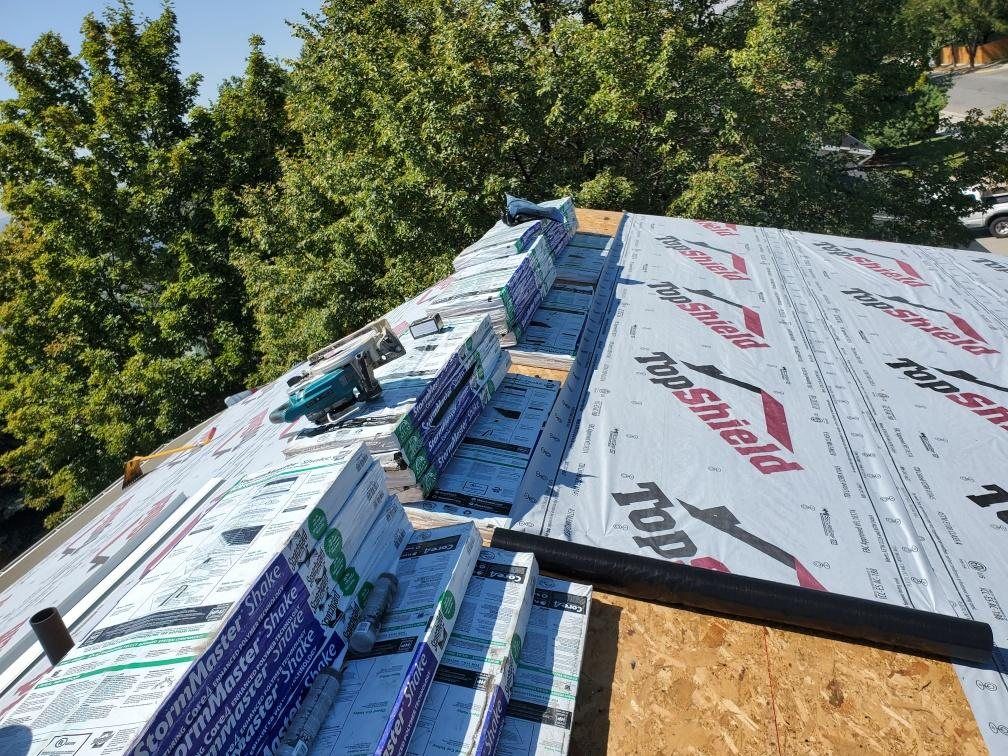
- Staging weight distributed across the roof
- Manufacturer pattern for the chosen product
Where roofs go wrong
The shortcut we see most
Shingles laid over a second existing layer to save a tear-off. It hides the decking, adds weight the framing was not sized for, and guarantees that the next roof is a bigger job than this one should have been.
What good looks like instead
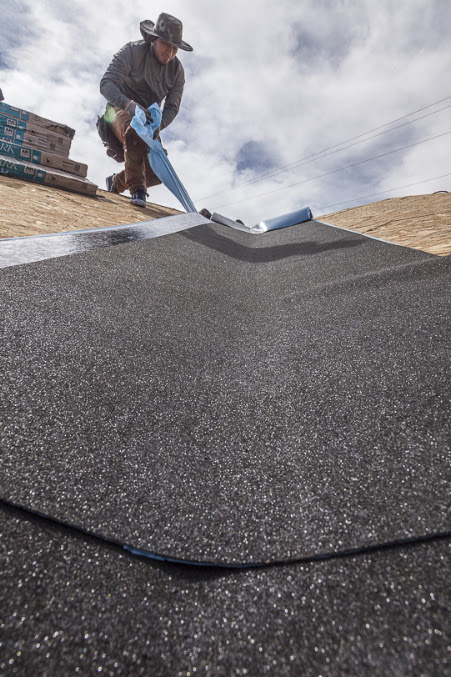
Down to the deck, sheathing repaired where it is soft, ice barrier where the eaves need it, and the flashing formed rather than sealed.
Signs worth a look
- Granules collecting in the gutters or at the downspout discharge
- Tabs lifting or curling along a rake or ridge
- Shingles that look bare or patchy from the street
- Staining or daylight visible in the attic
From recent jobs

What to expect
How long it takes
Most houses in this valley are one to two days on site once the crew arrives. What stretches it is pitch, the number of existing layers to strip, and how many valleys and penetrations the roof has. We tell you which of those apply to yours before the schedule is set.
What happens to your yard
Tarps go down over landscaping and the drive before anything comes off the roof. Material is staged where it will not crack concrete. At the end of every day the site gets cleared, and when the job is finished a magnet goes over the whole yard for nails.
What you should expect from us
A walk of the roof before anything is quoted, photographs of what we found, a plain explanation of what needs doing and what does not, and Hancock answering for the job through to the finish.
Why Hancock
Built for the house itself
We do not run one spec on every roof and call it standardization. A shaded bench home under heavy trees needs different attention than an exposed lot that catches every gust off the mountain. Pitch, exposure, elevation and what is already up there all change the answer.
Which is why we look first
Nobody can tell you what a roof needs from the street or over the phone.
Explaining before deciding
We would rather spend twenty minutes on a driveway explaining what a valley does than have you approve something you do not understand. A homeowner who knows why the ice barrier runs four feet past the wall makes better decisions about their own house, including sometimes deciding against what we suggested.
Take the information elsewhere
If you want another opinion, get one. A roof is a large thing to buy on one conversation and we are comfortable being compared.
No expiring pricing
The number holds while you think.
Questions we get asked
Not the question you had? Call the shop and ask a person. We would rather talk it through than have you guess from a website.
(801) 382-8898How long does a roof replacement take?
Most houses in this valley are a one to two day job once the crew is on site. Steeper pitches, multiple layers to strip and complicated roofs with a lot of valleys take longer, and we tell you which yours is before we start.
Do you work through the winter?
Yes, with judgment. Shingles need to seal, and in genuine cold that takes longer or needs hand sealing. Emergency work happens whenever it has to. Full replacements get scheduled around the weather rather than forced into it.
Will you tell me if I do not need a new roof?
Yes. Plenty of what we look at turns out to be a repair, and we say so. A roof with years left in it gets left alone, and you get the photographs either way.
What happens if you find bad decking?
We show you. The decking is only visible during a tear-off, so that is when soft sheathing gets found and replaced. We photograph it rather than just add it to a list.
How do I know when a roof is getting close?
Granules collecting in the gutters, tabs lifting or curling at the edges, shingles that look bare in patches, and daylight or staining in the attic. Any of those is worth a look.