
Roofing in the Washington Terrace area
Honest roof work in Washington Terrace, from a family company in its second generation.
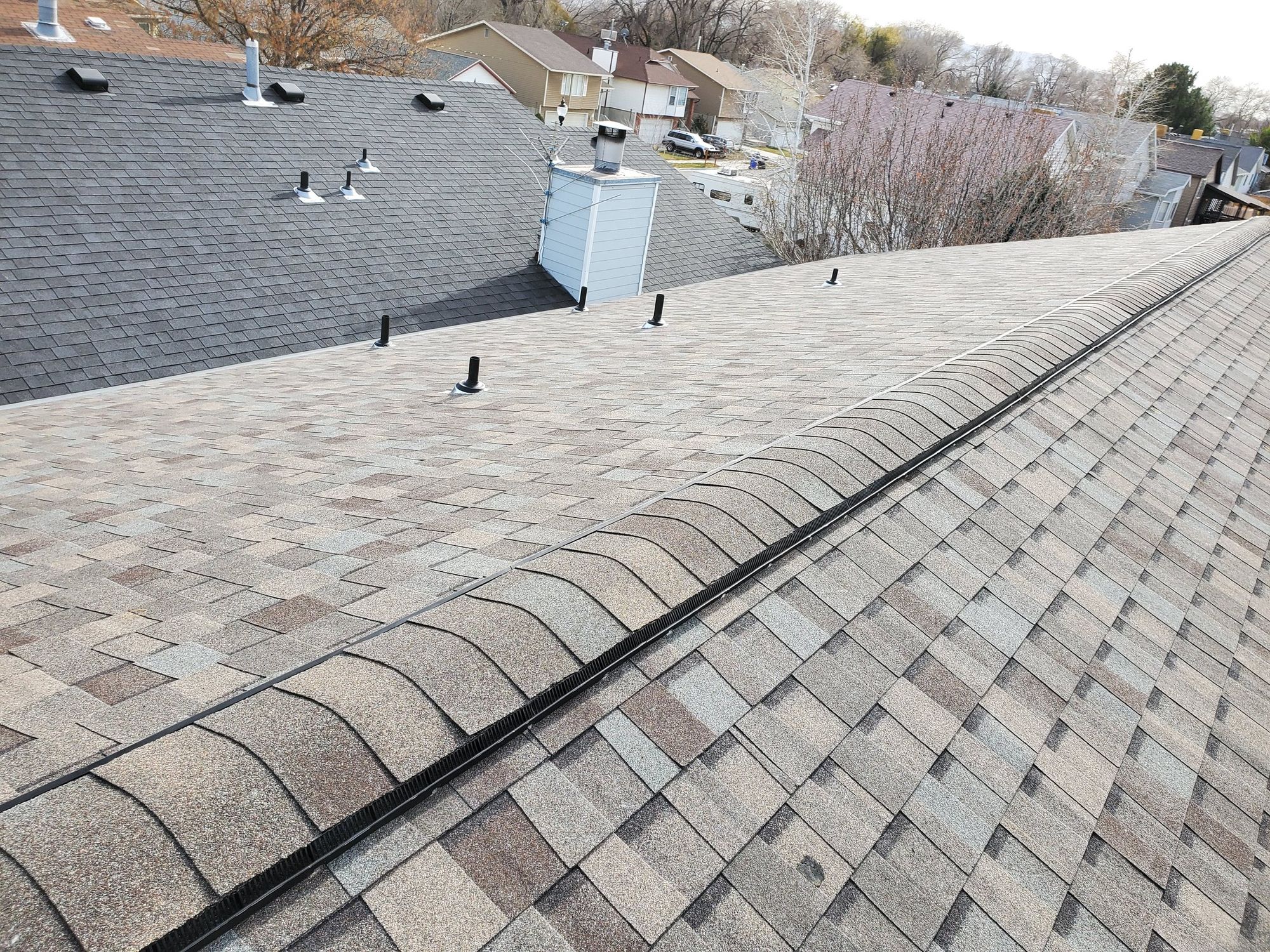
Why Washington Terrace roofs fail where they fail
Wind-driven rain is the failure nobody plans for in Washington Terrace. Water that would run harmlessly down a slope gets pushed sideways under a shingle lap or behind a piece of flashing, and it shows up on a ceiling two rooms from where it entered.
We have worked enough of Weber County to know which builders put up which subdivisions and where they cut the same corner twice. That is worth more on a roof than any brochure.

The weather a Washington Terrace roof works against
Microclimate changes street to street
Two homes ten minutes apart can be on completely different roofs in terms of what they endure. Elevation, whether the lot sits in a canyon draw, how much tree cover is overhead, and which direction the main slope faces all change the answer. A roof age that is fine on a shaded north-facing bench home is well past done on an exposed south-facing lot at a higher elevation.
Why we look before we talk
That is the reason we get on a roof before saying anything about it.
Sun at this elevation
The thing that quietly ages a roof around here is not a storm. It is a mile of thin air between the shingle and the sun, with more clear days than most of the country gets. Ultraviolet breaks down the asphalt binder, the mat loses flexibility, granules let go, and a south or west slope wears out years ahead of the north side of the same house.
Uneven wear is normal
On plenty of homes up here the south face is done and the north face has life left. That is not a defect, it is exposure, and it is worth knowing before anybody talks about replacing everything.
Ogden’s older housing stock has steeper pitches and more complicated rooflines than most of the valley, which means more valleys, more flashing, and more places for a rushed job to show.
What we find on roofs around Washington Terrace
Open valley or closed
A closed valley weaves or cuts the shingles across the intersection. An open valley runs metal down the center with the shingles cut back off it. Around here, with the volume of water and ice a valley concentrates, open metal over ice-and-water shield is the detail we reach for on most homes. It moves debris out instead of catching it, and it gives ice a smooth surface instead of a shingle edge to grab.
The W profile
A center rib keeps water from one plane washing up under the shingles on the other.
Intake and exhaust have to match
Attic ventilation is a balance, and most of the failures we find are unbalanced. Ridge vent with the soffit stuffed full of insulation is exhaust with no intake, so the attic pulls its air from the house instead and drags moisture up with it.
How it shows up
Frost on the sheathing in January, a hot attic in July, curling shingles on the upper courses, and an ice dam at the eave that nobody can explain.
Baffles are cheap
Keeping the insulation off the soffit with a proper chute fixes more roofs than most people would believe.
What we do around Washington Terrace
Every service is its own page. These are the ones Washington Terrace asks for most.
Roofing
Full replacements and new roofs on Washington Terrace homes, deck up.
Repairs
Leaks and failed details, which is most of what Washington Terrace calls about.
Upkeep
Inspections, cleaning and sealing before a small thing gets expensive.
Shingles
Architectural laminate, the field material on most of this valley.
Metal
Standing seam and corrugated, common on canyon-side snow load.
Tile
Clay and concrete tile, and the flashing work they need.
Commercial
Membrane systems for flat and low-slope buildings around Washington Terrace.
Coatings
Restoration coatings when a commercial roof has life left.
Storm
Hail, wind and the insurance paperwork that follows.
Skylights
Installation and the curb-flashing repairs skylights usually need.
Gutters
Gutters, downspouts and fascia, which are part of the roof.
Government
Schools, city, county, state and federal buildings. Every government service is on the government roofing page.
How the job runs
Photographs at every stage
We shoot the roof before anything comes off, we shoot the bare deck with anything we are replacing marked, we shoot the ice barrier and the metal before the shingles cover them, and we shoot the finished roof. The photos that matter most are the middle ones, because those are of the parts nobody can see once the job is done.
You get the whole set
Not a curated few. If something in there raises a question, ask it.
It keeps everybody honest
Including us.
Winter work is possible, carefully
Roofing in the cold half of the year is normal here and it has rules. Shingles get warmed and handled gently because cold asphalt cracks, the adhesive strips get hand-sealed since there is no sun to set them, and snow comes off the work area before anything else happens. Small repairs happen year round. A full tear-off waits for a window.
We will tell you to wait
If a roof can be stabilized and properly replaced in April, that is usually the better roof.

Work from around the valley



A person picks up the phone
No menu, no ticket number, no chat window that takes your address and promises somebody will reach out. You call and one of us answers, or calls you back. It sounds like a small thing until you have spent a week trying to get a roofer to return a message while there is a bucket in your hallway.
And it is somebody who roofs
The person on the phone has been on a roof, so you can describe what you are seeing and get a real answer rather than a scheduling slot.
Explaining before deciding
We would rather spend twenty minutes on a driveway explaining what a valley does than have you approve something you do not understand. A homeowner who knows why the ice barrier runs four feet past the wall makes better decisions about their own house, including sometimes deciding against what we suggested.
Take the information elsewhere
If you want another opinion, get one. A roof is a large thing to buy on one conversation and we are comfortable being compared.
No expiring pricing
The number holds while you think.
Questions we get asked
Not the question you had? Call the shop and ask a person. We would rather talk it through than have you guess from a website.
(801) 382-8898Do you actually work in Washington Terrace?
Yes, and often. Washington Terrace is part of our regular service area, so it is ground we know well.
How fast can you get to Washington Terrace after a storm?
We make the roof safe first, then come back and do the repair properly when conditions allow.
How long does a roof replacement take?
Most houses in this valley are a one to two day job once the crew is on site. Steeper pitches, multiple layers to strip and complicated roofs with a lot of valleys take longer, and we tell you which yours is before we start.
Do you handle the insurance side?
On hail-damaged roofs, we work with your insurance to get the roof covered. We document the damage thoroughly with photographs, so the claim reflects what is actually on the roof.
What happens if you find bad decking?
We show you. The decking is only visible during a tear-off, so that is when soft sheathing gets found and replaced. We photograph it rather than just add it to a list.
Do you work through the winter?
Yes, with judgment. Shingles need to seal, and in genuine cold that takes longer or needs hand sealing. Emergency work happens whenever it has to. Full replacements get scheduled around the weather rather than forced into it.
Where Washington Terrace sits on our map
Weber County work, Washington Terrace included, is a normal week for this crew rather than a trip.
Roof work in Washington Terrace
Call (801) 382-8898. If it turns out to be a repair we will say so and do the repair.