
November 2026
The small round pieces
Walk around almost any house in North Salt Lake and look up. Between the shingles you will see a handful of pipes poking through: plumbing vents, a furnace or water heater flue, maybe a bath fan cap. Each one is a hole in the roof, and each one is sealed by a small round flashing that gets less attention than anything else up there.
Those little flashings are where a lot of leaks begin, often years before the shingles around them are worn out. When someone calls our North Salt Lake flashing repair crew about a drip over a bathroom or a stain near the furnace closet, a pipe penetration is one of the first places we climb to.
Each type fails its own way, so it helps to know which one you have.
Rubber pipe boots
The plumbing vents on most houses are sealed with a boot: a metal or plastic base that slides under the shingles above it, with a rubber collar that hugs the pipe. The base handles the water running down the roof. The rubber collar keeps water from running down the outside of the pipe and into the hole.
That rubber sits in full sun all day, every day. Up here, with strong sun at elevation and big swings between afternoon and night, it dries out, hardens and cracks, usually starting on the side that faces the sun. Once it splits, water runs down the pipe on every storm and every snowmelt. The roof around it can look perfect.
From the ground, a cracked boot is hard to spot. From a ladder or the roof, you can usually see the gap between the rubber and the pipe, or a collar that has curled up and away. Squirrels and birds chew on them too.
Flue collars
A furnace or water heater flue is a metal pipe that gets hot, so it cannot wear a rubber boot. It comes through a metal flashing with a raised cone around the pipe, and on top of that cone sits a storm collar: a ring clamped around the flue a little above the flashing. The collar is a small umbrella. Water running down the hot pipe hits the collar and gets thrown out onto the cone instead of dropping straight into the gap.
Storm collars slide. A clamp loosens with years of heating and cooling, the collar drops down the pipe, and the gap it was covering opens up. Sometimes the collar is missing altogether, lost in a wind or never put on. And the cone itself can be bent or cracked where somebody stepped on it.
The sealant ring
Almost every flue collar and plenty of boots have a bead of sealant run around them, where the collar meets the pipe or where the flashing meets the shingles. That bead is a backup, and in this climate it has a short life. The sun bakes it, the cold shrinks it, and after a while it cracks and lets go along one edge while still looking like it is doing its job.
The common mistake is treating that bead as the seal. If the only thing keeping water out of a flue penetration is caulk, the leak is already on its way. A flashing that is lapped and shaped right sheds water with no sealant at all, and the bead only catches what the wind pushes sideways.
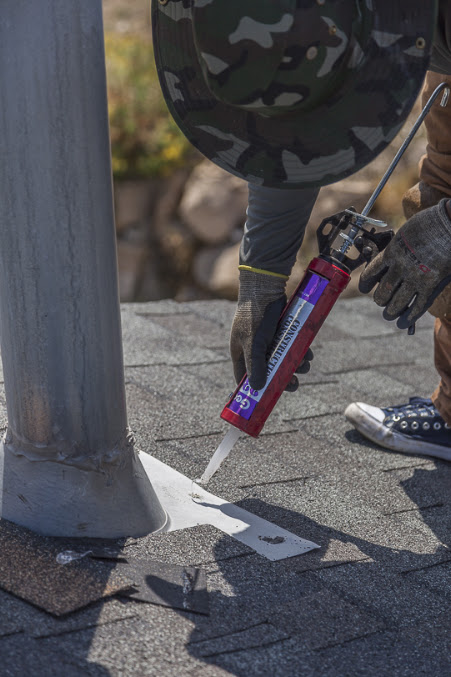
We still use sealant on these. It goes on the nail heads under the shingles, on the collar seam, and at the top of the cone, from a tube rated for roofing and for the heat a flue gives off. It is there to back up the metal, and we tell you plainly that it will need a look in a few winters.
Why they go before the rest of the roof
A shingle field is a big, simple surface that sheds water by gravity. A penetration interrupts that, and the flashing around it has to get water to flow around a pipe that sticks up into its path. On top of that, the boot rubber and the sealant age far faster than shingles do, and the pipes themselves move: plumbing vents shift as a house settles, and a flue grows and shrinks every time the furnace runs.
Snow makes it worse here. Snow piles on the uphill side of a pipe, melts against the warm flue in the afternoon, and refreezes against the collar overnight. A small crack that would drip a little in a summer storm can take on water for hours in a slow February thaw.
How we replace one
A failed pipe flashing almost never needs a new roof around it. It needs the flashing swapped out properly, and that is mostly about working with the shingles instead of on top of them.
Lift the courses above
We break the seal on the shingles above the pipe and lift them carefully, without creasing, so the nails holding the old flashing can come out. On a cold day that means warming the tabs first. Brittle shingles crack if you rush them.
Set the new flashing in the right lap
The new boot or flue flashing slides in so its upper half sits under the shingles above and its lower half lies on top of the shingles below. That lap is the whole trick. Water coming down the roof runs onto the flashing and off its lower edge without ever finding the hole.
Fasten it where water does not run
Nails go in the top corners, under the shingles that cover them, never through the exposed part of the base. On a flue we fit a new storm collar, clamp it snug, and set it so it overhangs the cone.
Reseal the shingles and check the attic
The lifted shingles get resealed so the wind cannot catch them. Then we go inside, look at the deck around the pipe for soft wood or old staining, and photograph both sides so you can see what was done.
If the shingles around a pipe are too brittle to lift without breaking, we tell you that up front and replace a small patch of them along with the flashing. Our roof flashing repair page covers the bigger pieces too: step flashing at walls, chimneys and skylight curbs.
What you can check from the ground
You will not see a cracked boot from the driveway, but you can see some things. Binoculars help. Look for a storm collar sitting low on the flue or missing altogether, a pipe that leans, a boot base that looks lifted or rusty, and shingles around a pipe that are darker or patched with a smear of black. Inside, look at the ceiling under each pipe and the top of the furnace closet.
A stain does not always sit right under the pipe that caused it. Water can run along a rafter for a few feet before it drops, so we trace it from the attic side instead of guessing from the ceiling.
When it makes sense to do them all
If one boot has cracked, the others on the same roof are the same age and have seen the same sun. When we are already up there with the shingles lifted, replacing every boot at once is usually the sensible call, and it saves you a second visit for the next one to fail. Same with flue collars. If the roof itself is close to the end, we would rather point that out than replace flashings that will come off with the tear-off.
A drip near a pipe? (801) 382-8898 gets you the shop, and the contact page works if you would rather send photos of the stain first.
Pipe flashing questions
How do I know if it is the boot or the shingles leaking?
Location helps. A stain that shows up within a few feet of a pipe, or after a slow snowmelt more than a hard rain, points at the flashing. We confirm it from the attic, where a wet ring around the pipe hole tells the story.
Can a cracked boot be sealed instead of replaced?
A boot can be wrapped or slipped with a rubber sleeve as a stopgap, and in the middle of winter we sometimes do that to stop the water. It is a temporary fix. A new boot, lapped in properly, is the repair.
Do metal boots last longer than rubber ones?
Some do. There are boots with a lead or all-metal collar that gets dressed down over the pipe, and with no rubber to crack, they hold up well in strong sun. They take a little more work to fit and suit some pipes better than others.
Why is my flue collar rusty?
Usually the collar or cone is plain steel that has lost its coating, or condensation from the flue gas has been running down the inside. Surface rust on a collar is mostly cosmetic. Rust holes in the cone are a leak waiting for snow.
Should pipe flashings be replaced when the roof is?
Always. Every boot and flue flashing comes off with the old shingles and new ones go on. Reusing an old boot on a new roof means the newest roof on the street has the oldest rubber on it.
Small parts, big drips
A pipe boot is about the smallest part on a roof, and it sends us up a ladder as often as anything. Catching a cracked one in the fall means the winter thaw runs past it instead of into your ceiling. We have 27 years in the trade, and we are happy to look at yours.
Call (801) 382-8898 or send a message through the contact page, and tell us which pipe the stain sits under.
Talk to Hancock
Talk to Hancock
Call (801) 382-8898 or send a note and we will get on the roof and tell you what it needs.