
Salt Lake City & surrounding counties
Architectural shingles, laid to hold in the wind
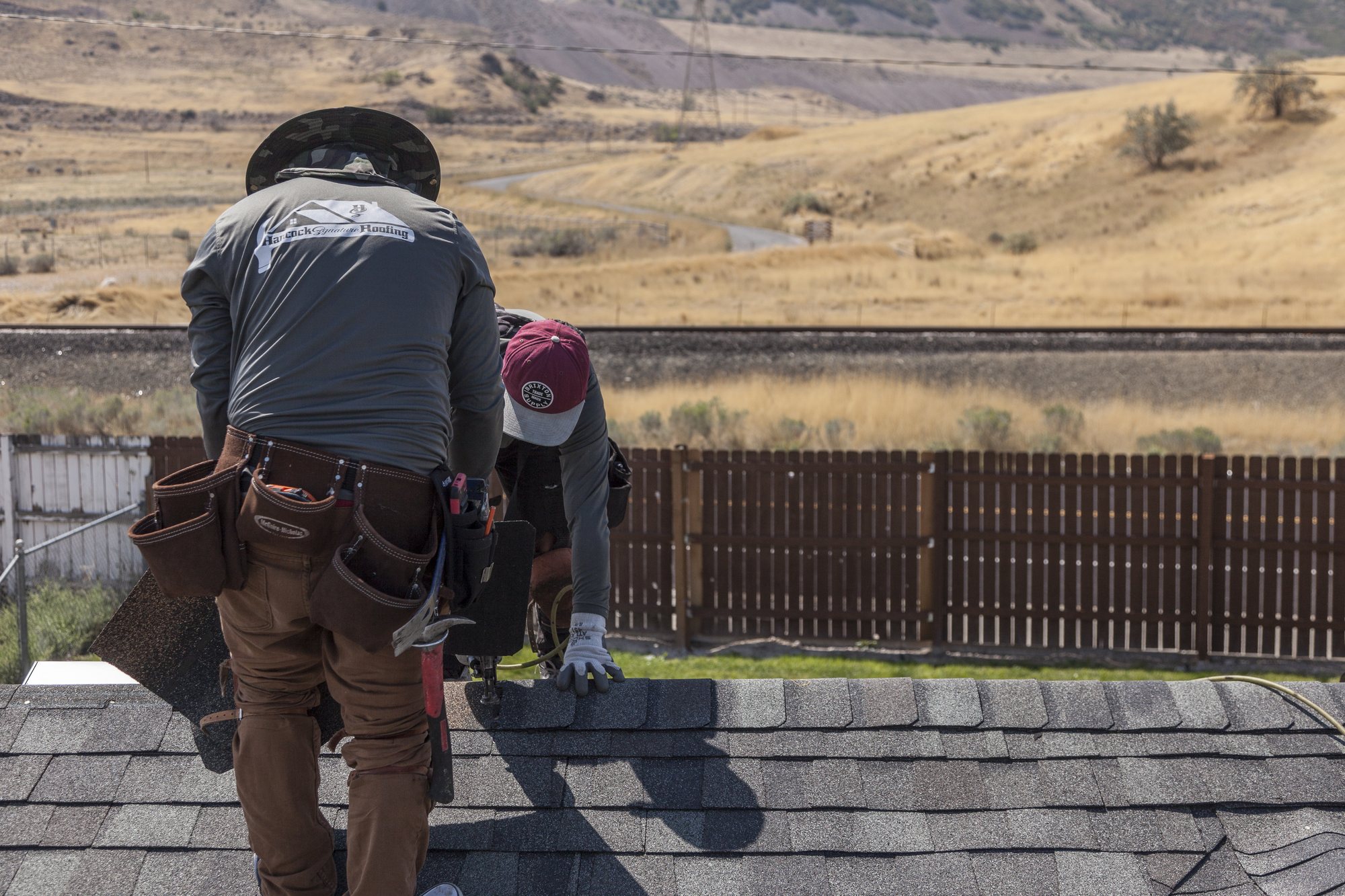
Laminated shingle covers most of the homes we roof around North Salt Lake. How long one lasts comes down to things nobody sees from the driveway, mostly where the nails go and how the edges get started.
Thicker shingle, same basic job
An architectural shingle is two layers bonded together, so it is heavier and throws a deeper shadow line than the old flat three-tab. That is most of the difference worth knowing, and our main architectural shingle roofing page goes further if you want it.
What the thicker shingle does not change is the job underneath it. It still sheds water only as well as it was laid, and it still holds against wind only where it was fastened. So this page is mostly about how we lay it, because that is the part you are actually hiring.
The nail line decides what the wind can lift
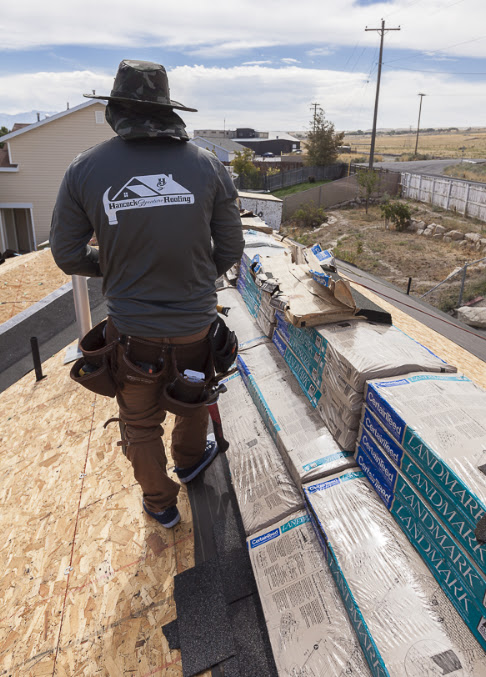
In this photo one of our guys in a Hancock shirt is standing on fresh OSB, with the bundles staged in rows beside him before a single course has gone down. Staging like that keeps the weight spread across the deck and keeps the crew from walking on finished shingle to fetch more.
Every laminated shingle has a narrow band across it where the two layers overlap. Nails that land in that band go through both layers and into the deck, and that is the fastening the manufacturer tested when they put a wind rating on the package. Nails set above it hold only one layer, and they miss the top of the shingle underneath, which then has less holding it down than anyone thinks.
Count matters as much as height. Each wrapper calls for a number of nails per shingle, and that number usually goes up on a steep slope or where the wind runs hard. Around North Salt Lake it runs hard. We nail to the higher count and set the gun so each head sits flush, neither proud nor punched through.
How a laminated roof goes on, eave to ridge
Drip edge
Metal goes along the eaves first so water leaving the roof clears the fascia.
Ice barrier
A self-sealing membrane runs up from the eaves and through the valleys, where melt backs up on a cold night.
Underlayment
The rest of the deck gets covered, each row lapped over the one below.
Starter
A starter course goes down along the eaves and up the rakes before any field shingle.
Field
Courses run up the roof, nailed in the band and offset so no seams line up.
Hips and ridge
Preformed cap pieces close the top of the roof.
Starter at the eaves and up the rakes
The first course on a roof has nothing under it to seal to. A starter strip fixes that. It is a strip of shingle with a factory sealant line set right at the edge, so the bottom of the first full course has something to bond to along its whole length.
Skip it, or cut it from field shingles with the sealant at the wrong end, and the bottom course sits loose. That loose lower edge is the first thing a gust gets under. Once it lifts, the course above it has lost its footing too.
Rakes get the same treatment, and they are the edge people forget. The sloped sides of a gable take wind from the side, and a shingle that ends there without a sealed starter under it flaps until it tears. We run starter up every rake and let the shingle overhang the metal edge just enough to throw water clear.
Most of a shingle roof’s strength sits along its edges, where nobody looks.
Hip and ridge cap, the last row the wind gets
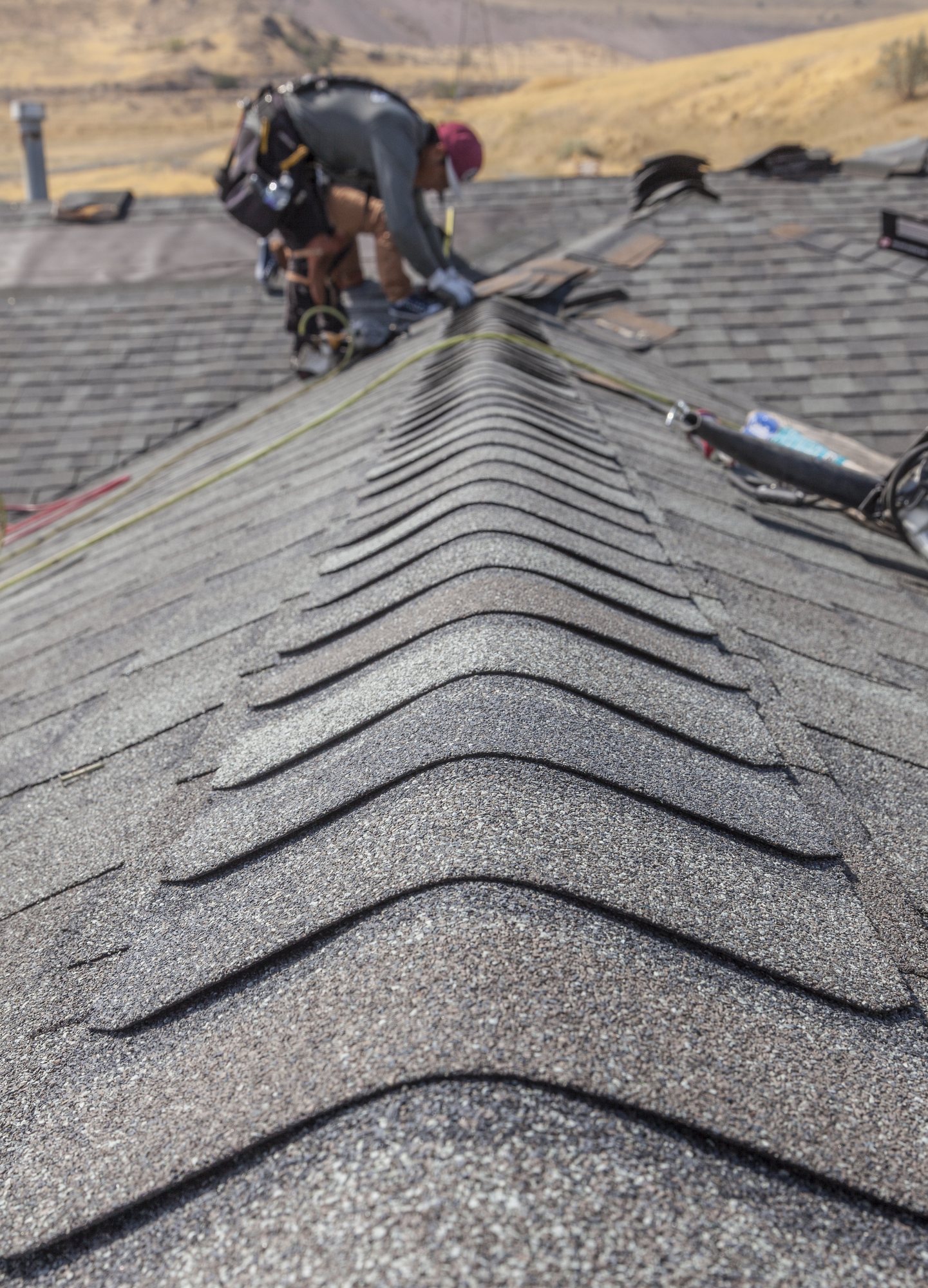
The second photo is a ridge freshly capped, with one of the crew finishing the far end. Cap pieces are thicker, preformed shingles made to bend over a peak without cracking. Folding a field shingle over the ridge saves a few minutes and leaves a crease that splits in the first cold snap.
The ridge and hips stand higher than anything else on the house, so they take the wind straight on. We start each run at the end away from where the weather usually comes from, so every lap faces downwind and the gust slides over it instead of catching the edge. Where the ridge carries a vent slot, the cap goes over the vent and gets nailed long enough to reach solid wood through it. How that slot pulls air is on our North Salt Lake roof ventilation page.
Picking a color people will see from above
On a hillside, the roof is the first thing the house up the street sees. A few things worth weighing before you pick.
What our warranty covers, in plain words
A full replacement from us carries a 10-year workmanship warranty. Workmanship means the work itself. How the shingles were nailed, how the flashing was set at chimneys, pipes and walls. If a shingle comes loose because it was fastened wrong, that is on us and we come fix it.
The shingle itself is covered separately by its maker, and that coverage follows their terms, not ours. Call us first, we come look, and we tell you plainly which it is.
We have 27 years in the trade, 8 of them under the Hancock Signature name. We are a second-generation, woman-owned family crew in Salt Lake City, just over the line from North Salt Lake. Wind that gets under a roof is covered on our wind damage page for North Salt Lake, and the rest of our work around town is on the North Salt Lake service area page. Finished roofs are in the gallery. Call (801) 382-8898 or reach us through the contact page and we will come walk your roof.
Where North Salt Lake sits on our map
North Salt Lake is right on our north edge, a short drive out of Salt Lake City.
Laminated shingle questions
What North Salt Lake homeowners ask before a new shingle roof goes on.
(801) 382-8898Is architectural shingle worth it over three-tab?
For most homes here, yes. It is heavier, it carries a higher wind rating when it is nailed the way the maker asks, and it looks better from the street.
Can you put new shingles over my old ones?
We would rather not. Stripping to the deck lets us find soft wood, replace it, and lay the starter and ice barrier properly. A second layer hides problems and adds weight the framing has to carry through a snowy winter.
Why does nail placement matter so much?
Because the wind rating printed on the bundle assumes nails in the narrow band where the shingle’s layers overlap. Nails set high hold only one layer, and that is how shingles start lifting in a gust.
Do I need new ridge vents with a new shingle roof?
Not always. We look at the attic from the hatch and check whether the roof is getting air in at the eaves and out at the top. If it is not, a new roof is the easiest time to fix that.
What does your warranty cover on a shingle roof?
A full replacement carries our 10-year workmanship warranty, which covers how we installed it. The shingle maker covers the material under its own terms. Either way, call us first and we will come look.
The rest of the North Salt Lake work
Talk to Hancock
Thinking about a laminated roof?
We will walk the roof, look at the deck from the attic, and tell you what it needs before anything gets quoted. Plan a replacement with us when you are ready.