
Farmington, Utah
Ice Damage Repair around Farmington
Fixing what ice dams leave behind.
Ice Damage Repair for Farmington homes and buildings
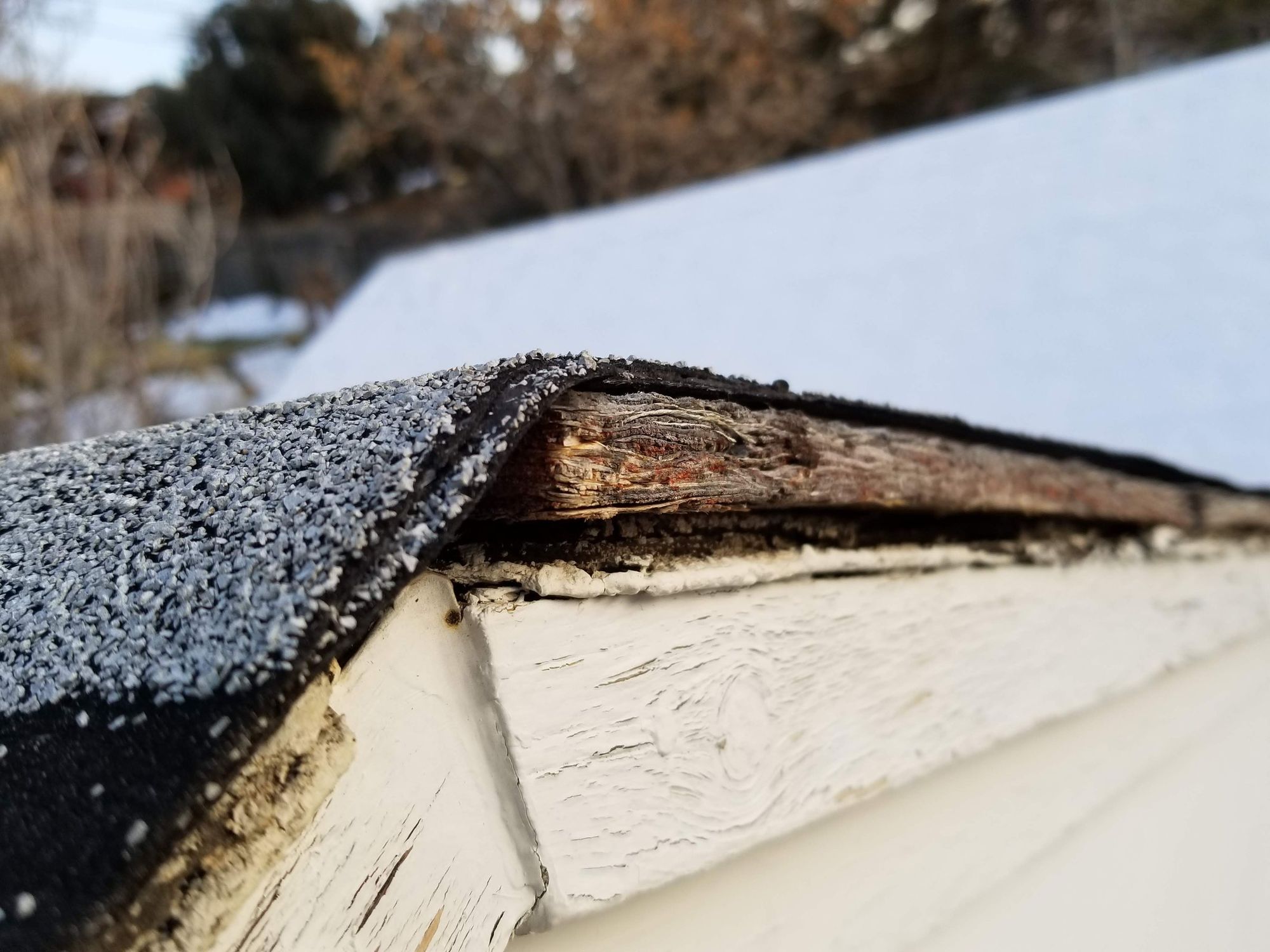
Damaged eave sections rebuilt with ice barrier, and the ventilation that caused it corrected.
Most of what shortens a roof around Farmington is slow and unremarkable: needles packed into a valley, debris caught behind a chimney, moss holding moisture on the north slope through a wet spring. None of it is dramatic and all of it works on the roof every single day.
An ice dam is a ventilation problem wearing a weather costume. Fix the attic or it returns.
What matters on ice damage repair
Reading hail honestly
Hail shows on soft metals first. Vents, flashing and gutter aprons take visible dents before the shingle mat shows bruising, so those are what we check first to date the storm and gauge severity. Bruising on the shingle itself is felt as much as seen.
Wind damage runs in lines
Wind gets under a course and lifts along a run, so the one missing shingle visible from the street is rarely the whole of it. The creased tabs either side of it have broken their seal even though they are still in place, and those fail in the next storm.
How the system goes together
Pipe boots and roof penetrations
The rubber collar around a plumbing vent is the shortest-lived thing on most roofs. Ultraviolet at this elevation cracks that rubber long before the shingles are tired, and the crack sits directly over an open hole in the deck. Lead boots or a metal collar with a replaceable seal last considerably longer.
Everything that comes through gets a plan
Furnace flues, swamp cooler curbs, satellite mounts, solar standoffs. Each one is a hole somebody has to detail correctly.
Counterflashing let into the masonry
Where a roof meets brick or stone, the honest detail cuts a groove into a mortar joint, tucks the top edge of the metal into it, and seals the groove. Water running down the wall face hits metal and gets thrown out onto the roof. The shortcut runs the metal flat up the wall and caulks the top edge, which works until the caulk moves.
Surface-mounted is a temporary answer
We will do it that way on an emergency repair and tell you plainly that it needs to be cut in properly when there is time.
What we check
- Ice barrier coverage past the warm wall line
- Where the ice dams form and why
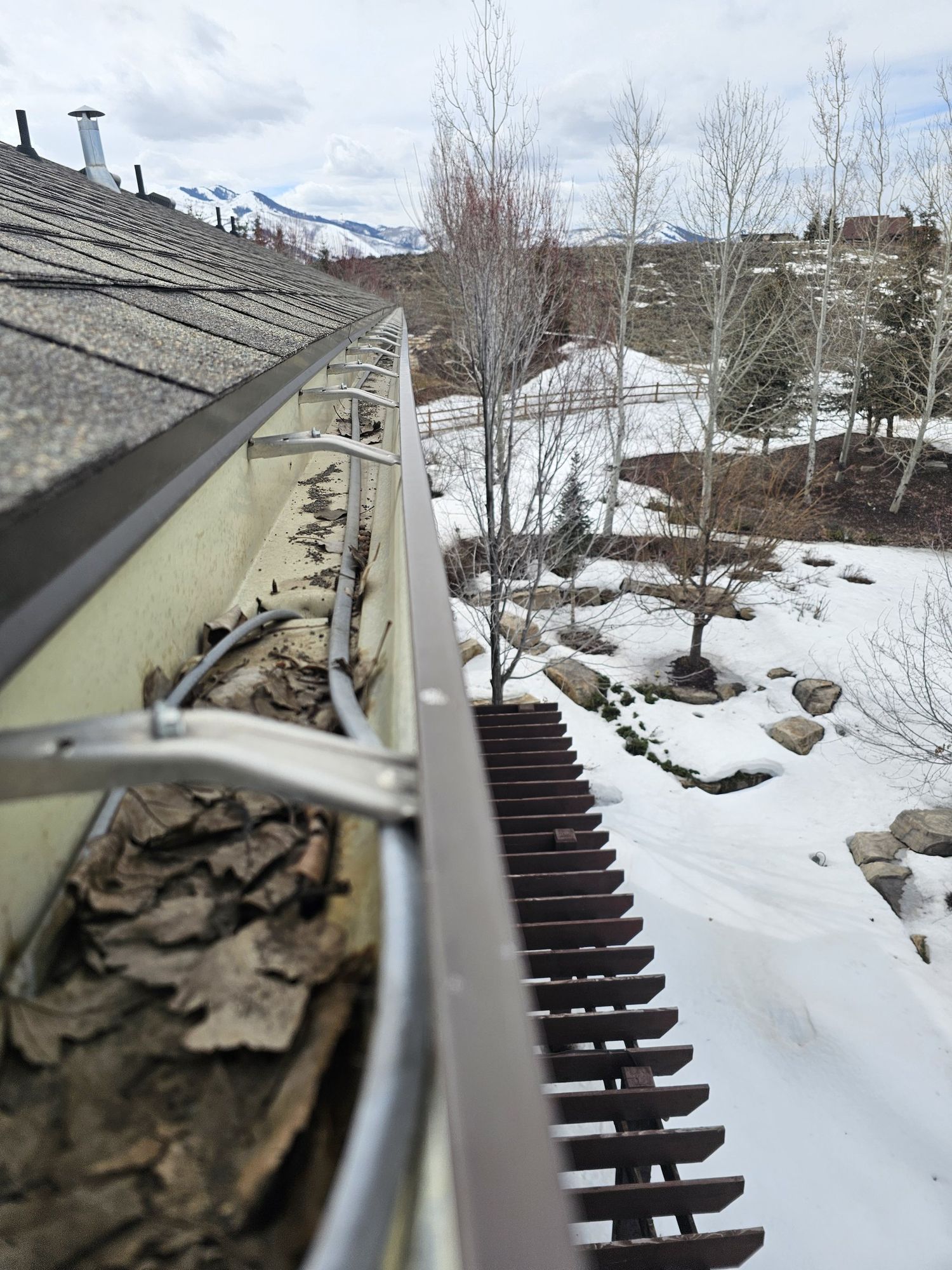
- Attic ventilation behind the eave
- Gutters and heat cable after the thaw
What the job looks like
Get on the roof
We walk it rather than look from the drive, check the decking underfoot, the flashings and the ventilation, and photograph what we find before any number is discussed.
Show you what we saw
The photographs come back to you with a plain read of what the roof needs and, just as often, what it does not need yet.
Crew on site
The crews we hire work under Hancock’s direction, staged so landscaping and the drive are protected, working the detail in the order it is supposed to go on rather than the order that is quickest.
Leave it clean
Site cleared at the end of every day, a magnet run over the whole yard for nails at the finish, and the roof walked with you before we go.
Wet leaves against a wall line
Where a lower roof runs into a two-story wall, leaves and needles collect in that inside corner and stay. The pile holds water directly against the bottom of the siding and the top of the step flashing, which is the one place on a roof where a little standing moisture does the most damage.
Clear the corner, check the kickout
A kickout flashing at the bottom of that run throws the water into the gutter instead of behind the siding. Plenty of houses up here were built without one.
Wind, water and dust, in that order
Ask what actually kills roofs in this part of the state and the answer runs wind first, then water that could not get away, then the grit that the wind delivered. Each one makes the next worse. A wind-broken seal lets water in. Water carries grit into a lap. Grit holds moisture against the mat. None of it is dramatic and all of it compounds.
Why we start at the edges
Perimeters and penetrations are where all three arrive together, so that is where an honest look begins.
Where roofs go wrong
The shortcut we see most
A claim filed off a ground-level look. Damage gets missed, the scope comes back short, and the homeowner finds out the hard way in the next storm.
What good looks like instead
The whole roof walked and photographed, soft metals checked to date the storm, and the adjuster met on the roof so everyone is reading the same evidence.
Signs worth a look
- Dents in vents, flashing or the gutter apron
- Shingles creased but still in place
- Granule loss concentrated on one slope
- Debris or branch strike marks on the field
Part of our Davis County work, out of Salt Lake City & surrounding counties. A full replacement carries our 10-year workmanship warranty.
What to expect
What to do first
Get the water stopped and get photographs. If something is actively coming in, call and we will make it safe before anything else happens. Documentation of the immediate aftermath is worth having.
How the claim process runs
We document the damage thoroughly, you file, and we work with your insurance from there. On hail-damaged roofs, we work with your insurance to get the roof covered, and the assessment is made from the same evidence we gathered.
Temporary versus permanent
Tarping and emergency sealing buy time and nothing more. Temporary is temporary and we say so. The permanent repair follows once the weather gives us a window.
Getting to Farmington
Because we are on Davis County roofs most weeks, we know how the housing around Farmington was put together, which is a different thing from knowing how roofs work in general.
That proximity is most of what matters when weather moves through. Farmington sits in Davis County, and we are on roofs across it regularly enough to know how the housing there was built.
Questions we get asked
Not the question you had? Call the shop and ask a person. We would rather talk it through than have you guess from a website.
(801) 382-8898Do you actually work in Farmington?
Regularly. Farmington is ordinary working territory for us, not an outlying job we take when it is quiet.
How fast can you get to Farmington after a storm?
As fast as we can get there. Stopping the water comes first and the permanent repair follows once the weather opens a window.
How do I know when a roof is getting close?
Granules collecting in the gutters, tabs lifting or curling at the edges, shingles that look bare in patches, and daylight or staining in the attic. Any of those is worth a look.
Will you tell me if I do not need a new roof?
Yes. Plenty of what we look at turns out to be a repair, and we say so. A roof with years left in it gets left alone, and you get the photographs either way.
How long does a roof replacement take?
Most houses in this valley are a one to two day job once the crew is on site. Steeper pitches, multiple layers to strip and complicated roofs with a lot of valleys take longer, and we tell you which yours is before we start.
Where Farmington sits on our map
Farmington work is scheduled like the rest of the valley.
Talk to Hancock
Ice Damage Repair in Farmington
Call (801) 382-8898.