
October 2026
Two things built to move differently, joined at one line
A brick chimney and the roof around it are close neighbors that never really agreed on anything. The chimney stands on its own footing and goes straight up through the house as one heavy column of masonry. The roof is lumber, nailed together, sheathed and shingled, and it swells and shrinks a little with every season. Where the two meet, somebody has to make a joint that keeps water out while letting each side move on its own.
On a newer house that joint is usually in decent shape. On an older one, the kind we work on all the time around South Salt Lake and the older parts of the valley, it has often been patched three or four times by three or four different people, and each patch made the next leak a little harder to find.
Why an older chimney leaks differently from a new one
When a chimney is new, a leak at the roof line is almost always a metal problem. A piece of step flashing was left out, the counterflashing was stuck to the face of the brick, or the uphill side had nothing to split the water. Those are installation mistakes, and our flashing repair work fixes plenty of them.
Once a chimney has been through a few decades of Utah winters, the masonry itself starts taking part in the leak. That changes how we look at it, because new metal pressed against tired brick still makes a leaky joint.
Mortar that has nothing left to grip
Proper counterflashing is bent into a slot in a mortar joint, then sealed there. That only works while the mortar is sound. Old mortar goes sandy, and you can rake it out with a house key. When the joint holding the counterflashing turns to grit, the metal loosens, the bead behind it opens, and water runs straight down behind the step flashing into the deck.
Somebody usually notices the loose metal and smears roof cement over the whole thing. That stops the water for a season or two, then the cement dries out in the sun up here, and now there is a crust of old patch over a joint nobody can see.
Water that soaks through the brick itself
Brick and mortar are porous. A chimney with a cracked crown on top, or faces that have started to flake, takes on water above the roof and lets it travel down inside the masonry. When that water reaches the roof line it comes out right where the flashing is, and it looks exactly like a flashing leak.
This is the one that wastes people’s money. The flashing gets redone, the stain comes back after the next storm, and the water was coming down through the chimney the whole time.
What the brick tells you before anyone climbs up
An old chimney leaves clues on its own faces. White, chalky streaks on the brick, usually below the crown or along one side, are salts that water carried out of the masonry as it dried. Brick does that when water is moving through it, so a streaky chimney is a chimney that is taking on water somewhere above the roof.
Look at the top courses too, from the street with a pair of binoculars if you have them. Brick faces that have popped off in flakes, mortar joints that look recessed and dark, or a crown with plants growing out of a crack all mean the masonry needs attention. None of those are flashing problems, and new flashing will not cure any of them.
Moss or a green stain on just the shady side of the chimney means that face stays damp long after a storm. On its own that is not a leak. It does tell us which side to look at hardest when we get up there.
Telling a crown leak from a flashing leak in the attic
If the attic is reachable, the framing around the chimney tells the rest. We go up with a light and look at the rafters and deck boards that box the chimney in, and at the brick itself where it passes through the attic.
A flashing leak tends to show low on the roof boards right beside the chimney, usually on the uphill side or along one edge, with a stain that runs downslope from there. It shows up in a hard rain or a fast melt and dries out between storms.
Water coming through the masonry shows differently. The brick inside the attic looks dark and damp above the roof line, sometimes with the same white streaking on the inside faces. The wet spot on the framing sits right against the brick instead of out on the boards, and it lingers for days after a long soaking storm, because the masonry holds water and gives it up slowly. When we see that, the crown and the top of the chimney get looked at before anyone talks about metal.
How we rebuild the joint
A chimney leak does not get fixed from on top of the old patches. Our chimney flashing repair in South Salt Lake starts by taking the shingles off around the chimney, a couple of feet out on every side, and pulling every piece of old metal and cement until we are looking at bare deck and bare brick. The page walks through the order the new metal goes back in.
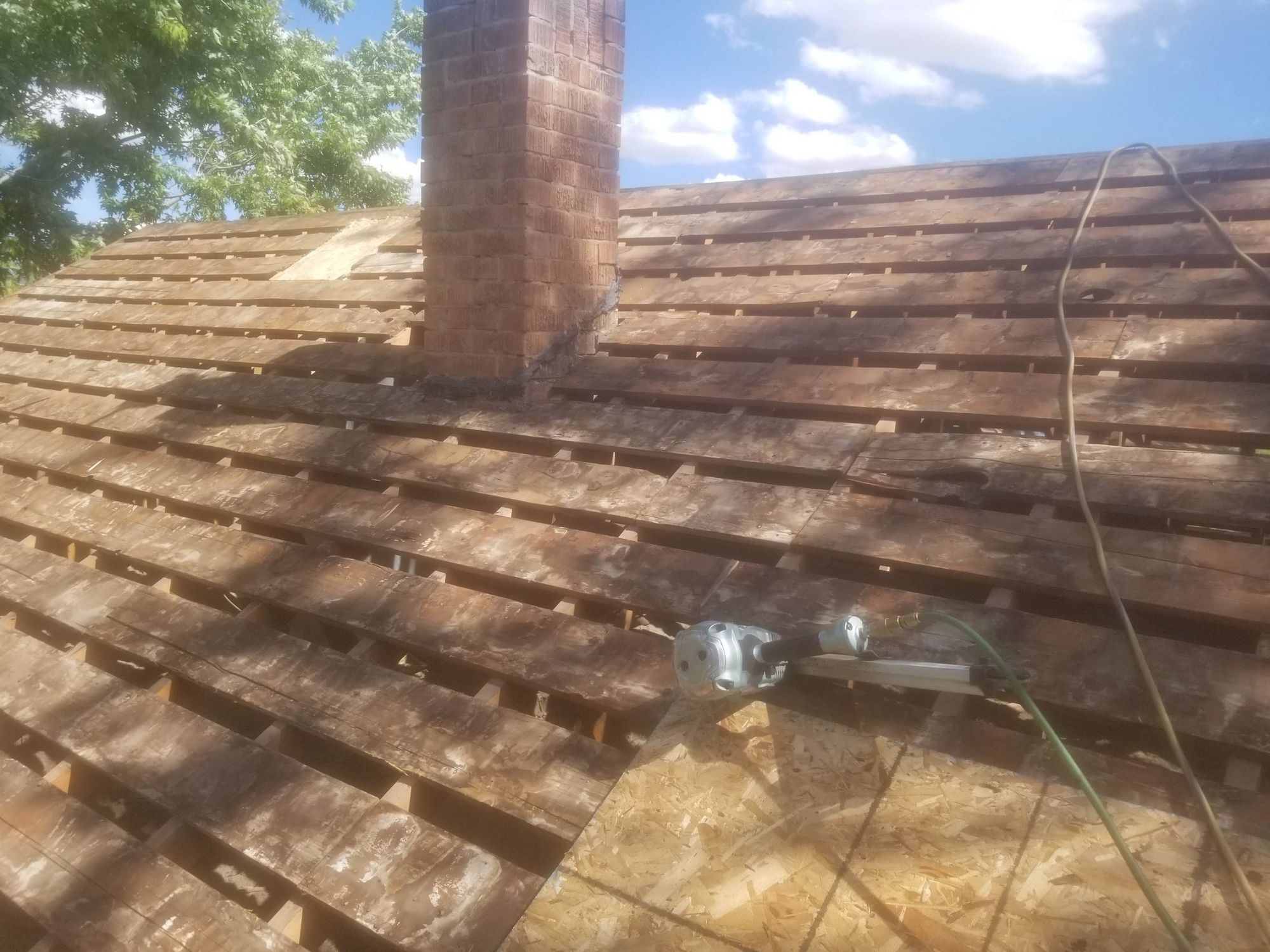
The deck around an old chimney is the most likely spot on the whole roof to be soft, because it has been taking those small leaks for years. On older houses it is often plank boards rather than plywood, like the stripped roof in the photo at the top of this post. Bad boards come out and get replaced before any metal goes back, since flashing nailed into punky wood will not stay put.
When the masonry has to come first
If the mortar is gone deep into the joints, the crown is split, or the top courses of brick are loose enough to move by hand, new flashing would be going onto a chimney that is still letting water in from above. In that case the roof around it gets dried in, a mason does the brick, and we come back to flash a chimney that is sound. Counterflashing slots need solid mortar to hold, so the order matters.
Plenty of older houses also carry a chimney that no longer vents anything. Whether to keep it and flash it, or take it down below the roof line, is laid out on the South Salt Lake chimney page.
If you have a stain near a chimney, or white streaks showing up on the brick, call (801) 382-8898 and have us look at it, or send a note through the contact page. If the water turns out to be coming from somewhere else, that becomes leak repair work instead.
Questions people ask about chimney leaks
Why does my chimney only leak in the spring?
Usually because snow piles against the uphill side and melts during the day, which puts more water against that joint than any summer storm does. In summer there is no standing pile of melt, so the same opening drips far less or stops altogether.
What are the white streaks on my chimney?
Salts left behind when water moves through brick and mortar and then dries on the surface. They wash off, and they come back as long as water keeps getting into the masonry. They point at the crown, the mortar or the brick faces, more than at the flashing down at the roof.
Should the cricket behind my chimney be metal or shingled?
Both work. A small cricket is often covered in sheet metal, which sheds snow and melt quickly. A larger one can be framed, wrapped in underlayment and shingled to match the roof. What matters is that it splits the water around the chimney and ties into the flashing on both sides.
My chimney has two flues. Does that change the repair?
Mostly it changes the width. A wider chimney holds back more snow on its uphill face, so it is far more likely to need a cricket than a narrow one. The flashing itself goes in the same way, one step piece per course up each side.
Can chimney flashing be done in the winter?
On a dry day, yes. The work happens with the roof open around the chimney, so we pick a day without snow on that slope and close it up the same afternoon. If the weather will not cooperate, the area gets dried in and the flashing waits for the next clear stretch.
Before the next snow piles up against it
Most chimney leaks on older houses are a day of work once the masonry is sound. The time to look is in the fall, before the first storm stacks snow against the uphill face and the melt starts testing that joint.
If you are in South Salt Lake or anywhere nearby, have us look at it while the roof is dry. Reach us through the contact form and we will set up a time.
Talk to Hancock
Talk to Hancock
Call (801) 382-8898 or send a note and we will get on the roof and tell you what it needs.