
September 2026
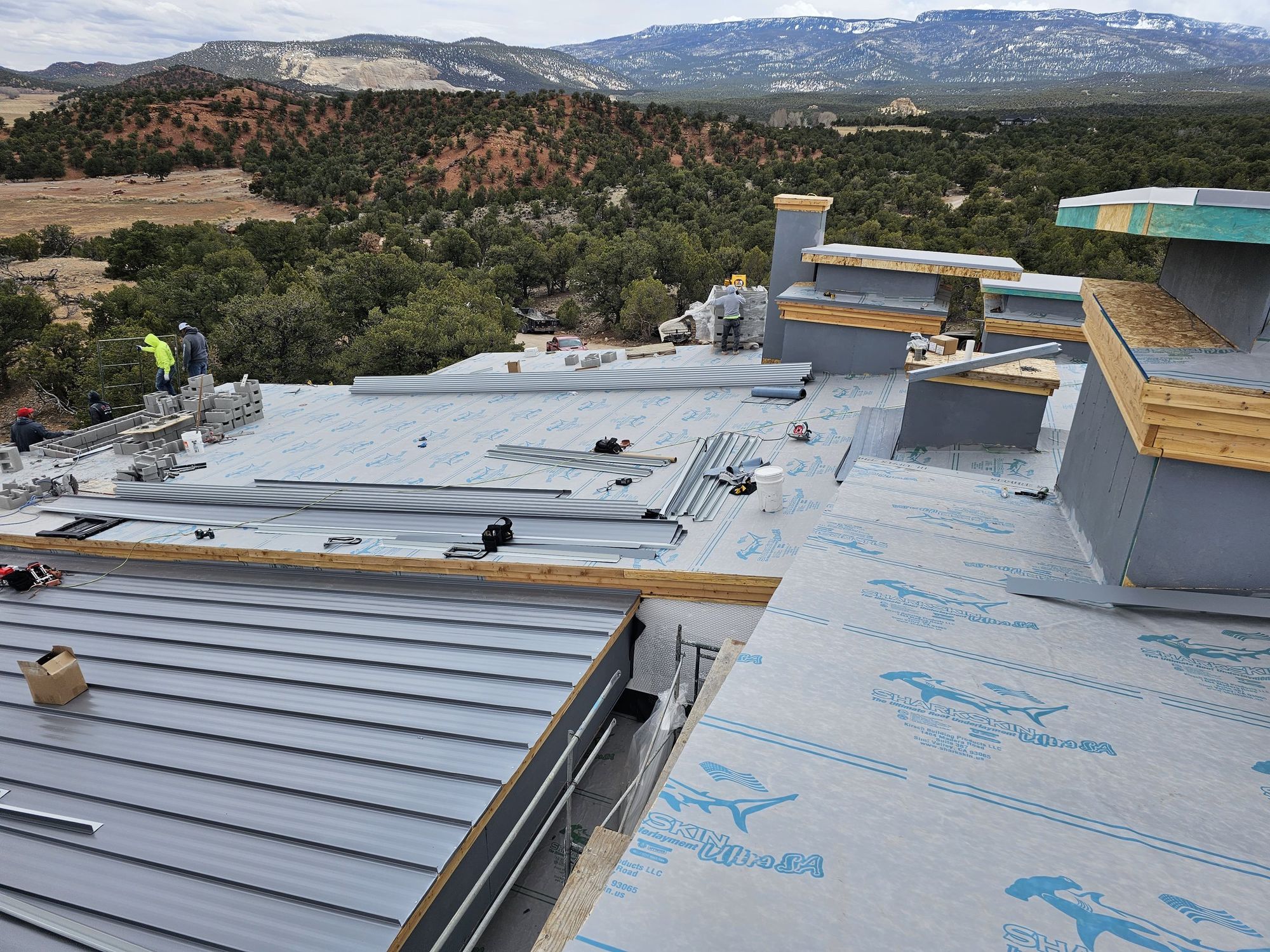
Look at the gutters before you look at the roof
A hailstorm rolls through Kearns on a June afternoon, twelve minutes of noise on the skylight, and by dinner there are three door hangers on the porch offering to handle the whole thing with the insurance company. That is how it goes every summer in this valley, and most of those companies are a phone number in another state with a crew hired that week.
Here is the thing worth knowing before you do anything: the roof is the last place to look. Hail leaves its clearest record on soft metal, and soft metal sits at eye level where you can walk up and touch it. Start there and you will know, within about ten minutes, whether the storm did anything to your house.
Why the metal tells you first
Hail is ice arriving at speed, and what it does to a surface depends on how much that surface gives. Aluminum gutter is thin and soft, so a stone leaves a dimple you can see from the sidewalk. An asphalt shingle does something subtler: the stone knocks granules loose and can fracture the fiberglass under them without leaving a hole or a dent you would notice from a ladder.
So the metal is your gauge. If the stones were big enough to bruise shingles, the gutters and downspouts and vent caps almost always show it, because they were softer targets in the same storm.
Go look at these, in this order
- Gutter faces and the tops of the downspouts. Stand at a corner and look down the length of the gutter with the light raking across it. Dimples show up as a rippled shadow line. A downspout elbow facing the weather takes hits square.
- Furnace and water heater vent caps. These are the softest metal on your house. A rash of small craters in the cap is hail and nothing else makes that mark.
- The air conditioner condenser. Look at the fins on the side facing the storm. Hail flattens them, and a flattened fin bed is dated evidence that holds up.
- Window screens, mailbox, the trash cans you left out. Screens tear or dent at the frame. A plastic can shows white stress marks.
- A wood fence or a painted deck rail. Fresh chips through the paint on the upward faces of horizontal boards, bare wood showing, are hail. Old chips have weathered gray.
If all of that is clean, your shingles almost certainly took nothing, whatever the door hanger says. If several of them are marked, there is a real conversation to have.
What hail damage to shingles actually looks like
Somebody has to get on the roof for this part, and it is worth understanding what they are looking for so you can tell whether they looked.
The thing that matters is a bruise. A bruise is a spot where the stone knocked the granules away and cracked the fiberglass mat beneath. It does not necessarily leak today. What it does is remove the shingle’s sun protection at that spot and open a fracture, and over the next few seasons that spot degrades faster than everything around it. Enough bruises on a slope and you have a roof that will fail years early.
You find a bruise with your hand. It feels soft and slightly springy, like a bad spot on an apple, and it usually sits under a small dark circle where the granules are gone. A photograph rarely shows it. A drone flight definitely does not. This is the reason we walk roofs by hand on storm calls instead of flying them, and it is a fair question to ask anyone who shows up with a tablet full of aerial shots.
Things that get called hail and are not
Plenty of what gets circled in chalk on a roof report has nothing to do with the storm.
- Blistering. Small raised bumps that pop and leave a shallow crater. Comes from moisture in the asphalt and a hot attic. Looks like hail in a photo, and the edges of a blister crater are clean rather than fractured.
- Foot traffic scuffs. Granules scrubbed off in an arc where a satellite installer walked a slope.
- Manufacturing granule loss. Sparse coverage in a regular pattern across a course, present since the day it went on.
- Mechanical damage. A limb dragging across a slope in a windstorm leaves lines, not scattered points.
If somebody has already handed you a report full of chalk circles and you want a second read on it, send it over through our contact page. An adjuster who has worked this market knows the difference. So does an honest roofer. The reason to care is that a claim built on blistering gets denied, and a denied claim sometimes poisons the file for the real damage sitting next to it.
How the adjuster visit should go
You file the claim yourself, with your own carrier. Nobody needs to do that for you, and you should be suspicious of anyone who wants to. Then the carrier sends an adjuster out, usually within a couple of weeks, sometimes longer after a big regional storm because they are working a queue.
Be there, and have your roofer there
This is the single most useful thing you can do. The adjuster is going to be on your roof for maybe twenty minutes, and they are measuring against a standard: typically how many hits show up inside a ten by ten foot test square on each slope. If nobody is up there with them, whatever they write is the whole record.
When we go up with an adjuster, we are not arguing. We are pointing. Here is the north slope test square, here is the soft spot under my thumb, here is the vent cap, here is where the gutter is dimpled on the same elevation. Standing on the roof looking at the same shingle is a completely different conversation than a phone call two weeks later about a photograph.
Know what is in the scope
A roof claim is more than shingles. Ice and water membrane, drip edge, pipe collars, valley metal, step flashing, ridge vent, the gutters if they are dented, the paint on a fascia that gets torn up in the tear-off. If the first scope comes back thin, that is normal and it is fixable. A supplement is a routine part of this process, not a fight, as long as somebody documents the missing line items with photographs.
Understand your own policy
Two things decide most of what happens. First, whether you carry replacement cost or actual cash value. Replacement cost pays what it takes to put the roof back, less your deductible. Actual cash value pays the depreciated worth of a twenty year old roof, which is not much. Second, whether your deductible is a percentage rather than a flat figure, increasingly common on Utah wind and hail and it catches people off guard.
Anybody who offers to cover your deductible is offering to commit insurance fraud with your name on the paperwork. Walk them off your porch.
The storm chasers, plainly
After a hail event this valley fills up with out-of-state crews. Some do competent work. The problem is year three, when a nail pop shows up or a valley starts weeping and the company that installed your roof has moved on to whatever market got hit next. There is nobody to call. A workmanship promise is only worth the shop standing behind it.
The tells are consistent. Pressure to sign today. An offer to inspect that comes with a contract attached. A claim filed on your behalf before you have read anything. A number that only works this afternoon.
If the storm hit and water is coming in
Different situation, different urgency. Active water in the house after a storm means tarping, and tarping means today. Call (801) 382-8898 and say water is coming in, because that moves you up the schedule ahead of everybody who wants a look at their gutters.
Photograph everything before you clean anything up. The ceiling stain, the bucket, the wet insulation, the hail on the lawn if it is still there. Date-stamped photos of stones next to a tape measure or a coin are worth a great deal later. Keep your receipts for anything you buy to stop the damage, because that is usually covered.
Questions we get after a hailstorm
How long do I have to file a hail claim in Utah?
Policies vary and most give you a reasonable window measured in months to a year from the date of loss, but the practical answer is sooner. Hail damage gets harder to attribute to a specific storm as the roof weathers, and a carrier can fairly ask why you waited. Once you know there is damage, file.
Should I let a roofer file the claim for me?
No. You call your carrier, it is your policy and your claim. A roofer’s job is to document the damage, meet the adjuster on the roof, and handle the supplement if the scope comes back light. Anyone who wants to be the one filing, or who asks you to sign an agreement before you have a claim number, is building their business model on your policy.
My neighbors all got new roofs and I got denied. What happened?
Usually one of three things: a different slope orientation caught the storm and yours did not, the adjuster’s test squares landed in cleaner areas, or your carrier applies a stricter threshold than theirs. It is worth a second look with somebody on the roof who will document what is there. A re-inspection is a normal request and carriers grant them.
Does hail damage a metal roof?
It can dent it, which is mostly cosmetic on a standing seam panel and mostly not covered as functional damage. Where metal gets hurt is at the soft parts: exposed fasteners, sealant at the seams, and painted finish chipped down to the substrate where it will eventually rust. A dented panel that still sheds water is usually left alone.
Can you tell how old hail damage is?
Roughly. A fresh bruise has bright unweathered asphalt where the granules came off, and it darkens as it oxidizes over a season or two. That is one of the things an adjuster is reading, and it is why a claim filed two storms later gets complicated.
My roof is fine but the gutters got hammered. Is that a claim?
It can be, and it is worth reporting. Functionally damaged gutters and downspouts are covered property under most policies. We have done plenty of jobs that were gutters and a vent cap with the shingles left alone, and told the homeowner exactly that.
We will tell you if the storm missed you
A fair share of the hail calls we go on end with us saying the roof came through it. That is not a wasted trip. Knowing your roof is sound is worth something, and it is a lot cheaper than finding out in five years that a crew from out of state put a claim through on blistering.
If a storm went over your neighborhood and you want somebody local to get up there by hand and give you a straight read, call (801) 382-8898 or send a note through our contact page. We are a family shop out of Salt Lake City, second generation, and we will still be here when your roof is five years old. If you have already filed and want somebody to meet the adjuster with you, tell us the appointment time and we will be on the roof when they get there.
Talk to Hancock
Talk to Hancock
Call (801) 382-8898 or send a note and we will get on the roof and tell you what it needs.