
Roofing across Davis County
Roofing across Davis County, from Layton, Clearfield, Kaysville, Farmington and more.
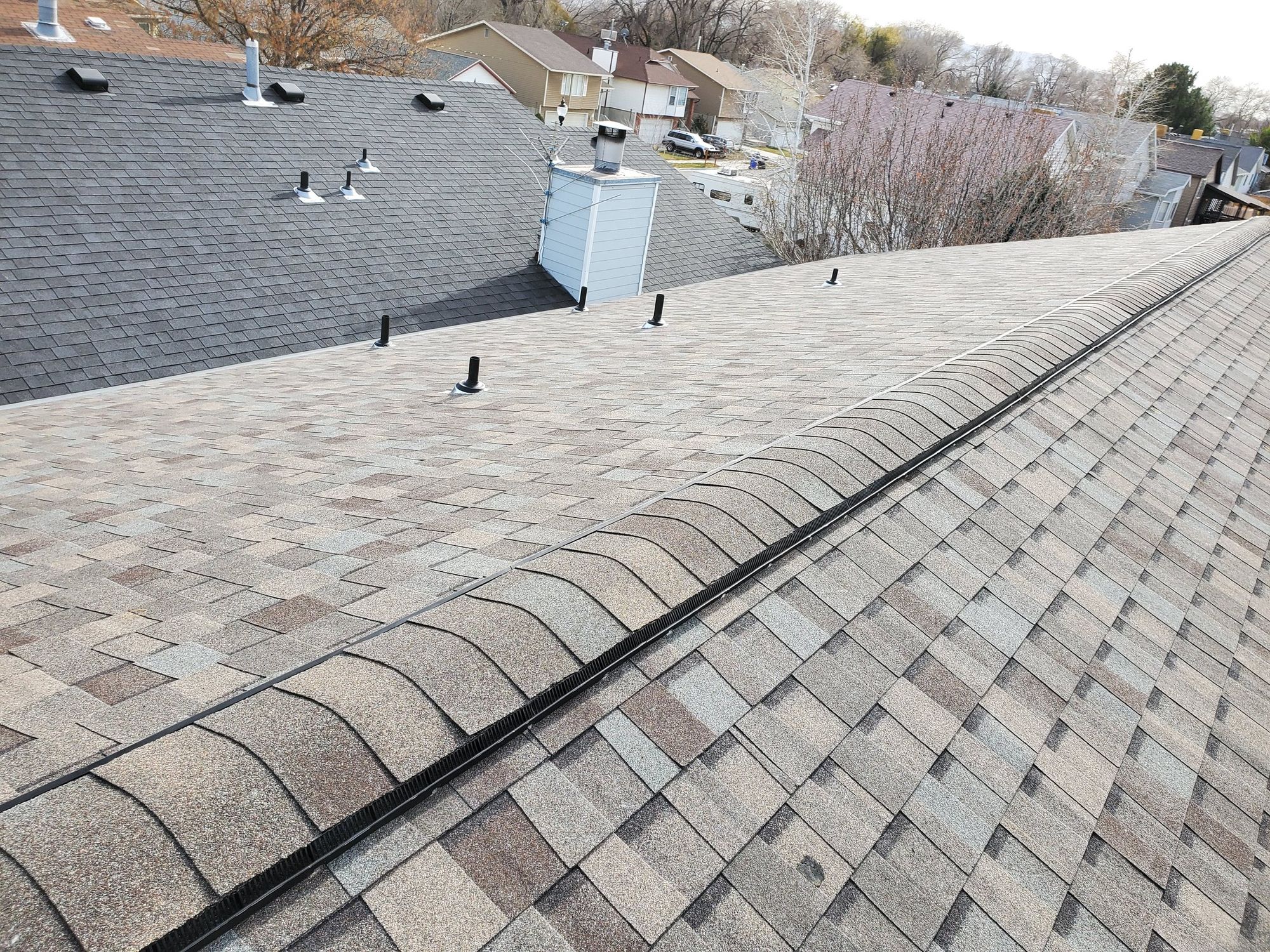
Hail damage across the county
Davis County roofs have taken a lot of hail this season, from Bountiful up through Layton, Syracuse and Clinton. On hail-damaged roofs, we work with your insurance to get the roof covered.
Working across Davis County
Davis County covers enough ground that a roof on one side of it faces a different year from a roof on the other. Exposure, elevation and the age of the housing all shift as you move across the county, and so does what a roof needs to survive here.
We cover 15 communities in Davis County as part of the ground we cover around Salt Lake City. Being close enough to get there quickly is most of what matters after a storm, and being on roofs across the county regularly is what makes an honest read of a roof possible rather than a guess from the driveway.

What Davis County does to a roof
Fog that never burns off
Valley fog in the cold months sits low and holds. It puts a film of moisture on everything without registering as precipitation, which is why a homeowner can swear it has not rained in three weeks while the roof has been wet the whole time. Organic debris in a valley stays soft and packed instead of drying out and blowing clear.
Where that shows first
Under the bottom course at a wall, and in the seam where a porch roof ties into the main body of the house.
Rain driven sideways into a lap
Shingles are built to shed water running downhill. A thirty mile an hour gust with rain in it does not run downhill, it runs across and up. That is the one condition where a lap that has worked for fifteen years lets water through, and it is the reason a leak can appear in a specific storm and then never again.
Chasing a wind-only leak
You cannot find it on a dry day by looking. You find it by knowing which wall faces the weather and checking every horizontal joint on that face.
Davis County runs narrow between the lake and the mountain, and the wind funnels through it. The corridor around the base sees gusting that the sheltered streets further east do not.
What we find across the county
Counterflashing let into the masonry
Where a roof meets brick or stone, the honest detail cuts a groove into a mortar joint, tucks the top edge of the metal into it, and seals the groove. Water running down the wall face hits metal and gets thrown out onto the roof. The shortcut runs the metal flat up the wall and caulks the top edge, which works until the caulk moves.
Surface-mounted is a temporary answer
We will do it that way on an emergency repair and tell you plainly that it needs to be cut in properly when there is time.
What underlayment actually does
Shingles shed water. Underlayment is what handles the water that gets past them, and something always gets past them. Synthetic underlayment has largely replaced felt because it does not wrinkle when it gets damp, does not tear when the wind catches it during installation, and keeps its footing when a crew is working a steep slope.
Felt still shows up
On small repairs and on matching an existing older assembly it is fine. On a full replacement up here there is no reason to go back to it.
Communities we cover in Davis County
Every community below has its own page. 15 of them across Davis County.
Davis County
How we work across the county
Ridge vent against box vents
A continuous ridge slot pulls air along the entire peak, which is why it outperforms a row of box vents on most houses. Box vents still win in specific situations: a hip roof with almost no ridge to cut, a roof broken into separate attic spaces that do not share air, or a low ridge where a slot would sit under drifted snow all winter.
Never mix the two on one attic
Put both on the same space and the ridge pulls its air from the nearest box vent instead of from the soffit. The attic barely moves and the roof looks correctly vented from the driveway.
Six nails in the right line
Every shingle wrapper prints a nailing pattern and a nail line, and that pattern is what the wind rating was earned with. High nailing misses the reinforced strip and leaves the nail head sitting in the exposed area of the shingle below. Four nails where the wrapper asks for six cuts the uplift resistance on the one part of the roof the wind works hardest.
Overdriven is as bad as missing
A gun set too hot cuts through the mat and the shingle is hanging on a hole.
Cheapest detail to get right
And the most common thing done wrong.
What we check on every roof
- Field condition and granule loss
- Valleys, ridges and every transition
- Penetrations and their flashing
- Gutter and fascia condition
What we do in Davis County
Every service below is its own page. Whichever one Davis County turns out to need, the roof gets walked before anything is quoted.
Roofing
Full replacements and new roofs on Davis County homes, deck up.
Repairs
Leaks and failed details, which is most of what Davis County calls about.
Upkeep
Inspections, cleaning and sealing before a small thing gets expensive.
Shingles
Architectural laminate, the field material on most of this valley.
Metal
Standing seam and corrugated, common on canyon-side snow load.
Tile
Clay and concrete tile, and the flashing work they need.
Commercial
Membrane systems for flat and low-slope buildings around Davis County.
Coatings
Restoration coatings when a commercial roof has life left.
Storm
Hail, wind and the insurance paperwork that follows.
Skylights
Installation and the curb-flashing repairs skylights usually need.
Gutters
Gutters, downspouts and fascia, which are part of the roof.
Government
Schools, city, county, state and federal buildings. Every government service is on the government roofing page.
Work from around the county


Questions we get asked
Not the question you had? Call the shop and ask a person. We would rather talk it through than have you guess from a website.
(801) 382-8898Do you actually work in Davis County?
Regularly. Davis County is ordinary working territory for us, not an outlying job we take when it is quiet.
How fast can you get to Davis County after a storm?
We make the roof safe first, then come back and do the repair properly when conditions allow.
What makes a Utah roof different?
Snow load, ice at the eaves, canyon wind and high-altitude sun, all on the same roof. A crew that learned roofing somewhere mild has to learn it again up here.
How do I know when a roof is getting close?
Granules collecting in the gutters, tabs lifting or curling at the edges, shingles that look bare in patches, and daylight or staining in the attic. Any of those is worth a look.
Will you tell me if I do not need a new roof?
Yes. Plenty of what we look at turns out to be a repair, and we say so. A roof with years left in it gets left alone, and you get the photographs either way.
Where Davis County sits on our map
Davis County work is scheduled like the rest of the valley.
Roof work in Davis County
Call (801) 382-8898 and we will get on the roof.