
Metal Roofing around Park City
Metal roofs that shed snow and last decades.
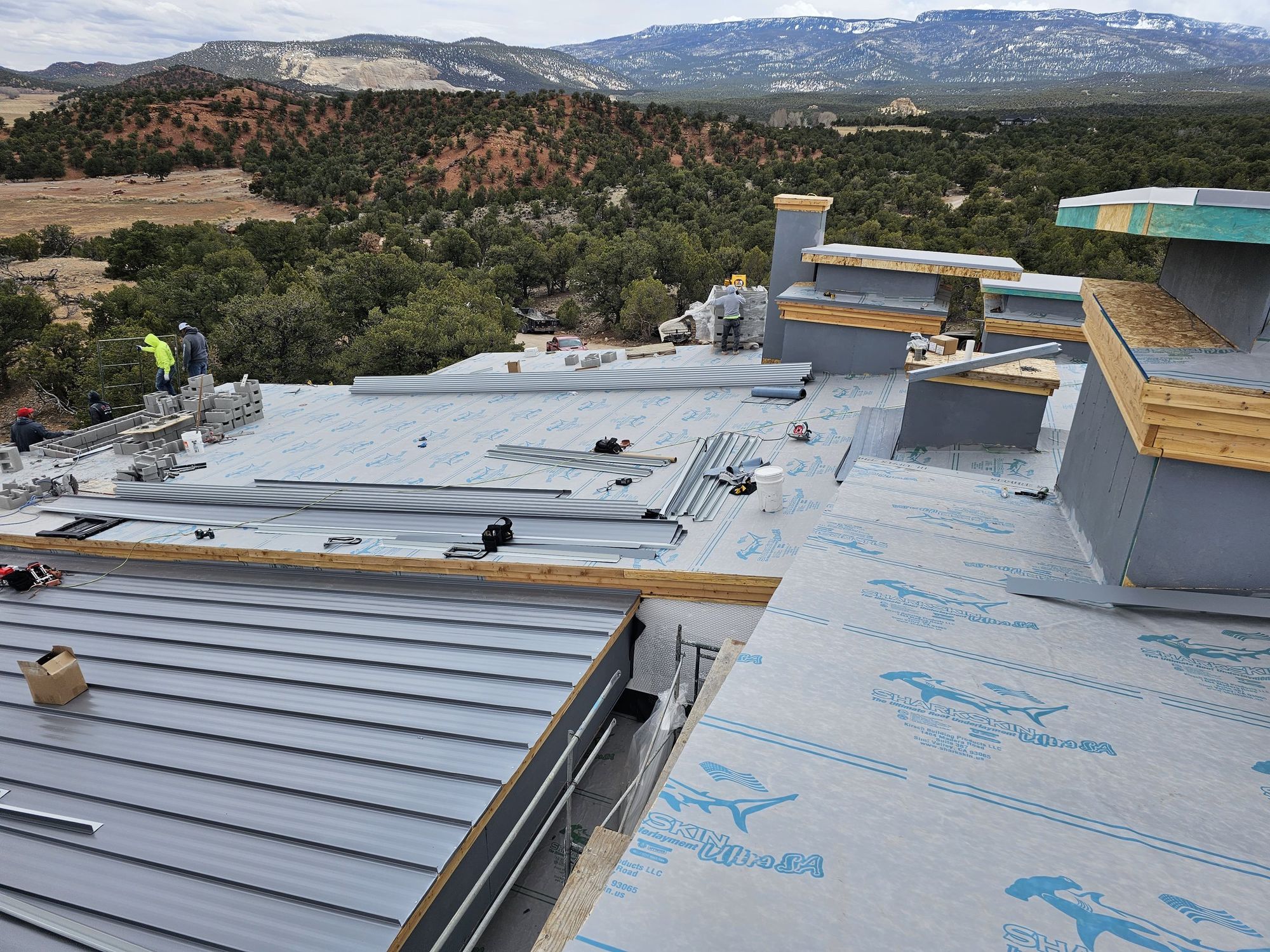
Metal Roofing for Park City homes and buildings
Standing seam and exposed-fastener panels over the right underlayment, with movement allowed for.
Snow load up here is not a theoretical number. Roofs carry weight for months, ice builds at the eaves where the attic leaks heat, and anything that sheds onto a walkway has to be planned rather than discovered in February.
Metal moves with temperature. A metal roof fails where somebody pinned it down.
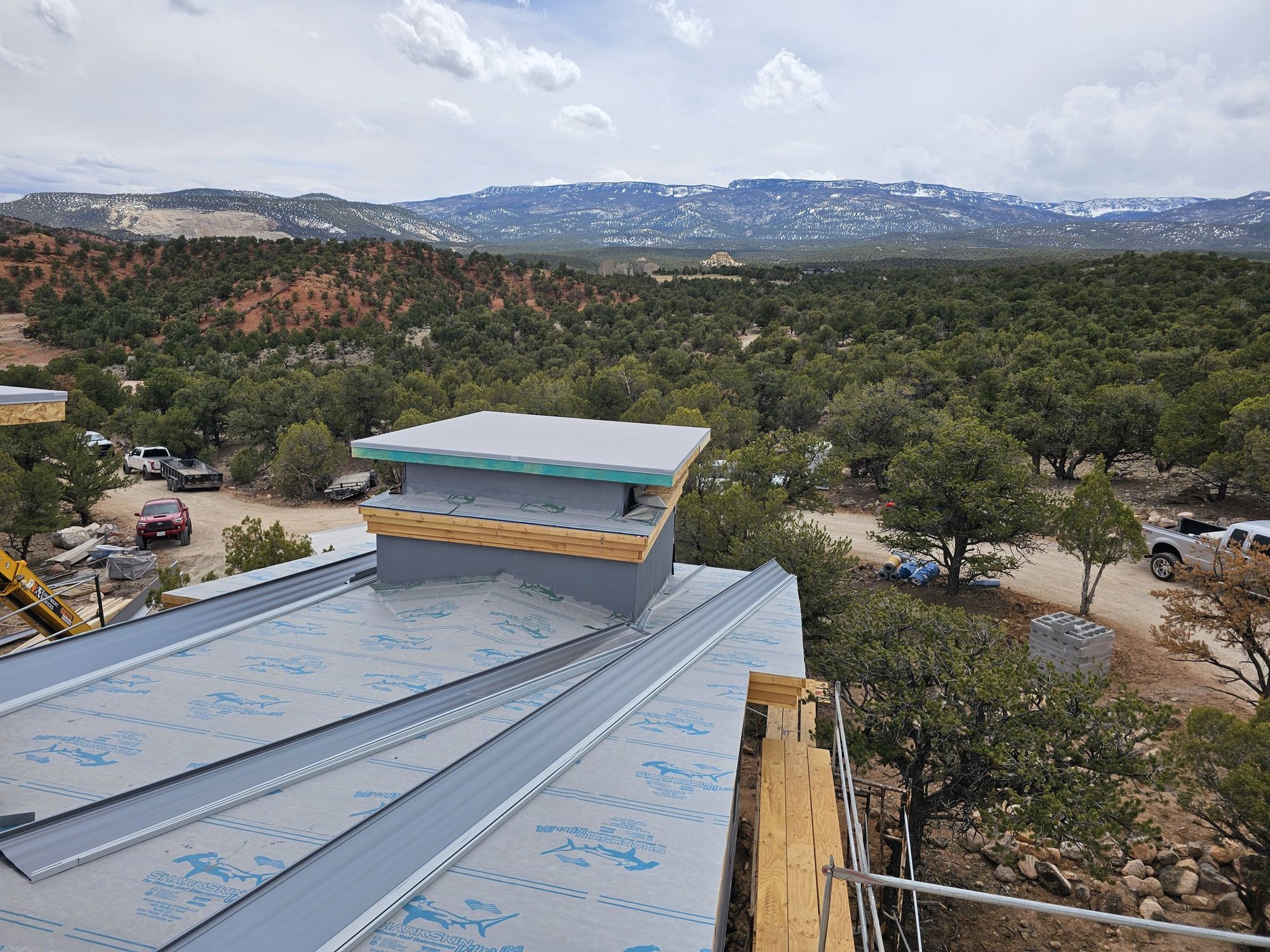
What matters on metal roofing
Movement is the design problem
Metal expands and contracts with temperature across the whole length of a panel. A metal roof that was pinned down rather than allowed to move will oil-can, work its fasteners loose, or tear at a fixing point. The clip and fastener strategy is the engineering.
Where metal earns its keep
At elevation, where snow sits for months, a metal roof sheds load instead of carrying it. That single property is why so much of the high country is metal.
How the system goes together
Dry-in is the real milestone
The moment that decides whether a re-roof goes well is not when the last shingle goes down, it is when the deck is covered, taped at the penetrations and sealed at the edges. From that point the house is weather-tight and everything after it is finish work. A crew that understands this never leaves at the end of a day with bare deck showing.
Ice barrier goes down first
Eaves, valleys and every pipe before any field underlayment. Working from the bottom up means every sheet laps over the one below it the way water expects.
Then the metal, then the field
In that order, every time.
Flashing is where roofs leak
Very few roofs fail in the field of the shingles. They fail at the transitions, at a wall, a chimney, a skylight curb, a pipe boot, a valley. Good flashing is metal shaped so water has nowhere to go but out. Bad flashing is sealant spread over a gap and a hope that nobody looks for four years. When we pull a roof apart, the flashing is what tells us whether the last crew was in a hurry.
Step flashing is one piece per course
There is no shortcut version of that detail that works.
What we check
- Panel profile and gauge against the snow load
- Clip spacing and room left for movement
- Underlayment rated for the heat under metal
- Trim at the eaves, rakes and walls
What the job looks like
Get on the roof
We walk it rather than look from the drive, check the decking underfoot, the flashings and the ventilation, and photograph what we find before any number is discussed.
Show you what we saw
The photographs come back to you with a plain read of what the roof needs and, just as often, what it does not need yet.
Crew on site
The crews we hire work under Hancock’s direction, staged so landscaping and the drive are protected, working the detail in the order it is supposed to go on rather than the order that is quickest.
Leave it clean
Site cleared at the end of every day, a magnet run over the whole yard for nails at the finish, and the roof walked with you before we go.
Microclimate changes street to street
Two homes ten minutes apart can be on completely different roofs in terms of what they endure. Elevation, whether the lot sits in a canyon draw, how much tree cover is overhead, and which direction the main slope faces all change the answer. A roof age that is fine on a shaded north-facing bench home is well past done on an exposed south-facing lot at a higher elevation.
Why we look before we talk
That is the reason we get on a roof before saying anything about it.
Two seasons of roof weather
Roofs here really only get two conditions and both are hard. There is the cold half, where everything is about snow load, ice at the eave and condensation under the deck. Then there is the hot dry half, where ultraviolet and surface heat cook the asphalt and the only water that arrives comes fast and sideways. Systems that do fine in a mild climate get worn from both ends up here.
Building for both
The details that handle winter and the details that handle summer are different details, and a roof has to carry both sets.
Where roofs go wrong
The shortcut we see most
Panels fastened tight at both ends with no allowance for movement. The roof oil-cans in summer, works its fasteners loose over a few seasons, and tears at a fixing point.
What good looks like instead
Clips and fasteners that let the panel move with temperature, and terminations detailed for the expansion the metal will actually see.
Signs worth a look
- Fasteners backing out or their washers cracked
- Panels oil-canning visibly along a run
- Seams opening at a termination
- Rust starting at a cut edge or penetration
What to expect
Lifespan against cost
Metal costs more up front and lasts considerably longer. Whether that is the right trade depends on how long you intend to be in the building, and we will talk through that honestly rather than push the bigger job.
Snow behaviour
Metal sheds snow, which is an advantage at elevation and a hazard over a walkway or a door. Snow retention gets designed in where the building needs it rather than added after somebody gets hit.
Noise and insulation
Over a solid deck with underlayment, a metal roof is not appreciably louder than asphalt. The drumming people remember is metal over open purlins on an outbuilding.
Getting to Park City
We have worked enough of Summit County to know which builders put up which subdivisions and where they cut the same corner twice. That is worth more on a roof than any brochure.
That proximity is most of what matters when weather moves through. Park City sits in Summit County, and we are on roofs across it regularly enough to know how the housing there was built.
Questions we get asked
Not the question you had? Call the shop and ask a person. We would rather talk it through than have you guess from a website.
(801) 382-8898Do you actually work in Park City?
Regularly. Park City is ordinary working territory for us, not an outlying job we take when it is quiet.
How fast can you get to Park City after a storm?
As fast as we can get there. Stopping the water comes first and the permanent repair follows once the weather opens a window.
How do I know when a roof is getting close?
Granules collecting in the gutters, tabs lifting or curling at the edges, shingles that look bare in patches, and daylight or staining in the attic. Any of those is worth a look.
Will you tell me if I do not need a new roof?
Yes. Plenty of what we look at turns out to be a repair, and we say so. A roof with years left in it gets left alone, and you get the photographs either way.
How long does a roof replacement take?
Most houses in this valley are a one to two day job once the crew is on site. Steeper pitches, multiple layers to strip and complicated roofs with a lot of valleys take longer, and we tell you which yours is before we start.
Where Park City sits on our map
We cover Park City on the regular route rather than treating it as a trip.