
September 2026
The shingle matters less than three things nobody asks about
Homeowners come to a roofing conversation with one question ready: which shingle is best. It is a reasonable question and it is not the one that decides how your roof does. The three things that decide it are how the shingle is nailed, how the attic under it breathes, and how the transitions are flashed. Get those right with a mid-grade architectural shingle and you have a good roof. Get them wrong under the most expensive shingle on the truck and you have a warranty claim.
That said, there are real differences between products, and things about this climate that make some choices better than others. So here is the shingle conversation, limited to the parts that apply to a house on the Wasatch Front.
Three-tab against architectural
A three-tab shingle is a single layer of mat with the tabs cut into it, so a finished roof reads as flat rows with even slots. It is the cheapest asphalt roof available and what most of the valley’s older housing stock was built with.
An architectural shingle, also called dimensional or laminate, is two layers bonded together with the lower one shaped to create shadow lines. Thicker, heavier, and it looks like something instead of a grid.
The practical differences come down to four things.
- Thickness. Two bonded layers give more asphalt and more mat to lose before the shingle is done. That is why an architectural roof outlasts a three-tab.
- Wind rating. Three-tab is commonly rated around 60 miles per hour, most architectural product to 110 or 130 with correct nailing. Not a theoretical difference in a valley that gets canyon wind.
- How it hides a deck. Shadow lines break up the surface, so a slightly wavy old deck looks fine. Three-tab shows every ripple.
- Repairability. Three-tab is easier to repair. Colors get discontinued on both, so a patch reads as a patch either way.
We do install three-tab. It is the right call on a detached garage, a rental where the number has to work, or a house being sold where the seller needs a sound roof rather than a nice one. For a house somebody is keeping, architectural is where the money goes further, and the gap between the two is smaller than most people expect.
The heavier grades
Above standard architectural sits a tier of designer and premium laminate: heavier, sometimes three layers, deeper shadow, higher wind ratings, and in some lines an impact rating. CertainTeed and Owens Corning both make them, and they look genuinely good on a larger house with steep visible slopes.
Whether they are worth it depends on what you are buying. If you want the look, they deliver it and nothing else does. If you are hoping heavier product will outlast a well-installed standard architectural roof by a decade, that is a stretch.
Impact rated shingles, and hail
This valley gets hail. An impact rated shingle carries a Class 4 designation, from a test where a steel ball is dropped twice on the same spot without cracking the mat. They use a modified asphalt that stays more flexible, so a strike deforms the shingle instead of fracturing it.
Two things worth knowing. Class 4 is not hail proof, a big enough stone marks anything, but it raises the threshold enough that bruising which would total a standard roof often does not appear. And many insurers offer a premium discount for a Class 4 roof. Call your carrier before you choose a product, because on some policies that discount changes the arithmetic on the upgrade.
Why the nailing pattern carries the wind rating
This is the part of the article we most want people to read, because it is where roofs are quietly built to fail and it costs nothing to do right.
Every asphalt shingle has a nail zone, a narrow band usually marked on the face, where the fasteners belong. On a laminate that band is where the two layers overlap, so a nail driven in it passes through both layers and the top edge of the course below. One nail, three layers held.
Miss high and the nail catches one layer only and misses the course below. The roof looks identical from the ground and its holding power is a fraction of what it should be. A high-nailed roof loses tabs off a whole slope in a wind event while the neighbor’s holds.
Then count. Standard is four nails per shingle. The high wind rating, that 110 or 130 number, requires six on most products plus a starter course and sometimes sealant at the rakes. Four nails on a product rated for six does not give you a slightly lower rating. It voids the wind coverage, and the manufacturer will say so if a claim gets filed.
Depth matters too. Nails go in flush. Overdriven, the head cuts the mat and the shingle has a slot instead of a fastener. Underdriven, the head stands proud and telegraphs through the shingle above it.
The wind rating on the wrapper is a description of an installation, not a property of the shingle. Four nails high on the shingle turns a 130 mile per hour roof into a 60 mile per hour roof.
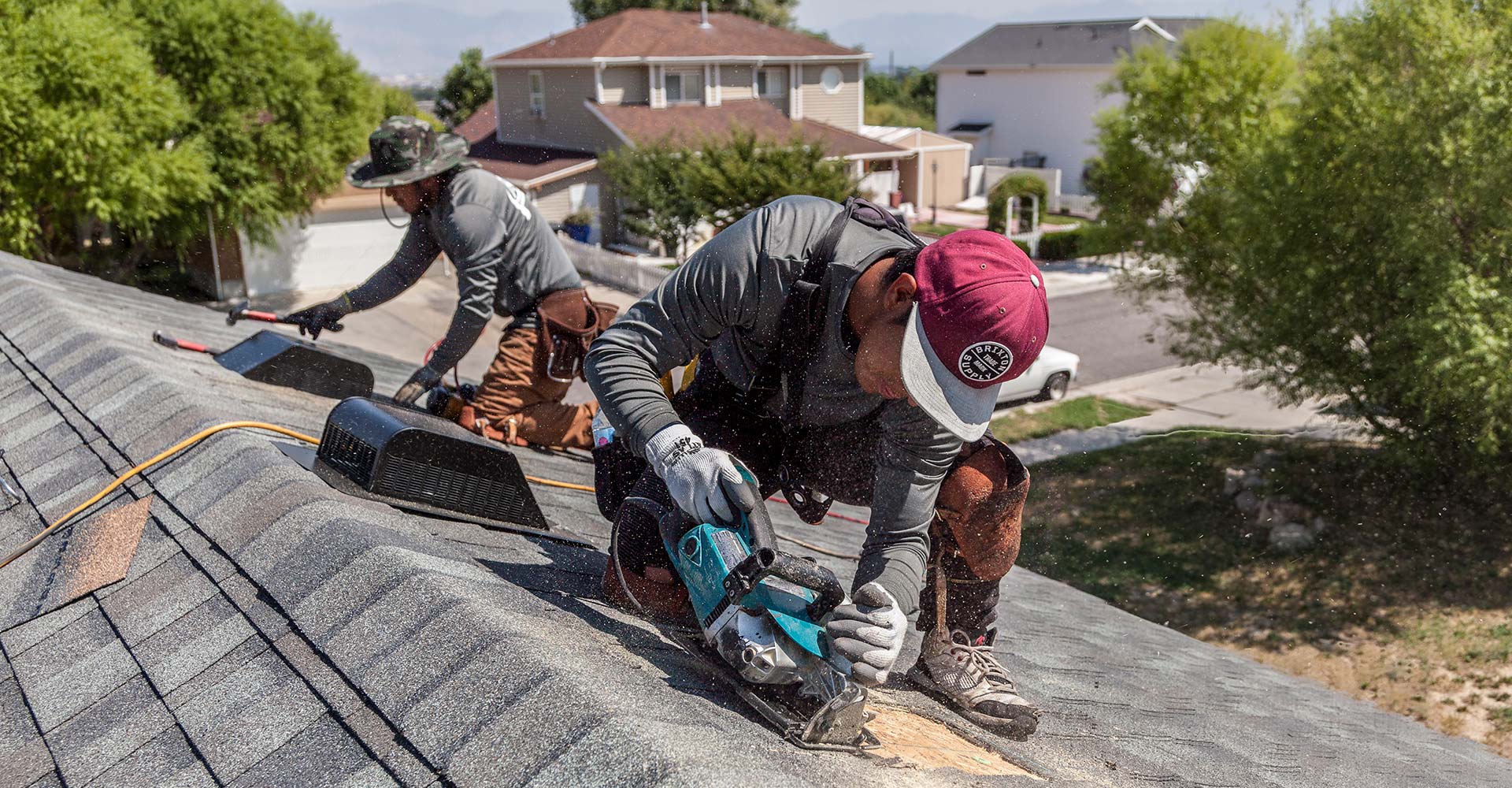
None of this is visible once the roof is on, which is why crews paid by the square skip it. When we tear off an old roof the nail holes are still in the deck, telling us exactly how the last crew worked. We photograph it, because homeowners deserve to know whether their roof wore out or was built short.
Starter course and hip and ridge
Two more in the same category. The bottom edge and rakes need a starter strip, a purpose-made piece with its sealant in the right place, so the first course has something to bond to. Cutting up field shingles for starter puts the sealant in the wrong place, and the bottom course is where wind gets its first grip.
At the peaks, hip and ridge cap should be the manufacturer’s matching product. Field shingles bent over a ridge crack at the fold, sooner at this elevation than most places, and a cracked ridge cap is an open seam along the top of your house.
What Utah sun does to color
Everybody asks about color and almost nobody asks about fading, which is the part that surprises people three years in. If you want to see how a color has held up, ask us on the contact page and we will point you at a roof we laid years ago.
At four to five thousand feet with the clear-day count this valley gets, ultraviolet exposure is meaningfully harder on a roof than it is at sea level. Modern granules are ceramic coated and hold their color far better than they used to, but a roof still lightens, and it does it unevenly because your south and west slopes take several times the dose the north slope does.
A few practical consequences.
- Mid-tone blends age best. Weathered wood, driftwood, the gray-brown blends, the slate ranges. Multi-tone granule blends hide the change because there was never one flat color to shift away from.
- Very dark solids show it most. A deep charcoal or black roof looks superb the first year and shows chalking earlier than anything else. It also runs hotter, which on an underventilated attic matters.
- Bright and unusual colors date fast. A strong green or a red reads as a decision, and it reads as a decision made in a specific decade.
- Pick a sample outdoors, on the roof, at the time of day you see the house. Asphalt looks entirely different in a showroom than it does lying on a slope in afternoon sun. And look at a full installed roof somewhere in the valley, not a shingle in your hand. A twelve inch sample tells you nothing about how a blend reads across two thousand square feet.
Heat and color
A lighter roof stays cooler, and on a July afternoon here that is a real number, not a rounding error. It matters most on a house with a marginal attic, because the shingles are getting cooked from above and below at once, and asphalt that runs hot loses its volatiles faster and goes brittle earlier. If your attic ventilation is not great and you are not fixing it, that is an argument for a lighter color. If you are fixing the ventilation, color becomes mostly an aesthetic decision again.
Questions we get about picking shingles
Which brand of shingle do you recommend?
The major lines are close enough in quality that we would rather talk about grade than brand. CertainTeed Landmark and Owens Corning Duration are both products we install a lot of and both hold up here. What moves the needle is the grade you pick within a line, whether you go impact rated, and the nailing. We will tell you what we have been seeing hold up in the valley and let you choose.
Is a fifty year shingle really going to last fifty years?
Treat those numbers as marketing rather than a forecast. They describe a material coverage period under ideal conditions, prorated after the first stretch. In this climate, on a well-ventilated attic with correct installation, a heavy architectural roof performs well for a long time. The number on the wrapper is not a prediction of your roof.
Should I go metal instead of asphalt?
Metal is an excellent roof here and it sheds snow better than anything. It costs meaningfully more up front, it needs snow retention over any entry or walkway because it releases its load all at once, and it wants a crew who does metal regularly. We do both and we will give you an honest comparison for your particular roof rather than steering you.
Can I put a lighter color on to save on cooling?
You will see some benefit, and it is smaller than fixing your attic. A cooler roof surface helps, but the bigger lever on a Utah house is air sealing the ceiling plane and getting real intake ventilation at the soffits. Do that first, then pick the color you want to look at for twenty years.
Does a heavier shingle hold up better in canyon wind?
Somewhat, and the nailing matters more. A heavier shingle has more mass resisting uplift and a wider sealant band. But a premium shingle nailed high with four fasteners will lose tabs before a standard architectural shingle nailed correctly with six. Ask whoever is quoting you what nailing pattern they use and whether they install to the high wind specification.
Come look at samples on a roof, not in a brochure
When we sit down with somebody about a replacement, we bring boards, and we would rather drive you past two or three houses in the valley with the colors you are considering already on them. It is a better way to decide and it takes twenty minutes.
We are a family shop out of Salt Lake City, second generation, woman owned, twenty-seven years in the trade and eight under the Hancock Signature name. Call (801) 382-8898 or reach us on the contact page and we will walk your roof, talk through the options that fit it, and put the nailing specification in writing. If you are still gathering quotes and just want a second read on somebody else’s scope, send it over and we will tell you what we think of it.
Talk to Hancock
Call (801) 382-8898 or send a note and we will get on the roof and tell you what it needs.